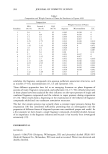
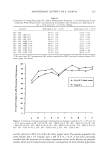
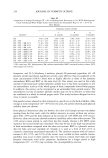
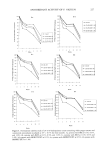
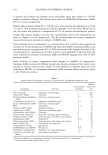
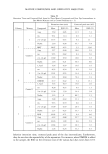
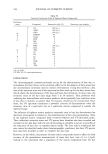
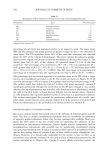
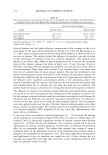
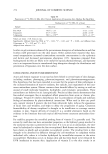
246 JOURNAL OF COSMETIC SCIENCE Table VI Statistical Extraction Yield of Eighteen Matrix Compounds Evaluation using Compound Extraction yield (%) Extraction step number H P L C U V / V I S OA 100 NNO 100 ORA 100 DMDM 80 NaAsc 50 EOP 0 MP 0 PVP 0 BHT 100 LDA 100 TDS 100 CC 100 DC 100 LS 0 SS 0 NOL 0 PQ 0 TEA 0 (n.p.) (n.p.) (n.p.) (n.p.) n.p.: no peak. UV/VIS: UV-Vis spectrophotometry. CONCLUSION The chromatographic method previously set up for the determination of hair dye in- termediates has been shown to be extremely effective for the analysis of forty-seven hair dye intermediates commonly used in cosmetic formulations. Using that method, a data base of the retention time and of the spectrum has been built up for the forty-seven dyes, which allows the determination of the dyes and their discrimination. In most cases, the retention times of the hair dyes range from 5 to 30 minutes. Thus problems with confusing dye intermediates with matrix products, which generally have retention times of less than 5 minutes or greater than 30 minutes, should not be encountered. Once more, the UV spectrum constitutes a powerful criterion of discrimination when the retention time of a particular dye or a particular matrix compound is outside the expected range. The influence of eighteen matrix products commonly used in hair dye formulations has also been investigated in relation to the determination of hair dye intermediates. Nine of the eighteen matrix compound show retentive behavior and UV-detectable peaks. Their individual retention times and UV spectra have therefore also been recorded and included in the data base with the aim of providing as complete a picture as possible of the separation of hair dyes in complex matrix media. The nine matrix compounds left over cannot be identified under these chromatographic conditions, but their UV spectra have also been recorded in order to complete the data base. However, on the whole, the presence of some matrix compounds seems to affect the final accuracy of the quantitative measurements of some hair dyes (case of 2-n-l,4-pd), leading to the conclusion that a separation of the matrix compounds from the dye

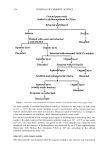
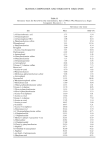
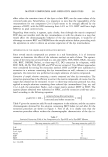
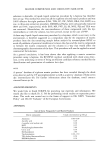
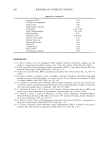
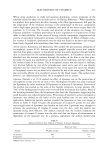
MATRIX COMPOUNDS AND OXIDATIVE HAIR DYES 247 solutions is desirable. A liquid-liquid extraction procedure by n-heptane has therefore been set up. This method was tested on all the eighteen selected matrix products and was 100% effective for eight products (LDA, TDS, CC, DC, NNO, ORA, OA, BHT) in a one- to three-step extraction procedure. DMDM and NaAsc were only partially extracted (80% and 50%, respectively), while EOP, MP, PVP, LS, SS, NOL, PQ and TEA were not extracted. Nevertheless, the non-interference of these compounds with the dye intermediates or with the column, has been proved, except in the case of PVP. A three-step liquid-liquid extraction procedure by n-heptane, which is not toxic to the environment, is therefore suggested as a compulsory step for the separation of matrix products from the dye-containing sample before analysis by reversed-phase HPLC to avoid all problems of potential interference between the dyes and the matrix compounds or between the matrix compounds and the column in a way that would affect the chromatographic determination of the dyes. This procedure will now be applied to actual commercial formulations. As a general conclusion, it has been shown that after applying a matrix extraction procedure using n-heptane, the RP-HPLC method, combined with diode array detec- tion, is very promising in terms of being an efficient candidate reference method for the identification and quantitation of oxidative hair dyes. NOTE A spectra' database of eighteen matrix products has been recorded through the diode array detector and the UV spectrophotometer as well as a spectra' database of forty-seven dye intermediates (8). For further information about the database, email contact: vincent@irmm.jrc.be ACKNOWLEDGMENTS We would like to thank COLIPA for providing raw materials and information. We would also like to thank Dr. E. Pel for performing initial studies on separation proce- dures. This work was carried out in the frame of support to DG XXlV "Consumer Policy" and DG III "Industry" of the European Commission. APPENDIX List of Some Frequently Used Matrix Products Matrix component Usual concentration (g/100 g) Ammonia 6.00-9.00 Ascorbic acid 0.20 L-ascorbic acid sodium salt 0.20 BHT 0.25 Diethyleneglycolmonoether 5.00 Citric acid 0.30 Diethanolamine 2.00 Triethanolamine 0.10-1.50 TEA-dodecylbenzenesulfonate 0.50 DEDM-hydantoin 0.10
Purchased for the exclusive use of nofirst nolast (unknown)
From: SCC Media Library & Resource Center (library.scconline.org)