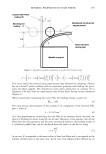
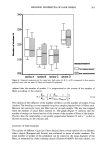
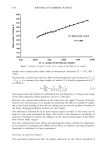
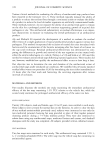
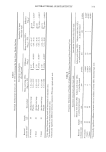
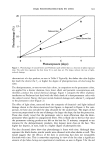
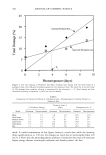
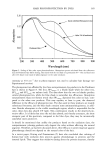
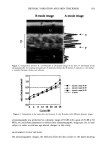
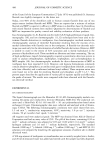
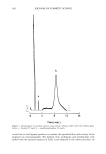
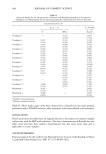
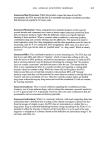
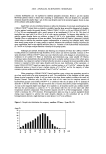
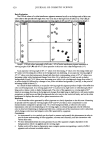
364 JOURNAL OF COSMETIC SCIENCE 350 330 310 290 270 250 230 210 190 t70 150 0,02 0.985 0,025 0,03 0,035 0,04 1In (n: number of hair fibres per sample) Figure 7. Number of strokes N versus 1/n (n: number of hair fibers in the sample). ! 0,045 samples were characterized under stable environmental conditions (T -- 25øC RH = 45%). Theoretically, considering virgin hair fibers with homogeneous elastic properties (i.e., E = E•,, N is a constant), the mean number of strokes N is directly proportional to R -4 according to Ei•,i , 4 Ez•,i , 1 = = (12) N Efle:• 39 q-r k E•4e3 N R 4 The experimental data (Figure 8) confirmed quite well Equation 12, using a large range of hair fiber diameters (mean diameters: 60 pm to 100 pm). However, the experimental ordinate at the origin does not equal 0 because of friction forces at the rotational axis. It is possible to recalculate the effective number of strokes due to the elastic bending of the fibers by taking into account the number of strokes of the freely swinging pendulum without any hair sample. The mechanical behavior for hairs from various origins recorded in this study can be related to the work performed by Swift (10). From a fully theoretical calculation of cantilever bending, he showed the influence of the cross-sectional shape of hair fibers from various ethnic origins. The close correlation between theory and experimental results confirms the importance of our method in evaluating the stiffness of hair fibers. In addition, the elastic behavior hypothesis is confirmed by these experiments. INFLUENCE OF RELATIVE HUMIDITY The mechanical properties of hair are greatly dependent on the relative humidity of

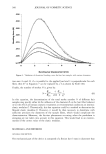
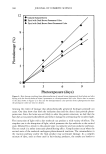
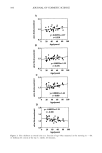
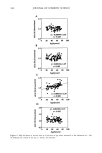
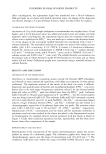
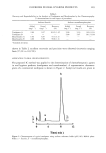
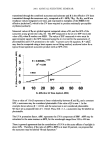
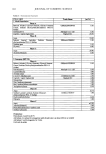
BENDING PROPERTIES OF HAIR FIBERS 365 350 300 250 200 15o 100 5O • ß N = 19.69 (10 ? / R 4) + 71.47 ß R 2 = 0.8496 0 i ! i ! i i 0 2 4 6 8 10 12 10 ? / R 4 (IJrn '4) Figure 8. Mean number of strokes N of the pendulum versus 1//•4 (/•: mean radius of hair fiber) for different natural hair fibers. ambient air (11). This test makes it possible to evaluate the influence of water content in air on the bending behavior of natural hair fibers. Due to its chemical and physical structure, hair can easily absorb water. The water molecules have a plasticizing effect on the keratin structure of hair. Because of their small size, water molecules can diffuse inside hair fibers, separate the keratin molecules, and reduce intermolecular interactions or change their nature (12). After reaching an equilibrium between hair and ambient humidity, the mechanical properties of hair are thus altered. Since the water-sensitive amorphous area of keratin is particularly involved during bending, the number of pendulum strokes can be measured in relation to the water content of ambient air. The analysis was based upon four series of four samples, each made up of 39 similar hair fibers. The hair fibers were previously washed with a shampoo. The measurements were taken in a temperature- and humidity-controlled chamber that was set to 25øC and to an appropriate relative humidity. Before being tested, the hair fiber samples were stored for 12 hours in the conditioning chamber. In order to measure the samples at 100% RH, they were immersed in distilled water for ten minutes before measurement in the controlled environmental chamber set to 90% RH and 25øC. The same samples were measured at different levels of relative humidity. The test was performed with virgin hair, bleached hair, and both waved and bleached hair (conditions are given in the Appendix). The numbers of pendulum strokes were then plotted against the level of relative humidity, as shown in Figure 9. The data confirmed that the moisture conditions played a key role in the bending properties of hair. Between 20% RH and 90% RH, the hair fibers became less rigid as the relative humidity increased irrespective of the type of hair. Since virgin hair is less
Purchased for the exclusive use of nofirst nolast (unknown)
From: SCC Media Library & Resource Center (library.scconline.org)