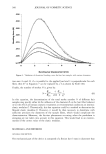
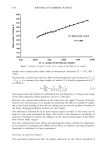
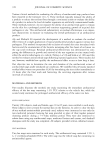
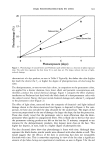
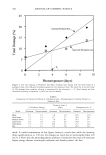
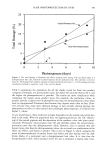
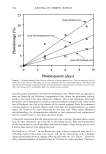
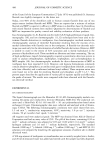
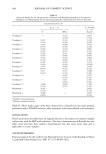
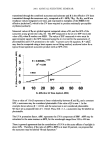
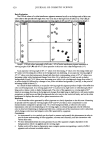
366 JOURNAL OF COSMETIC SCIENCE 400 z 350 300 250 200 150 ---- virgin hair - - ß - - bleached hair ß both waved and bleached hair 0 20 40 60 80 100 % of relative humidity (at 25øC) Figure 9. Strokes number N versus relative humidity (at 25øC) for three different types of hair (virgin, bleached, and both waved and bleached). rigid than bleached hair at 20% RH and up to 90% RH, both types of hair appear equivalent at 90% RH, with the stroke number values reaching a maximum. At 20% RH both waved and bleached hair and bleached hair are similar, but the former becomes less and less rigid as the relative humidity increases without reaching a maximum at 9O%. Those results indicate that from 20% RH to 90% RH, the active sites for plasticizing effect are progressively used. Above 90% RH, in the case of virgin or bleached hair, all the sites are occupied, whereas, in the case of both bleached and permed hair, the modifications of the structure are more numerous and more sites are available for water penetration. INFLUENCE OF COSMETIC TREATMENTS In the field of hair research, this technique is a useful test in evaluating the stiffening or weakening of hair fibers after a particular cosmetic treatment. It may also be useful in better understanding the possible structural modifications--or their prevention-- induced by bleaching, permanent waving, etc. Two types of treated hair were studied: bleached hair and both waved and bleached hair. The treatment conditions are given in the Appendix. The results (Figure 9) show alterations in the bending properties according to the cosmetic treatment performed. Both permanent waving and bleaching treatments alter the disulphide bond structures and consequently modify the mechanical properties of the fibers. At low relative hu-

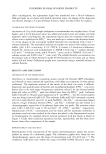
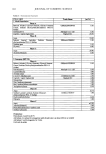
BENDING PROPERTIES OF HAIR FIBERS 367 midity levels, the bending stiffness of these hair fibers is similar. Bleached hair appears more rigid and more affected by humidity than virgin hair. At high humidity levels, it becomes as stiff as virgin hair. Permanent waving following bleaching leads to hair fibers even more sensitive to water. At 100% RH, the number of strokes of the pendulum is greater than for bleached or virgin hair (13). CONCLUSION The pendulum bending test developed in our laboratories is a simple and powerful test for quickly evaluating the bending behavior of hair in various conditions and following different cosmetic treatments. The first experimental data presented in this study are in good agreement with theo- retical calculations, considering the bending elastic properties of hair. Moreover, the technique allowed us an evaluation of the influence of different experimental conditions (relative humidity, cosmetic treatments), in good accordance with the structural modi- fications induced by these conditions. The validation of the test confirmed its relevance and its usefulness for the assessment of hair products. Since it corresponds to a bending test in the elastic domain of hair fibers, the test is not destructive. Evaluating the effect of additional, or superimposed, treatments on the same samples can therefore be undertaken. APPENDIX BLEACHING TREATMENT CONDITIONS Material: virgin hair Washing: 0.3% ammonium dodecylsulfate solution Rinsing: running tap water Bleaching: peroxide solution (hydrogen peroxide 15 vol and sodium peroxodisulfhte 22% and ammonia 2.9%) for 50 minutes at 30øC Rinsing: running tap water Neutralization: 0.22% sodium thiosulfate solution for 30 minutes at 30øC Rinsing: running tap water PERMANENT-WAVING TREATMENT CONDITIONS Material: bleached hair Reduction: 5% ammonium thioglycolate solution adjusted at pH 7.3 --+ 0.1 at 30øC for 15 minutes Rinsing: running tap water for 45 min Neutralization: hydrogen peroxide solution (6 vol) adjusted at pH 2.9-3.0 with an appropriate amount of concentrated HC1 solution for 10 minutes Rinsing: running tap water for 45 minutes
Purchased for the exclusive use of nofirst nolast (unknown)
From: SCC Media Library & Resource Center (library.scconline.org)