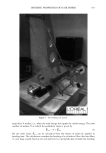
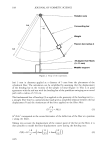
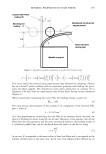
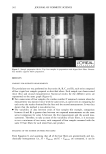
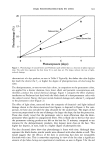
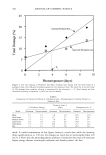
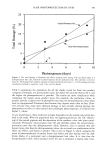
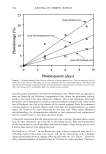
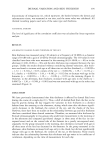
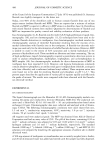
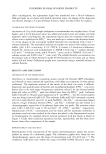
358 JOURNAL OF COSMETIC SCIENCE Rotation axis Connecting bar Weight Flexion bar (radius r) 39 aligned hair fibers (I = 11 mm) Metallic support Figure 2. Setup of the experiment. bar) 3 mm in diameter applied at a distance of 5 mm from the placement of the cylindrical fiber. The calculation can be simplified by assuming that the displacement of the bending bar in the vicinity of the sample is linear (Figure 3). This is in good agreement with the real test with the bending bar of the pendulum swinging on a curved path with a radius of 21.8 cm. The fundamental law of bending (9) as applied to the geometry of the bending test (i.e., a straight fiber bent by a perpendicular load) gives a simplified relation between the bar displacement 8 and the momentum of the force applied on the fiber M(x): d28 -= MOO (3) dx 2 (a '2 8/dx 2 corresponds to the second derivative of the deflection of the fiber at a position x along the fiber). Taking into account the displacement of the contact point of the bar on the fiber, it is then possible to model the force-displacement curve during the bending test: F(8) = E1 • cos Atan +Atan (4) with

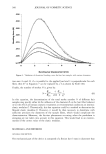
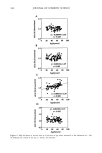
BENDING PROPERTIES OF HAIR FIBERS 359 Unbent Hair Fibre (radius R) Bending bar (radius: r) • I/ Modelized bending bar displacement Bent hair fibre during test Metallic support Figure 3. Equivalent mechanical geometry to model the bending energy. This curve model was checked using experimental data obtained by clamping a flexion bar on a Zwick © tensile machine with an equivalent geometry and bending the previ- ously described samples. The theoretical curves (after adjustment of constant El in Equation 4) fit well with the experimental data of hair fibers having various diameters (Figure 4). When numerically integrating the curve F(8), the bending energy is given by = (5) The most precise determination of the constant • by integration of the function F(•), gave a value of /• = 0.2149 mm -• (6) As a first approximation considering the hair fiber as an isotropic elastic material, the theory of bending for elastic materials can be used. Moreover, if one assumes that all the fibers have the same geometry and the same mechanical behavior, the bending inertia of . cylindrical parallel bars can be calculated from the radius of the bar by using -- I=n 4 (7) In our test, R corresponds to the mean radius of bent hair fibers and n corresponds to the number of fibers bent at the same time. In the case of an elliptical fiber defined by its
Purchased for the exclusive use of nofirst nolast (unknown)
From: SCC Media Library & Resource Center (library.scconline.org)