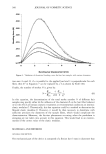
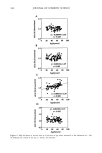
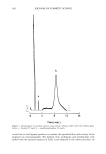
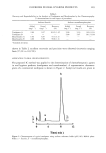
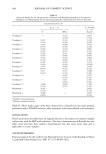
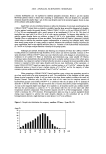
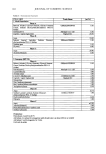
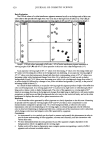
FLUORIDES IN ORAL HYGIENE PRODUCTS 401 After centrifugation, the supernatant liquid was transferred into a 50-ml volumetric flask and made up to volume with double aleionized water. An aliquot of the dispersion was filtered through a 0.2-pro (Gelman Sciences, Super Acrodisc) filter for analysis. FLUORIDE-ION ELECTRODE TECHNIQUE An amount of 2.0 g of the sample toothpastes or mouthwashes was weighed into a 50-ml beaker, and 6 ml of deionzied water was added and stirred until the sample was fully dispersed. After centrifugation, the supernatant liquid, after the treatment with hydro- chloric acid to hydrolyze the FPO3 2- ions, was made up to volume with deionized water. A 1.0-ml aliquot of the acid liquid (soluble fluoride) was neutralized with 4 tool 1-1 sodium hydroxide. The neutralized solution of sample was mixed with sodium acetate buffer (pH 4.82) containing 0.1% CDTA [(+)trans-l,2-diaminocyclohexane- N,N,N',N'-tetraacetic acid monohydrate] or TISAB I (0.50 tool 1 -• sodium chloride, 0.25 mol 1-1 trisodium citrate, and 0.50 tool 1-1 acetic acid) or TISAB II (1.83 mol 1-1 sodium acetate and 0.0052 tool 1 -• citric acid). The soluble fluoride concentration was determined with an Orion Research model 96-09 fluoride-ion electrode and an Orion model 420 mV meter. Calibration graphs were constructed using a standard solution of sodium fluoride. RESULTS AND DISCUSSION OPTIMIZATION OF THE MOBILE PHASE Dentifrices or mouthwashes containing anions include the fluoride, MFP, phosphate, and chloride in many commercial ingredients, and sulfate as an impurity in some anionic surfactants. The separation mixture of the anions of the short run times is difficult. Separation and quantification of fluoride and monofluorophosphate (FPO3 2-) was inter- ference-free in the wide range of separation conditions selected. At the elevated mobile phase pH value, an HPO42- peak was shifted away from the FPO32- peak. Carbonate buffer with pH 11.00 gave good separations of F- and FPO32-, but the overall analysis time was longer than with pH 9.85. The carbonate buffer (pH 9.85) contained a mixture of 0.94 m mole Na2CO 3 and 0.31 m mole NaHCO 3. The CO32- concentration helped achieve a larger resolution between FPO32- and SO42-. Chloride was also eluted in a chromatographic region free of interference from other ion peaks. The retention times were 2.683, 5.448, 8.473, and 11.393 rain for F-, CI-, FPO3 2-, and SO42-, respectively. Optimization of CO32- concentration and the eluent pH for maximum resolution at minimum total run time resulted in the eluent described in the Experimental section. A chromatogram of a standard solution mixture produced with this eluent is shown in Figure 1. Under these conditions separation was fast, reproducible, and free from inter- ference from other components of the sample. REPRODUCIBILITY AND ACCURACY Determination of the concentratin of the various chemotherapeutic agents was accom- plished by means of a calibration graph. The calibration graphs were linear for two chemotherapeutic agents over the range of concentration used (5.0-40.0 mg l-P). The correlation coefficients were within the range of 0.9990-0.9998. Recovery tests were

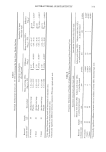
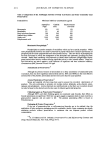
402 JOURNAL OF COSMETIC SCIENCE I ) i ..j 0 4 8 12 16 Time( min ) Figure 1. Chromatogram of standard solution using sodium carbonate buffer (pH 9.85). Mobile phase. Peaks: a = fluoride (25 mg/1) b = monofluorophosphate (30 mg/1). carried out on oral hygiene products to evaluate the reproducibility and accuracy of the proposed ion chromatographic (IC) method. Four toothpastes and mouthwashes were spiked with the amounts reported in Table I and subjected to the whole procedure. As
Purchased for the exclusive use of nofirst nolast (unknown)
From: SCC Media Library & Resource Center (library.scconline.org)