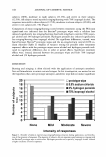
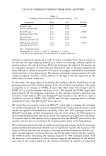
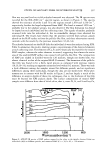
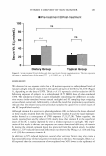
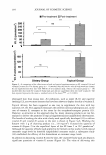
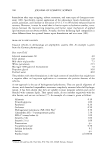
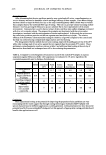
LACK OF BURNING/STINGING FROM FIRST-AID WIPES 161 Table I Summary of Analysis Results for Burning/Stinging (n = 24) Comparisons Mean SD *P value Bactine® wipe 0.25 0.44 0.5000 Sodium chloride 0.9% 0.29 0.46 Bactine® wipe 0.25 0.44 0.0001 Isopropyl alcohol 70% 2.29 0.69 Bactine® wipe 0.25 0.44 0.0001 Hydrogen peroxide 3% 1.54 0.78 Hydrogen peroxide 3% 1.54 0.78 0.0018 Isopropyl alcohol 70% 2.29 0.69 SD = standard deviation. Scoring scale: 0 = none, 1 = mild, 2 = moderate, 3 = severe. * The Wilcoxon signed-rank test was performed to analyze differences. burning or stinging on superficial wounds. In order to evaluate these sensory responses, we selected the tape-stripping method as a means to achieving uniform superficial wounds without the risk of scarring. With this technique, the depth of the wound can be controlled. As layers of corneocytes are removed by tape, it becomes progressively more difficult to detach corneocytes (7) because of stronger intercellular desmosomal interconnections in the deeper layers. The amount of stratum corneum removed by each stripping depends, therefore, on the adhesion of the tape to the skin layer and on the cohesiveness between corneocytes. In this study, the target depth of wounding was reached with the visualization of the glistening layer and with a barrier damage of 30-70 g/m2/h by evaporimetry. This value corresponds to an increase in TEWL of more than three times the average baseline TEWL of 5.4 g/m2/h (standard deviation of 2.1). We reached the TEWL target after approximately 30-50 strippings, depending on the stratum corneum's thickness and looseness in each subject. We used Transpore® tape because it was shown to create a significant increase in TEWL (30.8 g/m2/h) after 40 tape strippings and to perform significantly better than Micropore® rayon tape (7). We tested the two positive controls on Webril® cotton pads to simulate the consumer use of these formulations. In a previous unpublished pilot study using the same wound model, we applied all formulations, including saline and 70% isopropyl alcohol, to Webril® cotton pads. In that investigation, two out of 24 subjects (8.33%) reported a mild stinging/burning from the saline control. This represents a slightly lower incidence of responses than in the current study, suggesting that the Webril® pad used for the positive controls does not potentiate the stinging and burning of the formulations. The results demonstrate the lack of significant burning and stinging from the prototype pramoxine HCL/benzalkonium chloride wipe on superficial wounds. The majority of the subjects did not perceive any stinging or burning with this formulation and the inci dence of mild responses was lower than the one for the saline control. On the contrary, the 100% incidence of burning and stinging responses to 70% isopropyl alcohol, with the majority in the moderate-to-severe category, supports the adequacy of the method used and of the wound depth for the sensory assessment of topicals on superficial

162 JOURNAL OF COSMETIC SCIENCE wounds. It is important to note that the temporal order in which the treatments were applied did not affect the results, indicating that a ten-minute rest period between applications was sufficient to produce accurate responses. REFERENCES (1) Physicians' Desk References, For Nonprescription Drugs and Dietary Supplements, 20th ed. (Medical Econom ics Company, Montvale, NJ, 2001), p. 611. (2) V. P. Shah, Progress in methodologies for evaluating bioequivalence of topical formulations, Am. J. Clin. Dermatol., 2, 275-280 (2001). (3) Y. N. Kalia, I. Alberti, A. Naik, and R.H. Guy, Assessment of topical bioavailability in vivo: The importance of stratum corneum thickness, Skin Pharmacol. Appl. Skin Physiol., 14(S1), 82-86 (2001). (4) H.J. Weigmann, J. Lademann, R. von Pelchrzim, W. Sterry, T. Hagemeister, R. Molzahn, M. Schaefer, M. Lindscheid, H. Schaefer, and V. P. Shah, Bioavailability of clobetasol propionate Quantification of drug concentrations in stratum corneum by dermatopharmacokinetics using tape stripping, Skin Phannacol. Appl. Skin Physiol., 12, 46-53 (1999). (5) L.A. Nylander-French, A tape stripping method for measuring dermal exposure to multifunctional acrylates, Ann. Occup. Hyg., 44, 645-651 (2000). (6) T. Frodin and M. Skogh, Measurements of transepidermal water loss using an evaporimeter to follow the restitution of the barrier layer of human epidermis after stripping the stratum corneum, Acta Derm. Venereol., 64, 537-540 (1984). (7) S. J. Bashir, A. L. Chew, A. Anigbogu, F. Dreher, and H. I. Maibach, Physical and physiological effects of stratum corneum tape stripping, Skin Res. Technol., 7, 40--48 (2001). (8) J. Pinnagoda, R. A. Tupker, T. Agner, and J. Serup, Guidelines for transepidermal water loss (TEWL) measurement, Contact Dennatitis, 22, 164-178 (1990). (9) B. Jones and M. G. Kenward, Design and Analysis of Cross-Over Trails (Chapman and Hall, New York, 1990), pp. 197-199.
Purchased for the exclusive use of nofirst nolast (unknown)
From: SCC Media Library & Resource Center (library.scconline.org)