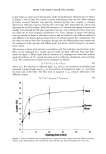
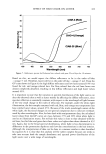
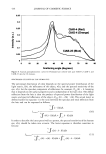
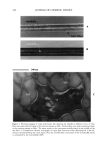
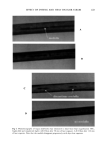
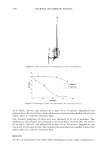
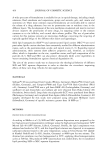
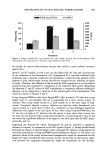
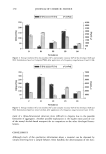
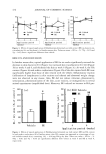
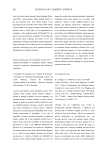
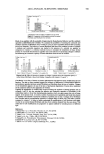
470 JOURNAL OF COSMETIC SCIENCE [Pal L-7--3 G' [Pal •l* [mPas] } 250 2OO 15o 1oo 5O 0 { { • B Bi B2 B3 B4 4500 4000 3500 3000 2500 2000 1500 1000 500 0 Formulation Figure 3. Storage modulus (G'), loss modulus (G"), and complex viscosity (•*) of the developed SLN and NLC formulations based on Compritol©888, after application of a frequency range between 0 and 10 Hz. i G [Pal • G" [Pal n* [mPas] ] 350 7000 300 250 200 150 1oo 5O C CI C2 C3 6000 5000 4000 3000 2000 1000 Formulation Figure 4. Storage modulus (G'), loss modulus (G"), and complex viscosity (qq*) of the developed SLN and NLC formulations based on stearyl alcohol, after application of a frequency range between 0 and 10 Hz. ment of a three-dimensional structure more difficult to disperse due to the possible formation of aggregates. Another possible explanation is the higher mean particle size of the stearyl alcohol-based nanoparticles in comparison to the other developed formu- lations. CONCLUSIONS Although much of the qualitative information about a material can be obtained by simply observing how a sample behaves when handled, the determination of the rheo-

VISCOELASTICITY OF SLN AND NLC FORMULATIONS 471 logical properties of a dermatological formulation is extremely important. These studies allow (i) the evaluation of a the capability of a vehicle to suspend solids or immiscible liquids (ii) the assessment of a topical formulation with respect to patient usage, e.g., the ease of removing the preparation from a container or spreadability and adherence to the skin and (iii) the monitoring of the effect of the vehicle's consistency on the release of a drug from the preparation and its subsequent percutaneous absorption (bioavail- ability of the drug substance). The determination of G', G", and qq* as a function of the applied frequency, using an oscillation frequency sweep test, gives important information concerning topical admin- istration. According to the obtained results, for Compritol©888 as a solid lipid for NLC preparation, sunflower oil seems to be the oil that presents the best attributes for a topical formulation, i.e., more elastic behavior and a higher viscosity. With regard to stearyl alcohol, tocopherol shows the best results. The presence of a more compact and organized system can have a significant beneficial effect on the stability and on the viscoelactic properties of particulate aqueous dispersions and, therefore, on the topical administration of drug substances. REFERENCES (1) B. W. Barry and B. Warburton, Some theological aspects of cosmetics, J. Soc. Co, met. Chem., 19, 725- 744 (1968). (2) J. Ceulemans, L. van Santvliet, and A. Ludwig, Evaluation of continuous shear and creep rheometry in the physical characterisation of ointments, Int. J. Pharm., 176, 187-202 (1999). (3) R.H. Miiller, W. Mehnert, J.-S. Lucks, C. Schwarz, A. zur Miihlen, H. Weyhers, C. Freitas, and D. Rtihl. Solid lipid nanoparticles (SLN)--An alternative colloidal carrier system for controlled drug delivery, Eur. J. Pharm. Biopharm., 41, 62-69 (1995). (4) R. H. M•iller, K. M•ider, and S. Gohla, Solid lipid nanoparticles (SLN) for controlled drug delivery-- A review of the state of art, Eur. J. Pharm. Biopharm., 50, 161-177 (2000). (5) W. Mehnert and K. M•ider, Solid lipid nanoparticles--Production, characterization and applications, Adv. Drug Deliv. Rev., 47, 165-196 (2001). (6) S. A. Wissing, A. Lippacher, and R. H. Miiller, Investigations on the occlusive properties of solid lipid nanoparticles (SLN),J. Cosmet. Sci., 52, 313-323 (2001). (7) S. A. Wissing. SLN alr innovatives Formulierungskonzept J•ir pflegende und protective dermale Zubereitungen, PhD Thesis, Free University of Berlin, 2002. (8) R. H. Miiller, "Zetapotential und Partikelladung in der Laborpraxis," in Wissenschaftliche Verlag•gesdl- schaft mbH (Stuttgart, 1996). (9) C. Freitas and R.H. Miiller, Correlation between log-term stability of solid lipid nanoparticles (SLN TM) and crystallinity of the lipid phase, Eur. J. Pharm. Biopharm., 47, 125-132 (1999). (10) A. Lippacher, R. H. Miiller, and K. M•ider, Preparation of semisolid drug carriers for topical appli- cation based on solid lipid nanoparticles, Int. J. Pharm., 214, 9-12 (2001). (11) A. Lippacher, R. H. Miiller, and K. M•ider. Semisolid SLN TM dispersions for topical application: Influence of formulation and production parameters on viscoelastic properties, Ez•r. J. Pharm. Bio- pharm., 53, 155-160 (2002). (12) E. B. Souto, S. A. Wissing, C. M. Barbosa, and R. H. Miiller, Evaluation of the physical stability of SLN and NLC before and after incorporation into hydrogel formulations, Eur. J. Pharm. Biopharm. 58, 83-9O (2OO4). A. Lippacher, R. H. Miiller, and K. M•ider, Investigations on the viscoelastic properties of lipid based colloidal drug carriers, Int. J. Pharm., 196, 227-230 (2000). A. A. Zaman, P. Singh, and B. M. Moudgil, Impact of self-assembled surfactant structures on the theology of concentrated nanoparticle dispersions, J. Colloid. Interface Sci., 251,381-387 (2002). (13) (14)
Purchased for the exclusive use of nofirst nolast (unknown)
From: SCC Media Library & Resource Center (library.scconline.org)