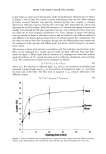
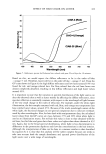
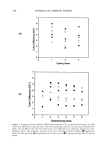
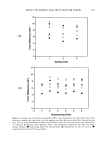
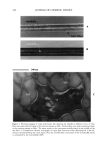
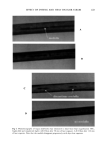
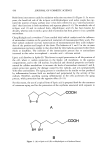
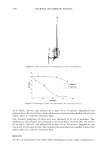
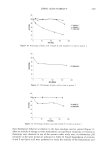
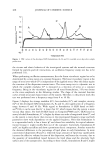
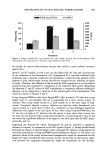
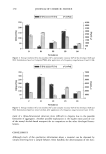
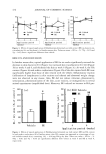
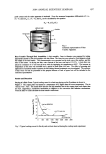
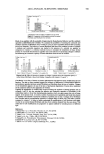
2004 ANNUAL SCIENTIFIC SEMINAR 501 Normal hum•m fibroi•sts F•broblasta I•n• wri•kles * SignScant result according to Student's rest •0. 05) •gure 2: Comp•mn of •e me•bolic activity of noel fib•bi•Ls and fibrobiasLs from •nkles, Study of •oy pepff•s w•h the potent&l of •proving the bioscharted behavior and the •ynthe• eapae•es of fibrobla• from •ink•s. We ex•fined •e possibili• of restoring •e con•a•le •d synCeric capadfies of fibroblasts •om writes by u•ng • a•ive in•edient obtained •er s•ee•ng several mw materiffs. •e beM•or of noir fibrobl•ts •d •ose from writes in te•s of collagen I syn•esis •d con•cfile c•adties w• sm•ed in •e pr•ence of a selected soy peptides in comparison to 'vim•n C, a reference molecule known to sfimtfiate •e metabolism of m•y derm• proteins. It w• found •at sdected soy pepfi&s were most effective for promot•g collagen I •n•esis •d e•c•g •e con•acfile c•acity of hum• fibroblasts from •e base of writes. 25 Figures 3a & 3b: Effect of selected soy peptides on collagen I synthesis and on the contractile capacity of normal human fibroblasts or those t¾om wrinkles. Comparison with vitamin C (1 pg.mL4). Conclusion. It was thus of interest to further understand the link between tissue modification and cell functiol• The data we have presented suggest the existence of differences in biomechanical behavior and synthesis capacities between normal fibroblasts and fibroblasts from the base of wrinkles. Changes of cell metabolism appear to be one of the keys of mechanical degradation of mature skin, manifested on the cutaneous surface by the appearance of wrinkles. Limiting the appearance of wrinkles thus involves boosting the synthesis of derreal proteins such as collagens I and III, but also restoring the adhesion and contractile capacities of fibroblasts to the extracellular matrix to favor their biomechanical properties which can again ensure their role of tissue support. In the present work, we tested a untobet of potential active ingredients and found that selected soy peptides concomitantly restored the synthesis of proteins such as type I collagen of by fibroblasts from wrinkles and the reorganization capacities of collagen fibers of these cells. This effect could be compared to vitamin C. In order to further understand the modifications of cell functions with aging, we plan to use normal human fibreblasts and those from wrinkles obtained from the same donor_ This could show if cell modifications are progressive or appear suddenly by including donors of different ages. References. 1 Piischel HU et al. d. Photochern. Photobiol. B. 27, 39-6 (1995) 2 Johnson BD et al. Lab. Invest., 55, 490-96 (1986) 3 Varani Jet al. d. Investig. Dermatol. Syrnp. Proc. 3, 41-4 (1998) 4 Varani Jetal. Am. d. Patho. 158, 931-42 (2001) 5 Chung JH et al. Photoderrnatol. Photo•rnrnunol. Photomeal. 12, 84-9 (1986) 6 Ehrlich HP et al, Tissue Cell. 22, 407-17 (1990) 7 Tada A et al. 22 • IFSCC congress Edinburgh Proc., 1 (2002)

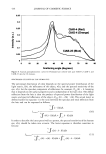
502 JOURNAL OF COSMETIC SCIENCE BASIC SKIN EVALUATION METHODS R. Randall Wickett, Ph.D. Universit3, of Cincinnati, College of Pharmacy Non-invasive biophysical or bioengineering methods have proven of great value in both understanding how products affect the skin and for claim support purposes. Some of the most common non-invasive methods to evaluate skin function will be reviewed in this presentation along with common protocols that incorporate skin bioengineefing instruments. TEWL Transepidermal water loss measurements can be used to quantify the effects of products on the barrier function of the skin. TEWL has proven very useful in cosmetic science for studies of surfactant damage to skin. The commonly used instruments rely on the principle first describe by Nilson. 'Relative humidity and temperature are measured at two points above the skin surface and TEWL is calculated from Fick's law. There are published guidelines for TEWL measurements 2. TEWL measurements are often used in the Forearm Controlled Application Test for soap and surfactant products and milder soaps consistently produce less elevation in TEWL. Three mild synthetic detergent bars and pure soap bar, known to be harsh and a mild soap bar with added humectant and water were compared in an FCAT The soap bar caused a significantly higher increase in TEWL compared to the other bars 4. Electrical Measurements on Skin Measurements of skin impedance or reactance (capacitance) are commonly used to estimate the moisture content of skin and for moisturizing claims after one or a few treatments. 5ø, We have investigated the effects of the products salt and glycerin content on these measurements with the three most commonly used commercial instruments 7 We also performed a study testing the ability of measurements 1 hr. after a single application to predict the results of a two week moisturizer testL Correlations betweens between I hr measurements and grade improvement after one week of treatment were significant for all three instruments. Mechanical Measurements T•vo commonly used instruments are the Dermal Torque Meter©(DTM) or T•vistometer • and the Cutometer© 'ø. We have investigated the effects of hydration on Cutometer measurements •' and compared the Cutometer to the DTM for assessing the effect of moisturizer treatment dry leg skin t2. The DTM was somewhat more sensitive than the Cutometer for this purpose. Sensitivity of the Cutometer to moisturizer treatment can be improved by using 200 mbar of negative pressure compared to 500 mbar?. Contact pressure can have a significant effect on mechanical measurements and needs to be controlled carefully. Skin pH Skin pH is a parameter that is easy to measure but not always so easy to interpret. Skin has an "acid mantle" with apparent pH values running between 4.0 and 6.0 for 95% of the populationY Soap washing causes an increase in pH which decreases with time due the innate buffering capacity of human skin•L D-Squames, Adhesive Disks. D-Squame© adhesive disks are a useful means to quantify skin scaling? • We have used D-Squames to investigate scaling in skin from Black and White subjects. '• While grades were generally higher in Black subjects the desquamation index of D- Squames from White subjects was as high or higher than from Black subjects. We hypothesize that grades of skin scaling are anomalously high from Black subjects because the scales show more clearly against the darker skin background.
Purchased for the exclusive use of nofirst nolast (unknown)
From: SCC Media Library & Resource Center (library.scconline.org)