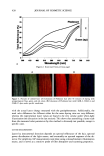
2004 ANNUAL SCIENTIFIC SEMINAR 503 Chromameter Measurements of Erythema The Minolta Chromameter © measures color on the L,a*b* scale. L is the brightness from 0 to 100, a* is red/green with +60 for pure red and -60 for green, b* is blue yellow with +60 for pure yellow and -60 fbr pure blue. The redness of an object can be investigated by measure a*. In the FCAT discussed above a* was increased significantly more from treatment with the harsh soap bar and correlated well with visual grades of erythema5 Sebutape and Subumeter Sebutape© is an opaque micro-porous hydrophobic polymer film. When placed on the skin sebum flows into the pores making transparent spots. Good quantitative agreement between sebum production measured by hcxane extraction of the skin and Sebutape collection has been reported. '9 Image analysis can be used to determine the number of active sebaceous follicles and estimate sebum production. The Sebumeter© uses a similar principle with an optical sensing system and is a convenient way to measure sebum output. Reference List 1. Hammarlund K, Nilson P, Oberg PA, Sedin G: Transepicermal water loss in newborn infants: I. Relation to ambient humidity and site of measurement and estimation of total transepidermal water loss. Acta Paediatr Scand 66: 553, 1977. 2. Pinnagoda J, Tupker RA, Agner T, Setup J: Guidelines fbr transepidermal water loss (TEWL) measurement. A report from the Standardization Group of the European Society of Contact Dermat•tis. Contact Dermatitis 22:164-178, 1990. 3. Ertel KD, Kesw•ck BH, Bryant PB: A torearm controlled application technique for estimating the relative mildness of personal cleansing products. J Soc Cosmet Chem 46: 67-76, 1995. 4. Wickett RR: Forearm wash testing of mild soap bars containing collmdal oatmeal. Candian Chemical News 49: 22-23, 1997. 5. Berardesca E: EEMCO guidance for the assessment of stratum corneum hydration: electrical methods. Skin Res Technol 3: 126-132, 1997. 6. Loden M, Lindberg M: The influence of a single application of different moisturizers on the skin capacitance. Acta Derm Venereol 71: 79-82, 1991. 7. Li F, Visscher M, Conroy E, Wickett RR: The ability of electrical measurements to predict skin moisturization I. Eftkcts of salt and glycerin on short-term measurements. J Cosmetic Science 52: 13-22, 2001. 8. Li F, Visscher M, Conroy E, Wickett RR: The ability of electrical measurements to predict skin mmstunzation 11. Correlations between one hour measurements and long term results. J Cosmetic Science 52: 23-33, 2001. 9. Agache PG: Twistometry measurement of skin elasticity, in Serup J, Jemec GBE (eds), Handbook of Non-invasive Methods and the Skin, Ann Arbor, CRC Press, 1995, 319-334. 10. Courage W: Hardware and measuring principle: corneometer, in P. Elsner EBaHIM (ed), Bioengineering of the skin: Water and the Stratum Corneum, Boca Raton, CRC Press, Inc., 1994, 171-175. 11. Murray BC, Wickett RR: Sensitivity of cutometer data to stratum corneum hydration level. Skin Research and Technology 2: 167-172, 1996. 12. Murray BC, Wickett RR: Correlanons between Dermal Torque Meter, Cutometer and Derreal Phase Meter measurements of human skin. Skin Research and Technology 3: 101-106, 1997. 13. Wickett RR: Stretching the Skin Surface: Skin Elastmity. Cosmetics and Toiletries 116: 47-54, 2001. 14. Dikstein S, Zlotogorski A: Skin Surface Hydrogen Ion Concentration (pH), in Leveque JL (ed), Cutaneous Investigation •n Health and Disease, New York, Marcel Dekker, 1989, 59-78. 15. TrobaughC.M., Wickett RR: Personal Care Products: Effects on Skin Surface pH. Cosmetics and Toiletries 105: 41-46, 1990. 16. Schatz H, Kligman AM, Manning S, Stoudemayer T: Quantification of dry(xerotic) skin by image analysis of scales removed by adhesive disks (D-Squames). l Soc Cosmet Chem 44: 53-63, 1993. 17. Schatz H, Altmeyer PJ, Kligman AM: Dry Skin and Scaling Evaluated by D-Squames and Image Analysis, in Serup J, Jcmec GBE (eds), Handbook of Non-Invasive Methods and the Skin, Ann Arbor, CRC Press, 1995, 153-157. 18. Wartier AG, Khgman AM, Harper RA, Bowman J, Wicket RR: A comparison of black and white skin using noninvasive methods. J Soc Cosmet Chem 47: 229-240, 1996. 19. Kligman AM, Miller DL, McGinley Kj: Sebutape: A device for visualizing and measunng human sebaceous secretion. J Soc Cosmet Chem 37: 369-374, 1986.

504 JOURNAL OF COSMETIC SCIENCE THE ROLE OF VERNIX CASEOSA IN NEONATAL ADAPTION Marty O. Visscher The Skin Sciences Institute, Cincinnati Children • Hospital Medical Center Vernix caseosa is a complex proteolipid material, unique to humans, which is synthesized in part by fetal sebaceous glands during the last trimester of pregnancy. Prenatally, vernix provides a thin, hydrophobic, surface film surrounding the fetus that protects the developing skin from maceration and the deleterious effects of water and urine. Vernix is believed to play a pivotal role in epidermal barrier development, nutrition and intestinal maturation prior to birth. Premature infants lack vernix and struggle to form an adequate epidermal barrier after birth and are susceptible to nosocomial and community acquired infections. Investigations of the composition and functional parameters of vernix demonstrate that it is important for innate immunity and neonatal adaptation at birth. The goal of our research goal was to provide the scientific basis for leaving vernix in place at birth and to establish the basis for evaluating 'vernix equivalents' on premature infants. The older literature contains sporadic reports of vernix as a potential wound healing ointment. The regulation of transepidermal water gradient is known to be important for epidermal barrier formation and regeneration following wounding. Data generated using human skin culture systems demonstrates a direct effect of vernix overlying cultured skin substitutes to increase glucose consumption and lactate production. These findings are consistent with a role of vernix to stimulate epidermal metabolism with potential effects on wound healing. At birth, vernix on the fetal skin surface is presumably transferred to the perineum of the mother during the birth process. Moreover, the formation of the epidermal barrier in utero has strong analogies to healing of an open wound. Newborn infants are known to undergo desquamation after birth with formation of a dry skin surface. Whether this desquamatory process is secondary to removal of vernix with resultant abnormal generation of natural moisturizing factor (NMF) is as yet unknown. It has also been shown that vernix when applied to adult volar skin increases transepidermal water loss and has an increased ability to bind exogenous water. Given, the high water content of vernix, and the above mentioned properties we hypothesized that vernix plays a significant role in neonatal skin adaptation as the baby enters the terrestrial world. We used non-invasive biophysical and optical techniques to evaluate neonatal skin condition objectively, by enrolling near term infants in a randomized clinical trial. We report the results of investigations of five aspects of vernix caseosa: the role in innate immunity, antioxidant properties, skin surface distribution at birth, thermal regulation, and skin surface adaptation dunng the immediate post birth period. The data indicate that vernix contains anti-infective materials, including surfactant proteins, SP-A and SP-D, and lysozyme. The anti-oxidant properties were attributed to the presence of a-tocopherol. A quantitative determination among a group of 430 newborns indicated that vernix skin surface coverage was generally higher for the lower gestational age infants, higher for the c-section infants, higher for females, higher for white infants, and lower in infants exposed to meconium. Preservation of vernix on the skin surface at birth had no effect on thermal stability of the infants, compared to a
Purchased for the exclusive use of nofirst nolast (unknown)
From: SCC Media Library & Resource Center (library.scconline.org)