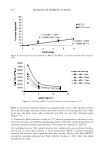
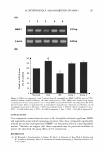
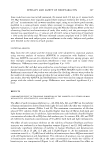
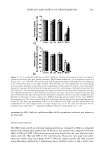
M. HETEROPHYLLA AND INHIBITION OF MMP-1 287 (A) 1 2 3 4 5 MMP-1 237 bp �-actin ------- 248 bp (B) 140 * 120 Q) 100 � - 80 0 z C: 0:: 0 60 E CJ - Q) 0 � 40 � Q) 0:: 20 0 Non-UVA UVA tRA Comp. 1 Comp. 2 Figure 4. Effects of compounds 1 and 2 isolated from M. heterophylla on MMP-1 mRNA level in UVA irradiated human dermal fibroblasts. (A) After irradiation by UVA, HDFs were treated with various concentrations of these compounds for 12 h. Total RNA extracted from HDFs was analyzed by RT-PCR, and each band, which is quantirated by a densitometer using 13-actin transcripts as references, in (A) corresponds to each bar in (B). Lane 1: UV A non-irradiated. Lane 2: UV A (6.3 J/cm2 ) irradiated. Lane 3: UV A + 4.0 µM of tRA. Lane 4: UV A + 6.0 µM of compound 1. Lane 5: UV A + 30.0 µM of compound 2. CONCLUSIONS Two compounds isolated from the roots of M. heterophylla exhibited significant DPPH and superoxide anion radical scavenging activities. Also, these compounds significantly reduced the activity and expression of MMP-1 at the protein level in a dose-dependent manner. Therefore, we suggest that these compounds may be potential candidates to protect the skin from the aging effects of UV stimulation. REFERENCES (1) M. Wlaschek, I. Tantcheva-Poor, L. Naderi, W. Ma, L.A. Schneider, Z. Razi-Wolf, J. Schuller, and K. Scharffetter-Kochanek, Solar UV irradiation and dermal photoaging, J. Photochem. Photobiol., 63, 41-51 (2001).

288 JOURNAL OF COSMETIC SCIENCE (2) Y. Kawaguchi, H. Tanaka, T. Okada, H. Konishi, M. Takahashi, M. Ito, and J. Asai, The effects of ultraviolet A and reactive oxygen species on the mRNA expression of 72-kDa type IV collagenase and its tissue inhibitor in cultured human dermal fibroblasts, Arch. Dermatol. Res., 288, 39-44 (1996). (3) A. F. Chambers and L. M. Matrisian, Changing views of the role of matrix metalloproteinases in metastasis,]. Natl. Cancer Inst., 89, 1260-1270 (1997). (4) E. J. Bernhard, S. B. Gruber, and R. J. Muschel, Direct evidence linking expression of matrix metal loproteinase 9 (92-kDa gelatinase/collagenase) to the metastatic phenotype in transformed rat embryo cells, Proc. Natl. Acad. Sci. USA, 91, 4293-4297 (1994). (5) E. A. Offord, J.C. Gautier, 0. Avanti, C. Scaletta, F. Runge, K. Kramer, and L.A. Applegate, Photoprotective potential of lycopene, beta-carotene, vitamin E, vitamin C and carnosic acid in UVA-irradiated human skin fibroblasts, Free. Rad. Bio. Med., 32, 1293-1303 (2002). (6) J. Varani, R. L. Warner, M. Gharaee-Kermani, S. H. Phan, S. W. Kang, J. H. Chung, Z. Q. Wang, S. C. Datta, G. J. Fisher, and J. Voorhees, Vitamin A antagonizes decreased cell growth and elevated collagen-degrading matrix metalloproteinases and stimulates collagen accumulation in naturally aged human skin, J. Invest. Dermatol., 114, 480-486 (2000). (7) G. J. Fisher, S. C. Datta, H. S. Talwar, Z. Q. Wang, J. Varani, S. Kang, and J. J. Voorhees, Molecular basis of sun-induced premature skin ageing and retinoid antagonism, Nature, 379, 335-339 (1996). (8) J. H. Park, The Encyclopedia of Chinese Crude Drugs (Shinilbooks Press, Seoul, 2002), pp. 310-311. (9) T. Hatano, H. Kagawa, T. Yasuhara, and T. Okuda, Two new flavonoids and other constituents in licorice root: Their relative astringency and radical scavenging effects, Chem. Pharm. Bull., 36, 2090- 2097 (1998). (10) K. Furuno, T. Akasako, and N. Sugihara, The contribution of the pyrogallol moiety to the superoxide radical scavenging activity of flavonoids, Biol. Phann. Bull., 25, 19-23 (2002). (11) S. E. Dunsmore, J. S. Rubin, S. 0. Kovacs, M. Chedid, W. C. Parks, and H. G. Welgus, Mechanisms of hepatocyte growth factor stimulation of keratinocyte metalloproteinase production,]. Biol. Chem., 271, 24576-24582 (1996). (12) T. Mosmann, Rapid colorimetric assay for cellular growth and survival: Application to proliferation and cytotoxicity assays,]. Immunol. Meth., 65, 55-63 (1983). (13) B. S. Min, H. K. Lee, S. M. Lee, Y. H. Kim, K. H. Bae, T. Otake, N. Nakamura, and M. Hattori, Anti-human immunodeficiency virus-type 1 activity of constituents from Juglans mandrhurica, Arch. Phann. Res., 25, 441-445 (2002). (14) T. Tanaka, G. J. Nonaka, and I. Nishioka, Punicafolin, an ellagitanin from the leaves of Punica granatum, Phytochemistry, 24, 2075-2078 (1985). (15) E. A. Haddock, R. K. Gupta, S. M. K. Al-Shafi, and E. Haslam, The metabolism of gallic acid and hexahydroxydiphenic acid in plants. Part 1. Introduction. Naturally occurring galloyl esters,]. Chem. Soc. Perkin Trans. I, 2515-2524 (1982). (16) I. M. Chang, Treatise on Asian Herbal Medicines (Natural Products Research Institute of Seoul National University, Seoul, 2003), pp. 4534. (17) I. R. Lee and M. Y. Yang, Phenolic compounds from Duchesnea chrysantha and their cytotoxic activities in human cancer cells, Arch. Phann. Res., 17, 476-479 0994). (18) D. G. Soares, A. C. Andreazza, and M. Salvador, Sequestering ability of butylated hydroxytoluene, propyl gallate, resveratrol, and vitamins C and E against ABTS, DPPH, and hydroxyl free radicals chemical and biological systems,]. Agric Food Chem., 51, 1077-1080 (2003). (19) R. Hirano, W. Sasamoto, A. Matsumoto, H. ltakura, 0. Igarashi, and K. Kondo, Antioxidant ability of various flavonoids against DPPH radicals and LDL oxidation,]. Nutr. Sci. Vitaminol., 47, 357-362 (2001). (20) I. Gulcin, 0. I. Kufrevioglu, M. Oktay, and M. E. Buyukokuroglu, Antioxidant, antimicrobial, an tiulcer and analgesic activities of nettle (Urtica dioica, L.), J. Ethnopharmacol., 90, 205-215 (2004). (21) L. Kangas, N. Saarinen, M. Mutanen, M. Ahotupa, R. Hirsinummi, M. Unkila, M. Perala, P. Soininen, R. Laatikainen, H. Korte, and R. Santti, Antioxidant and antitumor effects of hydroxymatairesinol (HM-3000, HMR), a lignan isolated from the knots of spruce, Eur. J. Cancer Prev., 11, S48-S5 7 (2002). (22) R. Buttemeyer, A. W. Philipp., L. Schlenzka, J. W. Mall, M. Beissenhirtz, and F. Lisdat, Epigallo catechin gallate can significantly decrease free oxygen radicals in the reperfusion injury in vivo, Transplant. Proc., 35, 3116-3120 (2003). (23) J. Wenk, P. Brenneisen, M. Wlaschek, A. Poswig, K. Briviba, T. D. Oberley, and K. Scharffetter Kochanek, Stable overexpression of manganese superoxide dismutase in mitochondria identification:
Purchased for the exclusive use of nofirst nolast (unknown)
From: SCC Media Library & Resource Center (library.scconline.org)