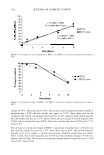
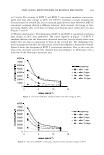
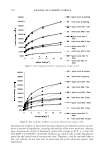
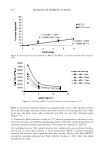
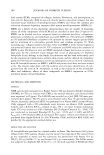
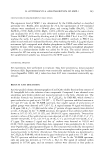
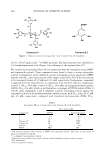
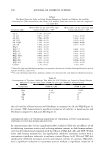
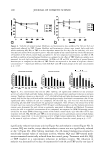
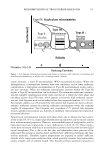
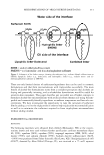
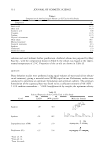
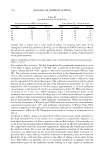
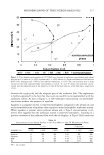
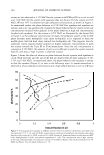
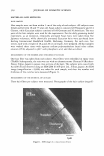
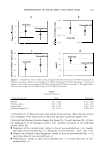
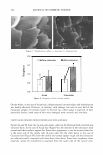
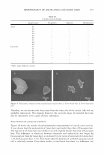
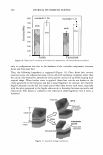
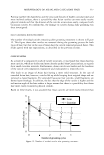
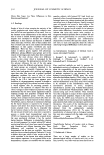
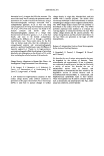
316 JOURNAL OF COSMETIC SCIENCE Table III Optimum Salinities for Oil Mixtures Isopropyl myristate (IPM)-sebum mixtures Ethyl laurate (EL)-sebum mixtures % 1PM % Sebum S* (%) % EL % Sebum S* (%) 20 80 0.5 20 80 0.5 40 60 0.5 40 60 0.5 60 40 0.8 60 40 0.5 80 20 1.5 80 20 0.5-0.7 100 0 3.5 100 0 1-1.5 product that is robust over a wide range of sebum oil secretion rates. One of the strategies to avoid this problem is finding a co-oil that has an EACN similar to that of the sebum oil, resulting in a similar optimum salinity. Therefore, based on this study, ethyl laurate is the best co-oil among the co-oils studied here, in terms of the robustness of the phase behavior. EFFECT OF SEBUM FRACTION IN OIL AND SURFACTANT CONCENTRATIONS ON PHASE DIAGRAM ([NaCl} = 0.5% wt) Microemulsion phase transition. The fish diagram for the system with squalene as co-oil at 0.5% NaCl is shown in Figure 3 the fish "tail" is observed in the high concentration region, whereas the fish "body" appears in the lower concentration region (Winsor Type III). The surfactant system was previously described in the Experimental Procedures section. The minimum surfactant concentration studied here was 14.19 wt%. At lower surfactant concentrations, very slow phase separation kinetics made it difficult to map out the remainder of the three-phase region. The surfactant concentration and the sebum fraction of oil at which the body and tail of the fish meet are denoted by "C" and "F," respectively. The concentration C for this system, approximately, is 25 wt% surfactant concentration at the fraction F of 0.42, as summarized in Table IV. When the fraction of sebum in oil is zero (i.e., 100% squalene), Type I microemulsion forms at the surfactant concentration studied. Without the co-oil (when sebum fraction is equal to one), a Winsor Type I microemulsion forms only at very high surfactant concentrations, but no microemulsion forms at lower surfactant concentrations. When the sebum frac tion in the oil increases, a Winsor Type I-III-II transition is observed at a low surfactant concentration regime up to 25% total surfactant concentration. A Winsor Type I-IV-I transition appears at high surfactant concentrations, although at intermediate surfactant concentrations, a Winsor I-IV-II transition occurs with an increase in sebum fraction in the oil. As shown in Table I, almost one-third of the sebum is fatty acids, which contribute to the high hydrophilicity of the sebum oil as compared to triglycerides. Squalene is a long-chain hydrocarbon oil that is present in the artificial sebum. Using squalene as co-oil in the microemulsion-based formulation can provide an efficient environment for the complicated comb-like structured triglycerides, enhancing the solubilization ability for artificial sebum. The co-oil can tune the spontaneous curvature of the surfactant monolayer, can help break up the structured triglyceride liquid phase (or liquid tri glyceride that is rigid, making it hard for surfactants to penetrate), and can increase the flexibility of the surfactant film, similar to the effect of adding a short-chain alcohol (5,7). Both effects are probably due to an increased interaction of squalene with the hydrocarbon region of the surfactant system, leading to a high degree of interaction

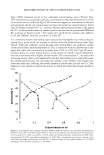
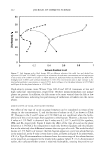
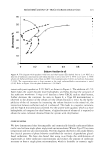
MICROEMULSIONS OF TRIGLYCERIDE-BASED OILS 317 � � C ca C, � Cl) ...... 60 50 IV 40 I I b. , , , 30 "C" ':' , , , A , , , 20 , , , , , ·� I , II , , , 10 , , , , nonmicroemulsion "F" phase 0 0 0.2 0.4 0.6 0.8 Sebum fraction in oil ♦ I/IV � IV/I .::c IV/Ill 1/111 o 111/11 A IVIII () N/11 - nonmicroemulsion 1 Figure 3. Fish diagram with sgualene at 0.5% NaCl as a function of surfactant concentration and sebum fraction in oil (a value of 0 is 100% sgualene and 1 is 100% sebum oil). Surfactant/linkers studied here are AOT (4%), hexylglucoside (5.06%), and sorbitan monooleate (5.13%). The concentration ratio is kept constant as the total surfactant/linker concentration is varied. "C" and "F" denote the surfactant concen tration and the sebum fraction of the mixed oil at which the body and tail of the fish meet, respectively (25°c). between the triglyceride and the nonpolar part of the surfactant film. The explanation is further supported by the fact that the co-oil can readily be microemulsified with the surfactant system. As seen in Figure 3, at low surfactant concentration, no microemul sion forms without the presence of squalene. Squalene is a nonpolar oil that is relatively hydrophobic compared to the sebum oil, and so microemulsification of squalene alone requires a more hydrophobic surfactant system. When squalene is present alone (without sebum oil), a Type I microemulsion is ob served. This suggests that the surfactant system is relatively hydrophilic, resulting in a positive curvature of the surfactant film with the oil droplets. A Type I-III-II transition Table IV Concentration (C) and Sebum Fraction in Oil (F) at Which a Type IV Microemulsion Forms C (%) F (fraction) Oil/NaCl (%) 0.50% 1.50% 3.00% 0.50% 1.50% 3.00% Sgualene 25 NS NS 0.42 NS NS Sgualane 25 35 42 0.35 0.20 0.15 1PM 25 38 NS 0.50 0.18 NS EL 25 38 NS 0.40 0.02 NS NS = not studied.
Purchased for the exclusive use of nofirst nolast (unknown)
From: SCC Media Library & Resource Center (library.scconline.org)