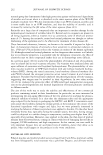
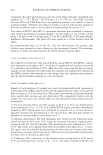
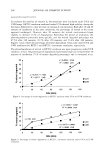
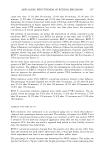
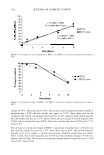
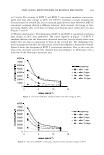
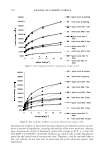
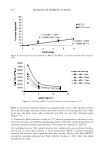
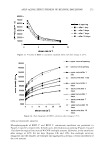
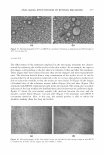
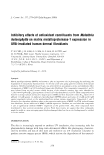
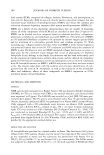
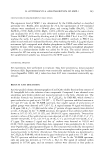
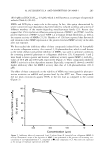
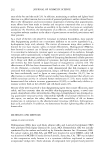
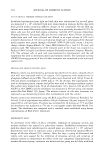
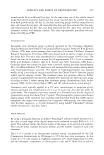
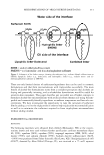
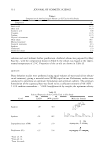
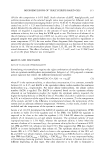
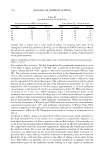
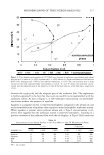
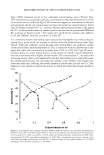
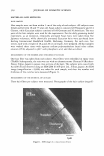
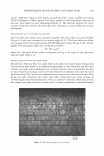
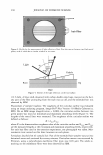
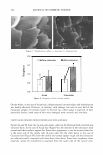
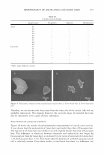
MORPHOLOGY OF ASIAN AND CAUCASIAN HAIR 329 cation xSOO) were taken at three points on each hair fiber, using a profile microscope VK-8510 (Keyence, Osaka, Japan). Five lines, parallel to the longitudinal direction of the hair, were drawn on each photograph (Figure 2). The intervals between the inter sections of the lines and the cuticular edges were measured at at least 100 points in each photograph. MEASUREMENT OF THE SURFACE INCLINATION Five hair fibers per subject were aligned in parallel with each other, in a special holder (Figure 3). Light was irradiated at an incident angle of 45°. The light reflection of hair was measured with a Goniophotometer GP-200 (Murakami Color Research Lab., Tokyo, Japan). The inclination angle was calculated as follows: 8 = ( 45--ys)/2 where 8 is the angle of the surface inclination and 'Ys 1s the angle of the specularly reflected light (Figure 4). DAMAGE EVALUATION OF EXTENDED HAIR Extended hair. One hair fiber was taken from each subject and small tresses of Asian and Caucasian hair were made. In a preliminary experiment, it was found that the lift-up of cuticles was slight when undamaged hair cut from near the scalp was extended. In order to induce easier hair damage, hair tresses were treated with shampoo and conditioner and then blow-dried. This process was repeated thirty times prior to the extension test. Nine Asian and eight Caucasian hair fibers were taken from each tress. Root sections of 10-mm length were then extended by 35% at a speed of 5 mm/min. Both ends of each hair sample were then attached to a glass plate, in order to maintain its extended length IOµm Figure 2. Microscope image of a hair surface.

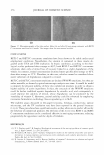
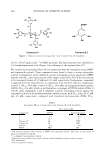
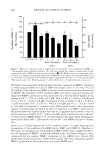
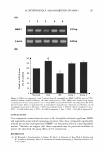
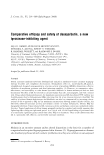
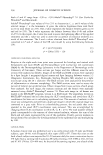
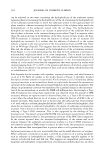
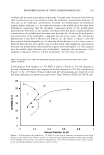
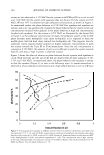
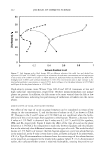
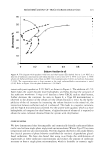
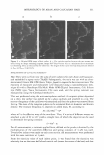
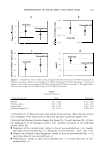
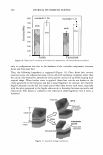
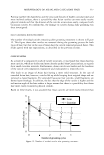
330 JOURNAL OF COSMETIC SCIENCE hair fiber Figure 3. Holder for the measurement of light reflection of hair. Five hairs are set between two black metal plates, each of which has a circular window at its center. Light Root Hair Figure 4. Scheme of the light reflection on the hair surface. (13.5 mm). A brass stub, mounted with carbon double-sided tape, was put on the hair, any part of the fiber protruding from the stub was cut off, and the extended hair was observed by SEM. Measurement of cuticular roughness. The roughness of the cuticular outline was evaluated using an image analyzing program, Image-Pro® Plus Version 4.0 (Media Cybernetics, MD). On an SEM image (magnification x 2,000), the cuticular outline between two given points was traced at minimum and maximum smoothing levels (Figure 5 ). The lengths of the traced lines were measured. The roughness of the cuticular outline was defined as follows: R = Lmin/Lmax where R is the dimensionless roughness value of the cuticular outline and Lmin and Lmax are the measured lengths at the minimum and maximum smoothing levels, respectively. For each hair fiber used in the extension experiment, one photograph was taken. Mea surements were carried our for three locations on each photo. Particulates detached from the extended hair. Parr of the extended hair samples was put into deionized water and sonicated for twenty minutes. Particulate matter was recovered by filtration, using a polycarbonate membrane filter (pore size: 0.05 µm). The solids re maining on the membrane filter were then observed by SEM.
Purchased for the exclusive use of nofirst nolast (unknown)
From: SCC Media Library & Resource Center (library.scconline.org)