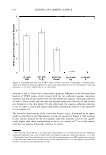
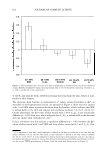
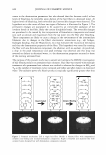
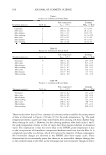
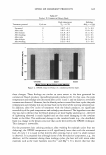
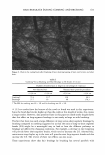
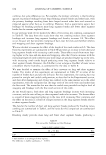
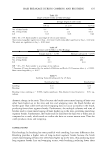
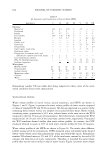
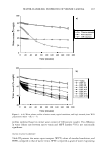
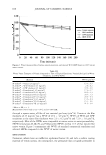
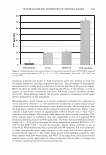
RANKING OF SURFACTANT-HUMECTANT SYSTEMS 611 Table II also reveals that 1 wt% C 12 E6 (aqueous contacting solution ii) induces the largest average pore radius, rpore! value when compared to aqueous contacting solutions i-v. Nevertheless, 1 wt% C 12 E6 ranks below 1 wt% SDS in terms of skin barrier perturbation, as reflected in both the RM and P EIPc values in Table II. This reflects the fact that 1 wt% SDS induces a much larger p E IPc value than that induced by 1 wt% C 12 E 6 , which more than offsets the larger r p ore value induced by 1 wt% C 12 E 6 . In addition, Table II reveals that the ranking metric (RM) value corresponding to 1 wt% C 12 E6 (aqueous contacting solution ii) is significantly larger than the RM values cor responding to the in vitro PBS control (iii) and to the aqueous humectant contacting solutions (iv and v). Transmission electron microscopy studies (21,24) have provided evidence that nonionic surfactants like C 12 E 6 can disorder, and at times, disrupt the ordered intercellular lipid bilayers in the SC. The disordering of the lipid bilayers of the SC can in turn result in a compromised skin barrier, and may also result in skin dryness (13-16,21-25). Another interesting observation from Table II is that 10 wt% PG (aqueous contacting solution iv) induces a smaller average p E IPc value, yet a larger average RM value, compared to 10 wt% G (aqueous contacting solution v). This result reflects the fact that 10 wt% PG induces a significantly larger rpore value relative to 10 wt% G, which more than offsets the smaller p E IPc value that it induces relative to 10 wt% G. There is evidence provided by the in vivo measurements reported below, as well as by other researchers (30,32,33), that G, because of its superior hygroscopic character, can better modulate water fluxes in the SC relative to PG, and therefore, can preserve the skin barrier more effectively than PG. It is important to note that the key measure of in vitro skin barrier perturbation is RM! which ranks aqueous contacting solutions i-v appropriately. The other model dependent variables, such as r 1 ,ore and pE/p0 provide additional useful information, thereby shedding light on the nature of the aqueous pores induced in the SC upon contacting p-FTS in vitro with aqueous contacting solutions i-v. RESULTS OF THE IN VIVO SKIN BARRIER MEASUREMENTS The deviation from baseline of transepidermal water loss (TEWL) values, determined using an evaporimeter as described in the Experimental section, are reported in Figure 3. In this figure, the height of each bar corresponds to the average TEWL value, which is measured as a deviation from the baseline, as explained in the Experimental section. Recall that TEWL is a measure of how easily water passes through the skin. Therefore, skin whose barrier has been compromised should exhibit a higher TEWL value (13,14). The bars in Figure 3 corresponding to the two aqueous surfactant contacting solutions (i and ii) are significantly higher than those corresponding to the untreated skin in vivo control (iii), and to the two aqueous humectant contacting solutions (iv and v) (Student t-test,p 0.05). These results indicate that aqueous surfactant contacting solutions i and ii induce a significantly larger extent of skin barrier perturbation, as determined by TEWL, relative to the in vivo control (iii), and to the two aqueous humectant contacting solutions (iv and v). In addition, a Student t-test conducted at a significance of p 0.05 indicates: (a) no significant difference between the deviation from baseline of TEWL values of skin treated with G or PG corresponding to the two humectant aqueous contacting solutions (iv or v), and (b) no significant difference between the deviation from baseline ofTEWL values of skin treated with the two surfactant aqueous contacting

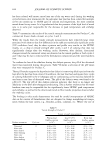
612 � .5 = � -= Q Q ·s: � -= t .5 8 6 4 2 0 (i) 1 wt% SDS JOURNAL OF COSMETIC SCIENCE (ii) 1 wt% C12Ea (iii) In Vivo Control (iv) 10 wt% PG (v) 10 wt% G Figure 3. Transepidermal water loss (TEWL) values, with the error bars corresponding to standard errors, which were measured using an evaporimeter upon contacting human skin in vivo with aqueous contacting solutions i, ii, iv, and v, and for the in vivo control (iii). solutions (i and ii). There was a statistically significant difference in the deviation from baseline of TEWL values of skin treated with the two surfactant aqueous contacting solutions and that of skin treated with the two humectant aqueous contacting solutions (iv and v). These results indicate that the aqueous humectant solutions (iv and v) were not disruptive to the skin barrier. On the other hand, the aqueous surfactant solutions (i and ii) induce a statistically higher skin barrier perturbation relative to the untreated in vivo control (iii). The deviation from baseline of the visual skin dryness scores, determined by an expert grader as described in the Experimental section, are reported in Figure 4. The increases in skin dryness induced by the two aqueous surfactant solutions (i and ii) are signifi cantly higher than those corresponding to the in vivo control (iii)12 or to skin treated with the two aqueous humectant solutions (iv and v). 12 Note that the control for the in vivo skin barrier measurements is an untreated skin test site exhibiting natural skin hydration that is not occluded and is not exposed to aqueous contacting solutions i, ii, iv, and v. On the other hand, the control for the in vitro skin barrier measurements is a p-FTS sample that is exposed to PBS. The reason why the in vitro PBS control can be compared to the in vivo non-exposed, non-occluded control is discussed in the Experimental section.
Purchased for the exclusive use of nofirst nolast (unknown)
From: SCC Media Library & Resource Center (library.scconline.org)