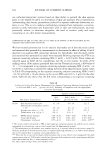
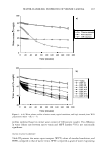
HPDSC OF COLORANT PRODUCTS 623 of a permanent hair colorant and thus the change in the fiber properties would be expected to be lower. EXPERIMENT AL Caucasian untreated mixed hair (medium brown), obtained from a commercial source (IHIP, New York), was formed into swatches (16 cm, 1.5 g). The hair swatches were subjected to a total of three repeat treatments with a commercial colorant product. Four grams of the mixed colorant were thoroughly applied to the hair and then kept for 25 minutes at a controlled temperature of 30°C. After rinsing for one minute, two hair swatches were removed for HPDSC and tensile strength analyses. One swatch was measured immediately after coloring and one was dialyzed in the deionized water. The remaining swatches were subjected to a series of shampoo and conditioner treatments (24 shampoos plus 12 conditioning treatments). After the washing cycles, a swatch was removed for HPDSC and tensile strength analyses. Measurements were made after one and three cycles. Four commercial colorant products were used, two blonde shades and two brown shades: • Product A-a commercial medium blonde shade containing ammonium hydroxide and hydrogen peroxide (3% on head) at pH 10. • Product B-a commercial medium blonde shade containing ammonium hydroxide and hydrogen peroxide (3% on head) at pH 10. • Product C-a commercial medium brown shade containing ammonium hydroxide and hydrogen peroxide (3% on head) at pH 10. • Product D-a commercial medium brown shade containing ammonium hydroxide and hydrogen peroxide (3% on head) at pH 10. Dialysis of the hair was achieved by soaking the hair in repeated changes of one liter of deionized water for a total of 144 hours. For the first seven hours the water was changed every hour. For the remaining time the water was changed every 12 hours. The pH of the dialyzed water was monitored at each change of deionized water. HPDSC investigations were carried out on samples for all four products using a Dynamic Difference Calorimeter DSC7 calibrated with indium supplied by Perkin Elmer. The heating range was 70 ° -l 70°C at a rate of 10°C/minute. Hair tresses were conditioned for 24 hours at 55% RH and 22°C before samples were removed and cut into 0.5-mm lengths. Four to seven milligrams of hair was placed into a Perkin Elmer pan. Fifty microliters of distilled water was added to the crucible, which was then sealed. At least three replicates were used for each determination. The tensile properties of the fibers were measured using a Diastron miniature tensile tester (MTT 675) equipped with a laser micrometer in a water-saturated environment. Only samples from product C were measured for tensile strength. RESULTS AND DISCUSSION The results below detail the effect on the HPDSC denaturation temperature and en thalpy following treatments with commercial colorant products A-D. Tables I-IV summarize the results of the HPDSC analyses.

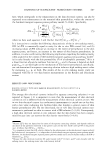
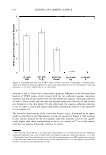
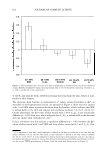
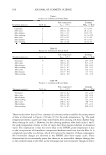
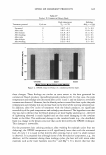
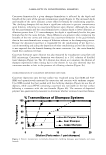
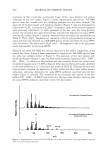
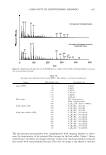
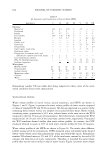
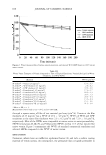
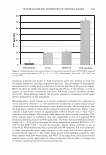
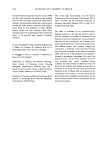
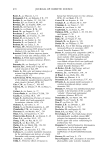
624 Treatment protocol Untreated After color After dialysis After washing After color After dialysis After washing Treatment protocol Untreated After color After dialysis After washing After color After dialysis After washing Treatment protocol Untreated After color After dialysis After washing After color After dialysis After washing JOURNAL OF COSMETIC SCIENCE Table I Product A: Commercial Blonde Shade Peak temperature Cycle no. TD±s (°C) 0 149.7 ± 0.2 145.8 ± 1.0 152.1 ± 0.2 1 144.6 ± 0.1 3 137.2 ± 0.5 3 149.0 ± 0.2 3 142.1 ± 0.4 Table II Product B: Commercial Blonde Shade Peak temperature Cycle no. TD±s (°C) 0 149.7 ± 0.2 146.6 ± 0.3 1 151.7 ± 0.7 1 145.6 ± 0.7 3 142.4 ± 0.4 3 151.6 ± 0.4 3 144.9 ± 0.9 Table III Product C: Commercial Brown Shade Peak temperature Cycle no. TD±s (°C) 0 149.7 ± 0.2 146.2 ± 0.3 150.3 ± 0.1 1 146.1±0.4 3 138.9 ± 0.2 3 150.8 ± 0.4 3 142.7 ± 0.5 Enthalpy .:iHD ± s (J/g) 13.7 ± 0.4 10.1 ± 0.1 15.8 ± 0.5 12.2 ± 0.05 11.3 ± 0.2 14.5 ± 0.2 10.3 ± 0.3 Enthalpy .:iH D ± s (J/g) 13.7 ± 0.4 10.7 ± 0.3 14.3 ± 0.6 12.3±0.5 12.9 ± 0.5 15 ± 0.1 11.3±0.6 Enthalpy .:iHD ± s (J/g) 13.7 ± 0.4 11.2 ± 0.6 14.7 ± 0.3 11.1±0.7 8.8 ± 0.4 13.7 ± 0.2 10.8 ± 0.4 These results show that all four commercial colorant products exhibit the same pattern of data as illustrated in Figure 2 (Product C) for the peak temperature, T0 . The peak temperature shows a significant drop immediately after coloring and then a further drop after coloring for cycle 3. However, for the coloring products, after both cycles 1 and 3 the peak temperature returns to that of virgin hair after repeated dialysis in deionized water. The implication is that the entire drop in the HPDSC peak temperature is due to the incorporation of formulation components/hardness metal ions into the fiber. It is completely reversible via dialysis, which will remove the majority of these components. No irreversible changes are observed in the HPDSC after three repeat cycles. These observations do not necessarily prove that there are no irreversible changes taking place in the covalent bonds in the fiber, as the technique may not be sensitive enough to detect
Purchased for the exclusive use of nofirst nolast (unknown)
From: SCC Media Library & Resource Center (library.scconline.org)