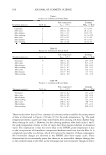
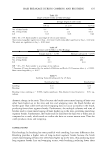
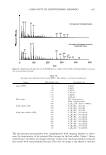
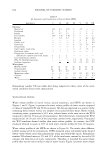
HPDSC OF COLORANT PRODUCTS 627 Table VI pH Measurements During Dialysis for Product C Time for dialysis (hours) DI water control 2 3 6 54 pH 5.59 9.01 7.03 6.86 6.66 5.72 product action is known to be the cortex (intermediate filaments, matrix, pigment), one should also expect some ingredients to remain in the fiber pending removal by repeated washing, as is the practice by consumers. In this case it is essential to separate permanent and temporary changes to the cortex when employing HPDSC methods. CONCLUSION We have used high-pressure differential scanning calorimetry to measure changes in the denaturation temperature of the crystalline component of the hair cortex from four commercial permanent hair coloring products over three treatment cycles. We have demonstrated that components of these products, such as the alkalizer, and other metal ions such as Ca2 + and Mg2 + , can induce large changes in the denaturation temperature that are not due to oxidative covalent bond cleavage. These changes in the denaturation properties are reversible on dialysis in deionized water. A similar, non-statistically significant pattern is observed from measured fiber tensile properties. These findings are consistent with previous findings observed with bleach products. It is hypothesized that during the coloring process bonds will be broken at different locations in the fiber. Close-range electrostatic interactions or salt bridges are readily broken and spontaneously reform as the hair dries. The presence of formulation com ponents such as residual alkalizer and/or metal salts within the fiber can influence the re-formation of salt bridges and hydrogen bonds. Interference with salt bridges will increase protein flexibility and reduce viscosity in the matrix. This in turn leads to a lowering of the denaturation temperature. These changes are reversible if the hair is dialyzed in deionized water. ACKNOWLEDGMENTS We thank Professor F.-J. Wortmann of the University of Manchester, UK, for suggest ing the dialysis experiment and providing help in the interpretation of the presented results. We thank the DWI and Crisan Popescu (Aachen) for the HPDSC measurements and subsequent discussion of the data. REFERENCES (1) J. Cao, Thermochimica Acta, 335, 5 (1999). (2) C. Popescu and F.-J. Wortmann, Revue Roumaine de Chemie, 48(12), 981 (2003). (3) P. Milczarek, M. Zielinski, and M. L. Garcia, Coll. Polym. Sci., 270, 1106 (1992). (4) J.M. Marsh, C. J. Clarke, K. Meinert, and R. M Dahlgren,]. Cosmet. Sci., 58, 319-327 (2007). (5) F.-J. Wortmann and H. Deutz,J. Appl. Polym. Sci., 48, 137 (1993). (6) J.M. Marsh, J. Flood, D. Domaschko, and N. Ramji,J. Cosmet. Sci., 58, 495-503 (2007).

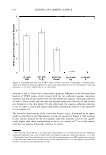
J. Cosmet. Sci., 58, 629-636 (November/December 2007) Hair breakage during combing. IV. Brushing and combing hair CLARENCE ROBBINS and YASH KAMATH, 12425 Lake Ridge Circle, Clermont, FL, 34711 (C.R), and Textile Research Institute, PO Box 625, Princeton, NJ 08540 (Y.K.). Accepted for publication June 26, 2007. Synopsis During combing of hair, longer fiber breaks (2.5 cm) occur principally by impact loading of looped crossover hairs, while short segment breaks ( 2.5 cm) occur primarily by end wrapping. Brushing provides breakage similarly but with a higher ratio of long-to-short segment breaks, and the ratio of long-to-short segment breaks (LIS) is a good way to follow these two pathways of breakage under different conditions. For example, bleaching hair, a longer comb stroke, increasing fiber curvature, wet combing versus dry combing, and brushing versus combing all provide for an increase in long segment breaks and this ratio, with the largest effect produced by brushing. INTRODUCTION The objective of this work was to provide a better understanding of how human hair fibers break during combing and brushing by exploring variables that have not been examined previously: brushing versus combing, increasing length of comb stroke, and hair fiber curvature. In the first paper in this series (1), hair snags were examined to determine the important hair-on-hair versus hair-on-comb arrangements and interac tions that might be involved in breakage. Hairs looped over other hairs as shown earlier by Brown and Swift (2) and end wrapping were shown to be important factors in hair breakage. Our second paper (3) showed that longer fiber breaks are consistent with impact loading of one hair against another in a snag, while short segment breaks are more consistent with end wrapping (4). We also decided to examine the variables of brushing versus combing, increasing the length of the comb stroke, hair curvature, and some of the variables in our earlier work through the ratio of long-to-short segment breaks, which reveals how breakage by impact loading versus end wrapping is involved. EXPERIMENT AL The hair used in all of these experiments was 12-inch dark brown, virgin hair from Caucasians, reported to be undamaged and purchased from DeMeo Brothers of New 629
Purchased for the exclusive use of nofirst nolast (unknown)
From: SCC Media Library & Resource Center (library.scconline.org)