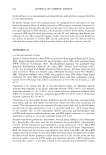
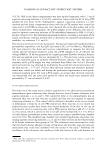
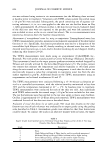
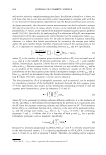
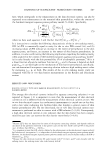
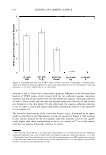
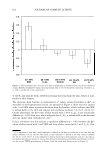
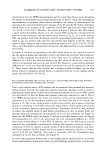
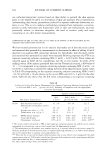
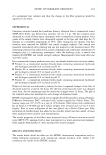
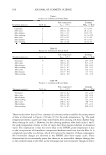
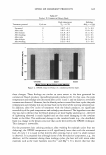
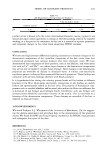
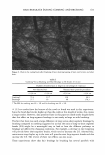
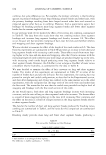
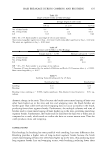
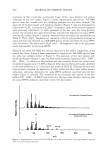
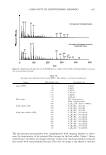
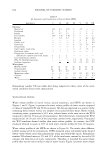
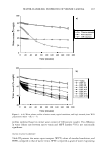
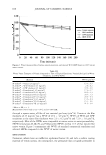
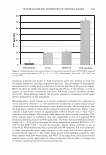
658 JOURNAL OF COSMETIC SCIENCE 120 ---o-- Vernix caseosa ---0--- W /0 emulsion --6:----- O/W emulsion -- HIPE # VII 0 0 20 40 60 80 100 120 140 160 180 200 Time (minutes) Figure 2. Water release profile of vernix, typical emulsions, and selected W/O HIPE based on 100% initial water content. Table III Water Vapor Transport of Vernix Compared to That of Typical Emulsions, Vernix-Like Lipid-in-Water Emulsions, and W /0 HIP Es Material N-terface® + Vernix (25 mg/cm2) N-terface® + W/0 emulsion (25 mg/cm2) N-terface® + O/W emulsion (25 mg/cm2) N-terface® + Formulation I (25 mg/cm2) N-terface® + Formulation II (25 mg/cm2) N-terface® + Formulation III (25 mg/cm2) N-terface® + Formulation IV (25 mg/cm2) N-terface® + Formulation V (25 mg/cm2) N-terface® + Formulation VI (25 mg/cm2) N-terface® + Formulation VII (25 mg/cm2) * Mean ± SD, n = 3. Measurements were made at 22°-24°C and 37-38% RH. WVT (g/ m 2 /h)* 19.3 ± 4.9 2.6 ± 0.2 72.0 ± 3.0 17.3 ± 1.7 18.9 ± 1.3 20.1 ± 1.3 20.0 ± 0.4 13.5 ± 0.4 15.1±0.6 21.5 ± 3.0 through a square meter of film of test material per hour (g/m2/h). Vernix at the film thickness of 25 mg/cm2 has a WVT of 19.2 ± 4.9 g/m2/h. WVTs of W/O and O/W emulsions at the same film thickness were 2.6 ± 0.2 g/m2/h and 72.0 ± 3.0 g/m2/h, respectively. Most of the HIPEs were comparable to native vernix in water permeability. HIPE formulations II, III, IV, and VII provided WVTs within 11 % of that reported for native vernix. Figure 3 summarizes the WVTs of standard commercial emulsions and selected HIPEs compared to the WVT of native vernix. DISCUSSION Premature infants have an ineffective epidermal barrier ( 4) and lack a surface coating material of vernix caseosa. As consequence, the premature skin is highly permeable to

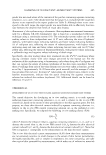
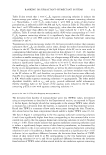
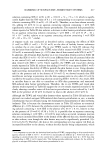
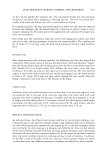
80 70 60 20 10 0 WATER-HANDLING PROPERTIES OF VERNIX CASEOSA 659 * T -- -- - �- - I - -- * ,-- - - - W /0 emulsion Vernix RIPE# VII O/W emulsion Figure 3. Summarization of water vapor transport of typical emulsions and a selected W/O HIPE compared to that of native vernix (mean ± SD, n = 3, * p 0.001). Measurements were made at 22°-24°C and 37-38% RH. exogenous materials and results in high evaporative water loss, leading to fluid and electrolyte imbalances and high evaporative heat loss. Topical therapy of hydrophobic materials has been widely used to substitute the barrier function of the preterm infants. However, there are conflicting reports regarding the efficacy of this therapy, as well as reports of late-onset nosocomial infections following topical ointment therapy (10,11,25). These findings indicate the need for alternative treatments that facilitate barrier development in this population. Morphologically, vernix consists of a cellular component surrounded by unstructured vernix lipid (13). Pickens et al. (13) reported the localization of carbon (lipid) around corneocytes with a high level of oxygen (water) within the cells. This finding shows that the high water content of vernix resides primarily within the vernix cells. Native vernix contains a high water content of approximately 82% by weight (13), a value that is consistent across samples. The present study shows that native vernix, containing 10% lipids, releases water at a relatively slow rate, comparable to that of a standard W /0 emulsion containing as much as 60% lipid phase. The water vapor permeability of native vernix (19.3 ± 4.9 g/m2/h) is between the values obtained for standard W/O (2.6 ± 0.2 g/m2/h) and O/W (72.0 ± 3.0 g/m2/h) emulsions. Native vemix, therefore, is not as occlusive as W/O emulsion and not as permeable as O/W emulsion. It is semi-permeable to water and provides water vapor transport in the range that has been reported to promote barrier repair (17). The results show unique water-handling properties, high water content with slow water release, and WVT in the range found to facilitate barrier repair of native vernix. Application of vernix is expected to be an effective therapy and to enhance epidermal barrier formation and function.
Purchased for the exclusive use of nofirst nolast (unknown)
From: SCC Media Library & Resource Center (library.scconline.org)