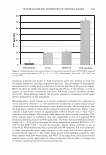
660 JOURNAL OF COSMETIC SCIENCE The barrier creams were formulated in an attempt to duplicate the physical appearance and water-handling properties of native vernix. Since vernix contains highly hydrated corneocytes surrounded by an unstructured lipid matrix (13 ), barrier creams were pre pared as W/0 emulsions. In the W/O emulsions, water is dispersed as the droplets are surrounded by the continuous phase of lipid components. W /0 emulsions containing water phases up to 74.05% w/w yield uniform spherical dispersed droplets. At higher water levels, the dispersed phase becomes much larger than that of the continuous medium. The dispersed droplets are deformed into the polyhedral-like shape with rounded corners (26). Such systems are known as high internal phase emulsions. HIPEs can be formed in a ternary system of water, oil, and non-ionic emulsifier, with an HLB range of about 3-5 (26,27). The addition of electrolytes to the aqueous phase increases the resistance of the water droplets to coalesce and lowers the attractive force between the water droplets, thus enhancing the stability of HIPE (28-30). In the present study, several single low-HLB emulsifiers or combinations of low-HLB emulsifiers were used to prepare the W/O HIPEs. Co-emulsifier(s), leading to stronger interfacial film, were important for the preparation of "stable" HIPEs. Using either vernix-like lipids or non-vernix-like lipids as a continuous oil phase in the presence of suitable emulsifier(s) provided stable HIPEs with no changes in visual appearance over three months at ambient temperature. The water release profiles show the importance of emulsion type in preventing water release. O/W emulsions (water is a continuous outer phase) release almost all of the water content after three hours. In contrast, the continuous oil phase of W/O emulsions may impede the water transport. Water release profiles also demonstrate the different capa bility of emulsifier combinations in impeding water loss. This effect may be attributed to the strength of interfacial film between the aqueous and oil phases. Emulsifier(s), providing a strong interaction between head groups and forming a strong, dense inter facial film, enhance the emulsion stability and, hence, impede evaporative water loss. Therefore, the type of preparation (O/W or W/O) and type, concentration, and combi nation of emulsifier(s) are the important factors in achieving a stable HIPE with a slow water release rate. This work indicates that the water release rate is influenced by the nature of the lipids. Preparations with vernix-like lipids (HIPE numbers VI and VII) demonstrated better water release profiles than those with conventional lipids, a finding that is consistent with the water-holding property of vernix lipids reported by Sumida et al. (15), who reported that pseudo-vernix lipids had a higher water-holding capacity than pseudo-skin-surface lipids (15). Formulation VII contained lipids similar to those seen in native vernix. Based on the lipid composition and effective emulsifier combi nation, HIPE number VII, containing up to 78% aqueous phase, was stable for at least three months at room temperature and could withstand at least three cycles of freeze thaw determination without any changes in visual appearance. The water loss rate of this formulation was not significantly different from that of native vernix over three hours of measurement. The water vapor transport of this formulation was 21.6 ± 3.0 g/m2/h and was in the range of WVT of native vernix. Formula VII provided water-handling properties similar to those of native vernix. The high water content with slow water release is expected to provide a moisturizing effect via increased skin hydration. The semi-permeability of formula VII films is expected to facilitate epidermal barrier repair. Therefore, it may provide a viable formulation for the treatment of premature or com-

WATER-HANDLING PROPERTIES OF VERNIX CASEOSA 661 promised skin. This research provides a prototype for further development of barrier creams with additional properties, such as anti-infective or antioxidant activity. REFERENCES (1) K. A. Holbrook and G. F. Odland, The fine structure of developing human epidermis: Light, scanning and transmission electron microscopy of the periderm,j. Invest. Dermatol., 65, 16-38 (1975). (2) M. J. Hardman, L. Moore, M. W. J. Ferguson, and C. Byrne, Barrier formation in the human fetus is patterned,]. Invest. Dermatol., 113, 1106-1113 (1999). (3) M. 0. Visscher, V. Narendran, W. Pickens, A. A. Laruffa, J. Meinzen-Derr, K. Allen, and S. Hoath, Vernix caseosa in neonatal adaptation,]. Perinatal., 1-7 (2005). (4) N. Rutter, The immature skin, Eur. J. Pediatr., 155, S18-S20 (1996). (5) N. Rutter and D. Hull, Water loss from the skin of term and preterm babies, Arch. Dis. Child., 54, 858-868 (1979). (6) J. Agren, G. Sjors, and G. Sedin, Transepidermal water loss in infants born at 24 and 25 weeks of gestation, Acta Paediatr., 87, 1185-1190 (1998). (7) D. R. Wilson and H. I. Maibach, Transepidermal water loss in vivo: Premature and term infant, Biol. Neonate, 37, 180-185 (1980). (8) A. J. Nopper, K. A. Horii, S. Sookdeo-Drost, T. H. Wang, A. J. Mancini, and A. T. Lane, Topical ointment therapy benefits premature infants, J. Pediatr., 128, 660-669 (1996). (9) A. T. Lane and S. S. Drost, Effects of repeated application of emollient cream to premature neonates'skin, Pediatrics, 29, 415-419 (1993). (10) N. Rutter and D. Hull, Reduction of skin water loss in the newborn. I. Effect of applying topical agent, Arch. Dis. Child., 56, 669-672 (1981). (11) W. H. Edwards, J.M. Conner, and R. F. Soll, The effect of prophylactic ointment therapy on noso comial sepsis rates and skin integrity in infants with birth weight of 501 to 1000 g., Pediatrics, 113, 1195-1203 (2004). (12) T. Agorastos, G. Hollweg, E. I. Grussendorf, and A. Papaloucas, Features of vernix caseosa cells, Am. J. Perinatal., 5, 253-259 (1988). (13) W. Pickens, R. Warner, Y. Boissy, R. Boissy, and S. Hoath, Characterization of vernix caseosa: Water content, morphology, and elemental analysis, J. Invest. Dermatol., 115, 875-881 (2000). (14) P.H. Hoeger, V. Schreiner, I. A. Klaassen, C. C. Enzmann, K. Friedrichs, and 0. Bleck, Epidermal barrier lipids in human vernix caseosa: Corresponding ceramide pattern in vernix and fetal skin, Br. J. Dermatol., 146, 194-201 (2001). (15) Y. Sumida, M. Yakumaru, Y. Tokitsu, Y. Iwamoto, T. Ikemoto, and K. Mimura, Studies on the function of vernix caseosa: The secrecy of baby's skin, International Federation of the Societies of Cosmetic Chemists, 20th International Conference, Cannes, France, 1998. (16) M. I. B. Bautista, R.R. Wickett, M. 0. Visscher, W. Pickens, and S. Hoath, Characterization of vernix caseosa as a natural biofilm: Comparison to standard oil-based ointments, Pediatr. Dermatol., 17, 253-260 (2000). (17) M. 0. Visscher, S. Hoath, E. Conroy, and R.R.Wickett, Effect of semipermeable membranes on skin barrier repair following tape stripping, Arch. Dermatol. Res., 293, 491-499 (2001). (18) W. Pickens, Y. Zhou, R.R. Wickett, M. 0. Visscher, and S. Hoath, Antioxidant defense mechanisms in vernix caseosa: Potential role of endogenous vitamin E, Pediatr. Res., 47, 425A (2000). (19) G. Marchini, S. Lindow, H. Brismar, B. Stabi, V. Berggren, A.-K. Ulfgren, S. Lonne-Rahm, B. Agerbetth, and G. H. Gudmundsson, The newborn infant is protected by an innate antimicrobial barrier: Peptide antibiotics are present in the skin and vernix caseosa, Br.]. Dermatol., 147, 1127-1134 (2002). (20) H. T. Akinbi, V. Narendran, A. K. Pass, P. Markart, and S. Hoath, Host defense proteins in vernix caseosa and amniotic fluid, Am. J. Obstet. Gynecol., 191, 2090-2096 (2004). (21) H. Yoshio, M. Tollin, G. H. Gudmundsson, H. Lagercrantz, H. Jornvall, G. Marchini, and B. Agerberth, Antimicrobial polypeptides of human vernix caseosa and amniotic fluid: Implications for newborn innate defense, Pediatr. Res., 53, 211-216 (2003). (22) R. Moraille, W. Pickens, M. 0. Visscher, and S. Hoath, A novel role for vernix caseosa as a skin cleanser, Biol. Neonate, 87, 8-14 (2005).
Purchased for the exclusive use of nofirst nolast (unknown)
From: SCC Media Library & Resource Center (library.scconline.org)