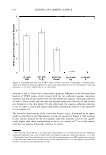
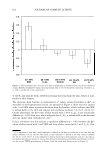
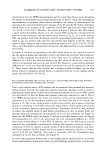
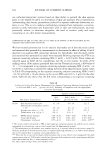
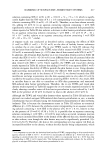
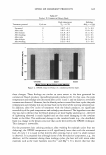
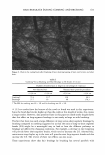
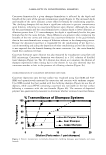
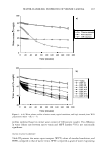
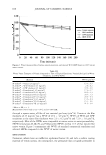
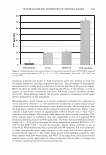
1.2 .9 = � 0 0.8 � = .s = .t 0.6 e � 0 'fJJ. r'-l 0.4 � = 0.2 'fJJ. 0 ,... - "" "" RANKING OF SURFACTANT-HUMECTANT SYSTEMS 613 -- (I) 1 wt% SDS -- (ii) 1 wt% C12Ea -+- (ill) In Vivo Control ,......._.i - (iv) 10 wt% PG -..__ (v) 10 wt% G Figure 4. Visual skin dryness scores, with the error bars corresponding to standard errors, which were determined by an expert grader upon contacting human skin in vivo with aqueous contacting solutions i, ii, iv, and v, and for the in vivo control (iii). The expert grader could not discriminate differences in skin dryness between skin sites treated with the two aqueous humectant solutions (iv and v) or between skin sites treated with either of the two aqueous surfactant solutions (i and ii). These results indicate that the aqueous surfactant solutions (i and ii) induce skin dryness while the two aqueous humectant contacting solutions (iv and v) do not. One should note that in comparing results from the TEWL measurements and the visual skin dryness scores, the TEWL measurements more closely resemble the in vitro skin barrier perturbation measurements (skin electrical current and mannitol skin permeability) (see Figures 1-4) (17-20). In addition, an instrumental measurement like TEWL allows for finer discrimination between the effects of the aqueous humectant solutions (iv and v), and the in vivo control (iii), relative to the visual skin dryness scores determined by an expert grader. Indeed, there was no discrimination between the effects of the aqueous humectant solutions (iv and v) and the in vivo control (iii) (see Figure 4). Both the TEWL measurements and the visual skin dryness scores indicate that the aqueous surfactant solution containing 1 wt% C 12 E6 induces significant skin dryness relative to the in vivo control and to the aqueous humectant solutions (iv and v). This finding is consistent with in vivo studies that have shown that although nonionic surfactants like C 12 E6 do not induce significant erythema (skin redness) relative to SDS, they can be drying to the skin (21-24). This reflects the fact that nonionic surfactants like C 12 E6 can interact with the intercellular lipid bilayers

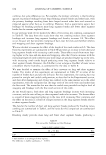
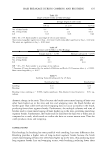
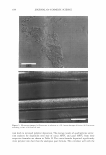
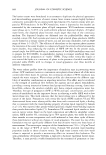
614 (i) 1 wt% SDS JOURNAL OF COSMETIC SCIENCE (iii) In Vivo Control (iv) 10 wt% PG (v) 10 wt% G Figure 5. Skin erythema scores, with the error bars corresponding to standard errors, which were measured using a Minolta chromameter upon contacting human skin in vivo with aqueous contacting solutions i, ii, iv, and v, and for the in vivo control (iii). of the SC and disorder them, thereby increasing water loss from the skin, which in turn, results in skin dryness. The deviation from baseline in chromameter a* values, denoted hereafter as Lla*, as described in the Experimental section, are reported in Figure 5. Note that skin treated with 1 wt% SDS shows a positive deviation from the baseline, which indicates that SDS is indeed harsh to the skin and induces skin erythema (redness) (13-16,21-24,29,37). On the other hand, the Lla* value of skin treated with 1 wt% C 12 E6, is not statistically different (p 0.05) from zero, which indicates that C 12 E6 , is indeed mild to the skin and does not induce skin erythema (21-24). 13 In fact, a Student t-test did indicate a significant difference (p 0.05) between the Lla* values of skin treated with 1 wt% SDS and those of skin treated with 1 wt% C 12 E 6 . One 13 It is important to note that a mild surfactant is defined in the skin care literature as one that does not induce erythema (21-24). On the other hand, a harsh surfactant is defined as one that induces erythema (13-16,19-22,24-29,37). It is also important to keep in mind that a mild surfactant such as C 12 E6 induces skin barrier perturbation because it induces skin dryness by disordering intercellular lipid bilayers in the SC (see the in vivo TEWL measurements in Figure 3 and the visual skin dryness scores in Figure 4).
Purchased for the exclusive use of nofirst nolast (unknown)
From: SCC Media Library & Resource Center (library.scconline.org)