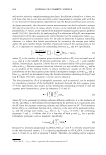
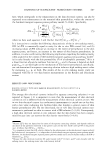
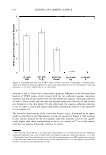
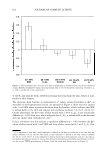
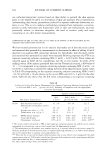
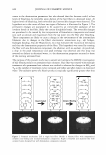
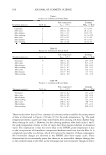
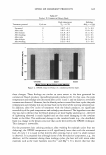
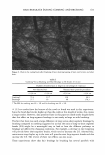
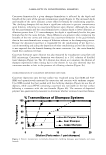
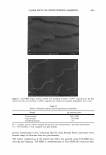
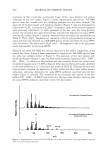
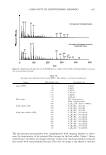
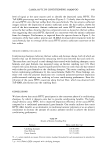
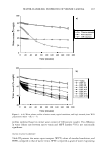
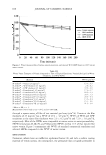
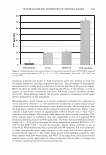
Treatment protocol Untreated After color After dialysis After washing After color After dialysis After washing u ! 149 ! E 144 • D. U 139 D. ::c 134 HPDSC OF COLORANT PRODUCTS Table IV Product D: Commercial Brown Shade Peak temperature Cycle no. 0 1 3 3 3 Untreated Cycle 1 T0 ± s (°C) 149.7 ± 0.2 146.1 ± 0.3 151.0 ± 0.7 144.9 ± 0.2 141.8 ± 0.2 150.8 ± 0.4 143.3 ± 0.4 I ■After Coloring ■After Dialysis □After washing I Cycle 3 Figure 2. HPDSC Data for Product C: commercial brown shade. 625 Enthalpy �HD ± s Q/g) 13.7 ± 0.4 12.8 ± 0.3 16.1 ± 0.2 12.0 ± 0.3 9.5 ± 0.4 16.1 ± 0.3 9.5 ± 0.4 these changes. These findings are similar to some extent to the data generated for commercial bleach products (persulfate/peroxide products) (4). In that case, the peak temperature and enthalpy also decreased after cycles 1 and 3, and on dialysis a reversible increase was observed. However, for the bleach products treated for three cycles the peak temperature and enthalpy did not increase back to the level of the starting substrate hair. In addition, after five cycles of treatment with the bleach products, no significant reversibility of the peak temperature and enthalpy was observed. The hypothesis was that this was due to the fact that the bleach products are more highly oxidizing (i.e., the level of lightening observed is much higher) and are thus more damaging to the covalent bonds in the fiber. This additional damage to the covalent bonds (e.g., the disulfides) leads to a change in the keratin structure that can be detected by the HPDSC technique. This damage is irreversible. For the permanent hair coloring products, after washing for multiple cycles (but not dialyzing), the HPDSC temperature is still significantly lower than with the untreated hair. At cycle 1 it is equal to that directly after c·oloring, but at cycle 3 a small increase is observed. It is proposed that although some of the formulation components, e.g., the alkalizer, will be removed during these washing cycles, the hair will still retain other materials such as the water hardness ions (Ca2 + and Mg2 + ). It is known that hair that

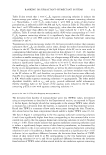
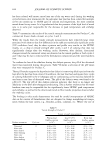
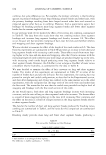
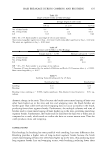
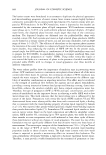
626 JOURNAL OF COSMETIC SCIENCE has been colored will extract metal ions out of the tap water used during the washing cycles between color treatments (6). In particular, hair that has been colored for multiple cycles can contain up to 10,000 ppm of calcium and magnesium, the most common metals found in tap water. It is hypothesized that the presence of the high level of metal ions is in some part responsible for the decrease in peak temperature and enthalpy observed. Table V summarizes the results of the tensile strength measurements for Product C, the commercial brown shade colorant at cycles 1 and 3. While the results from the tensile strength measurements have relatively large errors associated with them so that few differences in the table are statistically significant at the 95% confidence level, they do show a pattern and profile very similar to the HPDSC results, i.e., a drop in tensile strength after cycles 1 and 3 of coloring that does not significantly change after the washing cycles. However, after dialysis, directional changes toward the untreated values are observed in the tensile profiles at both cycles 1 and 3 that may be due to removal of the formulation components and the water hardness ions. To confirm the loss of the alkalizer during the dialysis process, the pH of the deionized water was monitored during this process. Table VI shows a selection of the pH values that were measured for Product C. These pH results support the hypothesis that dialysis is removing alkali species from the hair after the hair has been colored. In addition, the hair that had undergone three cycles of coloring followed by the 24 shampoo and 12 conditioning cycles was also dialyzed for one hour in one liter of deionized water. The pH of the dialysis water was found to be pH 6.19. The low pH of this dialysis solution indicates that there is no longer any alkalinity in the fiber after shampoo/conditioning. This is further evidence that the water hardness ions may be responsible for the significantly lower HPDSC peak temperature and enthalpy, as well as for the directional trends in fiber tensile properties observed after the washing cycles. The findings in this study demonstrate the need for careful interpretation of HPDSC data in the context of formulations that are designed to change morphological compo nents within the hair cortex, e.g., bleaches, perms, colorants, etc. Where the site of Product treatment Untreated After color After dialysis After washing After color . After dialysis After washing Cycle no. 0 1 3 3 3 Table V Tensile Strength of Product C Plateau load Gmf/sq. micron (x 103) 6.88 ± 0.53 6.43 ± 0.44 6.86 ± 0.57 6.46 ± 0.54 6.12 ± 0.50 6.59 ± 0.76 6.21 ± 0.60 Tensile strength measurements Load @ 25% Gmf/sq. micron (x 10') 8.22 ± 0.40 7.47 ± 0.48 8.23 ± 0.78 7.51±0.66 7.19 ± 0.64 7.92 ± 0.88 7.41 ± 0.82 Break load Gmf/sq. micron (x 103) 22.3 ± 1.8 21.9 ± 1.40 22.8 ± 1.6 21.7 ± 1.9 20.3 ± 1.3 20.9 ± 2.9 20.5 ± 1.7
Purchased for the exclusive use of nofirst nolast (unknown)
From: SCC Media Library & Resource Center (library.scconline.org)