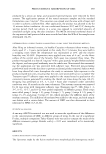
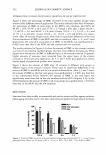
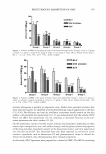
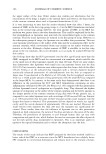
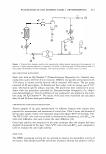
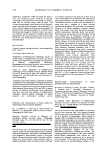
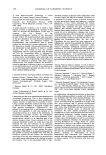
446 JOURNAL OF COSMETIC SCIENCE 450 mAU 400 350 300 250· 200 150 100 50 1-Fe WVL:530nm 4-Zn 2-Cu 6-Mn \- 3-N11 ' 5-C J\ � ... \ 0 A. o.a-------�--....Wljll.,. ....... __ � ..... � min -50,11,,..---.-..--.........-...-.-....-� eta fa 4.o B:o rto 10:0 12·.o 14:0 1s:o 1a:o Figure 2. Chromatogram of Ultramarine Pink coloring agent. concentrations of the metals in coloring agents and cosmetic products are presented in Tables IV and V, respectively. Lead and cadmium, which can cause serious problems of safety on the skin, were not detected in the coloring agent and cosmetic product. Copper, nickel, cobalt, and man ganese were not detected in all of the cosmetic products except some of the coloring agents. This means that all the cosmetic products in the skin test are safe from heavy metals except for some coloring agents. To prevent cosmetic products from containing heavy metals, which are separated from raw materials, quality control for heavy metals is definitely necessary for both cosmetic products and their raw materials. DISCUSSION To determine the heavy metals, ICP-MS, flame AAS, and HPLC have been compared. ICP-MS and flame AAS are fast and sensitive for the determination of heavy metals. However, if we analyze water-soluble heavy metals in cosmetic products by using ICP-MS or the flame AAS method, it is difficult to determine the exact amount of heavy Table IV Determination of Metals in Coloring Agents Concentration (µg ml - 1 ) Samples Pb Fe Cu Ni Zn Co Cd Mn Ultramarine Pink 75.7 2.5 5.7 50.3 0.3 17.8 Ultramarine Blue 156.3 1.8 100.9 0.5 34.9 Cobalt Blue 2.2 0.4 21.6 177.9 0.8 Chromium Oxide Green 30.2 0.4 27.1 8.4 U nipure Green 0.9 1.2 28.5 1.0. Black 719.9 13.8 80.1 Mapico Black 789.8 17.0 7.7 Mapico Red 666.8 6.6 103.3 2.9 67.7 Soft-Tex Red 616.9 16.6 9.4 Mapico Yellow 541.2 4.5 22.9 7.2 16.9 Socovit Brown 19.5 31.1 4.5 27.5 Above are the average concentration values of 3-time injection.

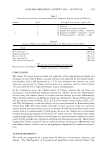
SIMULTANEOUS DETERMINATION OF HEAVY METALS 447 Table V Determination of Metals in Cosmetic Products Concentration (µg ml - 1 ) Samples Pb Fe Cu Ni Zn Eyeshadow ,pink 3.7 2.5 679.3 Eyeshadow blue 66.9 715.8 Eyeshadow yellow 7.3 0.3 508.2 Eyeshadow purple 2.2 181.3 Makeup base A 1.3 173.2 Makeup base B 0.5 59.4 Makeup base C 62.7 Foundation A 0.8 116.7 Foundation B 2.2 32.6 Foundation C 8.4 0.5 88.7 Gloss A 1.1 25.6 Gloss B 2.9 2.6 26.9 Gloss C 0.6 26.6 Lipstick A 2.4 0.4 24.1 Lipstick B 17.5 Lipstick C 2.0 23.5 Mascara A 55.7 27.8 Mascara B 52.5 57.3 Mascara C 224.1 68.3 Eyeliner A 342.5 118.0 Eyeliner B 115.7 33.2 Eyeliner C 683.1 78.2 Above are the average concentration values of 3-time injection. Co Cd Mn 3.9 1.7 9.6 metals because of the interference of residual organic materials. The HPLC method is not suitable for the determination of heavy metals. Even though the interference of residual organic materials can be ignored because it is the determination method for organic materials, the HPLC method is not sensitive in analyzing trace heavy metals due to the ion-exchange column in the stationary phase in the system. On the other hand, the Dionex IonPac CSSA analytical column for IC is dedicated to the analysis of heavy metals. The limit of detection (LOD) of IC is higher than in the HPLC method and IC can improve the quality control process in the manufacturing of cosmetics. In this study we have found that the flow rates of the eluent and the post-column reagent are critical to the analysis of heavy metals in cosmetics. The flow rate of the eluent should be two times the flow rate of the post-column reagent, which enables microanalysis because the baseline is most stable under this condition. The concentration of the eluent (PDCA) and the post-column reagent (PAR) are important for the sensitivity and selectivity of the peaks of heavy metals. The sensitivity of the detection can be changed by the concentration combination of PDCA and PAR, and so it is important to look for an optimum concentration combination. CONCLUSIONS We have developed a simultaneous determination method for water-soluble trace heavy metals in cosmetic products and coloring agents. The proposed techniques show that ion
Purchased for the exclusive use of nofirst nolast (unknown)
From: SCC Media Library & Resource Center (library.scconline.org)