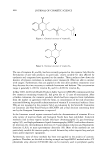
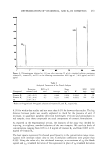
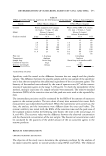
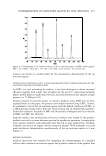
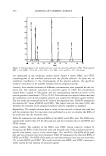
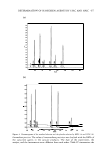
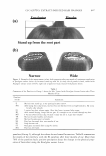
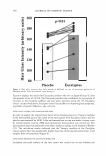
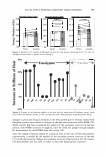
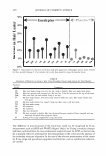
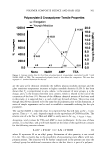
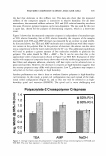
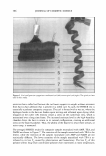
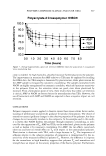
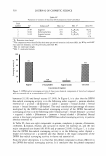
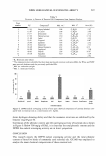
POLYMER COMPOSITE SCIENCE AND HAIR GELS 505 the hair that dominate in this stiffness test. The data also show that the measured stiffness of the composite samples is insensitive to relative humidity. For all three neutralizers, the measured stiffness values at 50% and 90% relative humidity are about the same. However, polymer response can be rate-dependent. The rate used for this test is quite fast, chosen for the purpose of determining crispness, which is a short-time event. Figure 5 shows that the measured composite crispness is independent of neutralizer type at 50% relative humidity, but at 90% relative humidity the crispness of the samples neutralized with TEA and AMP decreases (as measured by an increase in peak width). As discussed above, the TEA and AMP molecules are in equilibrium with their respec tive cations in the polymer film. In the presence of moisture, the amines can also enter into a competition with the water molecules for the H + ion. This additional equilibrium will tend to produce a greater amount of free molecules available to plasticize the polymer. The order should be TEA AMP Na. It can be seen that this is the approximate order of plasticization shown in Figure 5 at 90% RH. Evaluation of these results with respect to composite theory shows that with the reinforcing properties of the hair fibers and adequate adhesion, relatively stiff hair styles can be achieved even in plasticized systems. However, the decrease in crispness at high humidity suggests that the sensory properties may differ with plasticization. Low T g polymers may impart a tacky feel on the hair, especially at high humidity. Another performance test that is done to evaluate fixative polymers is high-humidity curl retention. In this study, a spiral curl configuration was used instead of the tradi tional rolled configuration (Figure 6), and so this test will be referred to as high humidity spiral curl retention (HHSCR). The spiral curl is more challenging and .-.. 1.4 E E 1.2 .,_,, .... 1.0 � Cl u, 0.8 (§) 0.6 .c .... "C 0.4 ti . 0.2 CJ 0.0 Polyacrylate-2 Crosspolymer Crispness ! I •. f H :u l II iii LI! n , 111 ij I I TEA AMP 50% R.H. [TI] 90% R.H . NaOH Figure 5. Average crispness data for polyacrylate-2 crosspolymer versus neutralizing base at 50% RH and 90% RH. The error bars represent ± 1 standard deviation for the test.

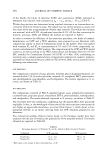
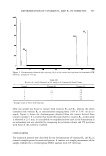
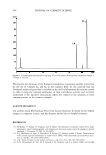
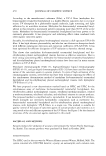
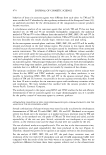
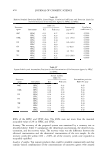
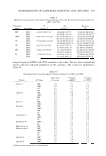
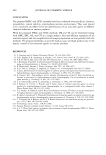
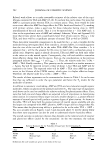
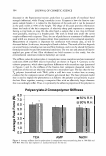
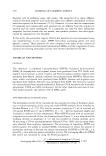
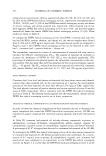
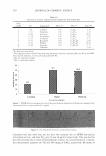
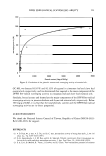
506 JOURNAL OF COSMETIC SCIENCE Figure 6. Curl configuration comparison: traditional curl (left) versus spiral curl (right). The spiral curl was used in this study. sensitive than a rolled curl because the curl must support its weight without assistance from hair-to-hair adhesion that is present in a rolled curl. As such, the HHSCR test is essentially a polymer composite creep test. The curl is formed with a wet set, where the hydrogen bonds in the hair are broken upon wetting and reformed upon drying while wrapped on the curler (18). Gravity creates a stress on the curled hair tress, which is maintained over a long time frame. The increased moisture level in the high-humidity chamber drives the hair to return to its natural configuration, creating an additional stress on the fixative polymer. Thus, the ability of the fixative to resist these stresses, or resist creep, is measured. The averaged HHSCR results for composite samples neutralized with AMP, TEA, and NaOH are shown in Figure 7. The retention of the sample neutralized with TEA is the lowest, while the retention of the samples neutralized with AMP and NaOH are not statistically different. The lower retention of the sample neutralized with TEA is at tributed to its low T g caused by plasticization and humectancy. The low T g of this polymer allows long-chain coordinated polymer chain movement at room temperature
Purchased for the exclusive use of nofirst nolast (unknown)
From: SCC Media Library & Resource Center (library.scconline.org)