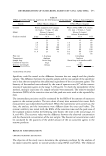
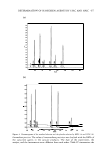
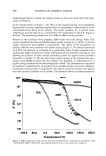
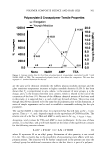
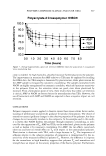
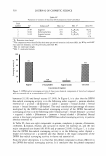
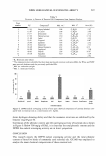
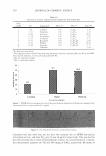
POLYMER COMPOSITE SCIENCE AND HAIR GELS 507 Polyacrylate-2 Crosspolymer HHSCR 100.0 90.0 C: 80.0 C: Ci) Et: 70.0 Ci) --.. _ _...._.....,__...., --+-AMP ---TEA 60.0 c( ---.- NaOH 50.0 0.0 1.0 2.0 3.0 4.0 5.0 6.0 7.0 8.0 Time (hours) Figure 7. Average high-humidity spiral curl retention (HHSCR) values for polyacrylate-2 crosspolymer versus neutralizing base. creep is enabled. At high humidity, absorbed moisture further plasticizes the polymer. The improvement in retention for AMP relative to TEA may be explained by recalling the DMA data: the TEA sample is dominated by plasticization, while plasticization for the AMP sample is mitigated by ionomeric crosslinking. The samples neutralized with NaOH are highly strengthened by ionomeric crosslinks, which add moisture sensitivity to the polymer. Even so, the retention values are good, even when plasticized by moisture. From a formulation point of view, these results show that when curl retention is critical, AMP or NaOH are better choices for neutralization than TEA. However, the use of humectants with AMP and NaOH are expected to have a negative impact on curl retention. CONCLUSIONS Polymer composite science applied to fixative-treated hair tresses allows better under standing of performance and provides guidance for product formulation. The choice of neutralizer causes significant changes in the cohesive properties of the polymer, but these changes do not necessarily translate to the composite. In the example used in this work, it is shown that NaOH hardens the polymer through ionomeric crosslinking, as indi cated by the suppression ofT g· AMP and TEA, on the other hand, plasticize the polymer as well as harden it by ionomeric crosslinking. For AMP, the two effects cancel each other out and have no overall effect on T g with respect to the unneutralized polymer. Plasticization is dominant with TEA, with a large decrease in T g· The importance of adhesion relative to the cohesive properties of composites is demonstrated by the in sensitivity of the measured stiffness to polymer T g· However, the difference in crispness for the neutralizers at high humidity suggests that polymer T g and neutralizer acid strength have an impact on the sensory properties of the fixative polymer. Furthermore,

508 JOURNAL OF COSMETIC SCIENCE significant plasticization of the polymer is shown to affect high-humidity curl retention. This suggests that neutralizers that are good plasticizers and humectants, as well as ingredients typically used for humectant properties, should be avoided in a fixative formulation where good curl retention and low tack are essential. ACKNOWLEDGMENTS The authors thank Lubrizol Advanced Materials, Inc. (a wholly owned subsidiary of the Lubrizol Corporation) for permission to publish this work. REFERENCES (1) S. T. Peters, "Introduction, Composite Basics and Road Map," in Handbook of Composites, 2nd ed., S. T. Peters, Ed. (Chapman & Hall, London, 1998), pp. 1--4. (2) M. Piggott, Load Bearing Fibre Composites, 2nd ed. (Kluwer, Boston, 2002), p. 173. (3) ASTM D882-02, Standard test method for tensile properties of thin plastic sheeting, (ASTM, West Conshohocken, PA, 1996). (4) G. L Wilkes, "Mechanical Properties," in Comprehensive Desk Reference of Polymer Characterization and Analysis, R. F. Brady, Ed. (American Chemical Society, Washington, D.C., 2003), p. 634. (5) L. H. Sperling, Introduction to Physical Polymer Science, 2nd ed. (John Wiley & Sons, New York, 1992), p. 304. (6) T. D. Juska and P. M. Puckett, "Matrix Resins and Fiber/Matrix Adhesion," in Composites Engineering Handbook, P. K. Mallick, Ed. (Marcel Dekker, New York, 1997), pp. 144, 146, 158. (7) L. H. Sperling, Introduction to Physical Polymer Science, 2nd ed. (John Wiley & Sons, New York, 1992), p. 314. (8) A. Eisenberg and]. -S. Kim, Introduction to lonomers (John Wiley & Sons, New York, 1998), pp. 45--48. (9) L. E. Nielsen and R. F. Landel, Mechanical Properties of Polymers and Composites, 2nd ed. (Marcel Dekker, New York, 1994), pp. 49-50. (10) I. M. Ward and D. W. Hadley, An Introduction to the Mechanical Properties of Solid Polymers (John Wiley & Sons, New York, 1993), p. 178. (11) H. Matsuura and A. Eisenberg, Glass transitions of ethyl acrylate-based ionomers,j. Polym. Sci., 14, 1201-1209 (1976). (12) J. Graton, F. Besseau, M. Berthelot, E. D. Raczynska, and C. Laurence, L'echelle pKHB de basicite de liason hydrogene des amines tertiares aliphatiques, Can. j. Chem. 80, 1375-1385 (2002). (13) G. Raabe, Y. Wang, and]. Fleischhauer, Calculation of the proton affinities of primary, secondary, and tertiary amines using semiempirical and ab initio methods, Verlag de Zeitschrift fur Naturforschung, 55a, 687-694 (2000). (14) Z. Pawlak, S. Kuna, M. Richert, E. Giersz, M. Wisniewska, A. Liwo, and L. Chmurzynski, Acidity constants of 19 protonated N-bases in cyclohexanone, acetone, and butan-2-one,J. Chem. Thermody nam., 23, 135-140 (1991). (15) P. Smith and L. Goulet, Effect of the addition of amine diluents on the physical properties of poly(methyl methacrylate-co-methacrylic acid) copolymers obtained by partial hydrolysis of PMMA, ]. Polym. Sci. B, 31, 327-338 (1993). (16) R. A. Weiss and P. K. Agarwal, Influence of intermolecular interactions on the melt rheology of a propylene-acrylic acid copolymer and its salts,]. Appl. Polym. Sci., 26, 449--462 (1981). (17) ASTM D790-99, Standard test methods for flexural properties of unreinforced and reinforced plastics and electrical insulating materials (ASTM, West Conshohocken, PA, 1999). (18) C.R. Robbins, Chemical and Physical Behavior of Human Hair, 4th ed. (Springer-Verlag, New York, 2002), pp. 133-134.
Purchased for the exclusive use of nofirst nolast (unknown)
From: SCC Media Library & Resource Center (library.scconline.org)