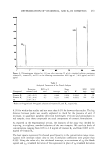
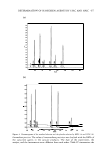
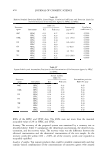
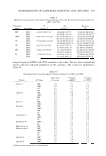
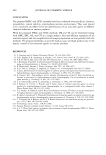
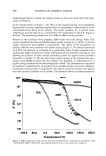
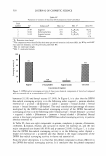
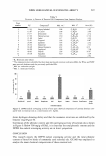
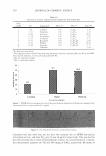
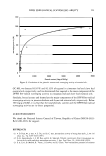
DPPH FREE-RADICAL SCAVENGING ABILITY 521 120 100 ♦ • - 80 � . 60 ·oo 40 20 0 0 1000 2000 3000 4000 5000 Phenolic content (10mg ofGAE'g) Figure 9. Correlation of the phenolic content and scavenging activity of essential oils. GC-MS, we detected 82.87% and 82.32% of eugenol in cinnamon leaf and clove bud essential oils, respectively, and we determined that eugenol is the main component of the DPPH free-radical scavenging activity in cinnamon leaf and clove bud essential oils. Similarly, benzyl acetate and thymol are the major components of the DPPH free-radical scavenging activity in jasmine absolute and thyme red essential oils, respectively. Below 500 mg/g of GAE, it is clear that the total phenolic content and the DPPH free-radical scavenging activity are in direct proportion. ACKNOWLEDGMENT We thank the National Science Council of Taiwan, Republic of China (NSC96-2622- B241-001-CC3) for support. REFERENCES (1) P. D. Duh, W. J. Yen, P. C. Du, and G. C. Yen, Antioxidant activity of mung bean hulls,]. Am. Oil Chem. Soc., 74, 1059-1063 (1997). (2) G. K. Jayaprakasha, L. J. M. Rao, and K. K. Sakariah, Volatile constituents from Cinnamomum zey lanicum fruit stalks and their antioxidant activities,]. Agr. Food Chem., 51, 4344--4348 (2003). (3) E. A. Lissi, B. Modak, R. Torres, J. Escobar, and A. Urzua, Total antioxidant potential of resinous

522 JOURNAL OF COSMETIC SCIENCE exudates from Heliotropium sp.: A comparison of ABTS and DPPH methods, Free Rad. Res., 30, 471-477 (1999). (4) M. Wang, J. Li, M. Rangarajan, Y. Shao, E. J. La Voie, T. Huang, and C. Ho, Antioxidative phenolic compounds from sage (Salvia officinalis), J. Agr. Food Chem., 46, 4869-4873 (1998). (5) X. Pin-Der-Duh, Antioxidant activity of burdock (Arctium lappa Linne): Its scavenging effect on free radical and active oxygen,]. Am. Oil Chem. Soc., 75, 455-461 (1998). (6) D. E. Pratt and B. J. F. Hudson, "Natural Antioxidants Not Exploited Commercially," in Food Anti oxidants, B. J. F. Hudson, Ed. (Elsevier, Amsterdam, 1990), pp. 171-192. (7) A. Sala, M. D. Recio, R. M. Giner, S. Manez, H. Tournier, G. Schinella, and J. L. Rios, Anti inflammatory and antioxidant properties of Helichrysum italicum, J. Pharm. Pharmacol., 54, 365-371 (2002). (8) M. Namiki, Antioxidants/antimutagens in food, Crit. Rev. Food Sci. Nutr., 29, 273-300 (1990). (9) R. W. Owen, A. Giacosa, W. E. Hull, R. Haubner, B. Spiegelhalder, and H. Bartsch, The antioxidant/ anticancer potential of phenolic compounds isolated from olive oil, Eur. J. Cancer, 36, 1235-1247 (2000). (10) N. Bendimerad, S. A. T. Bendiab, A. B. Benabadji, X. Fernandez, L. Valette, and L. Lizzani-Cuvelier, Composition and antibacterial activity of Pseudocytisus integrifolius (Salisb.) essential oil from Algeria, ]. Agr. Food Chem., 53, 2947-2952 (2005). (11) B. Halliwell, Free radicals, antioxidants, and human disease: Curiosity, cause, or consequence, Lancet, 34(4), 721-724 (1994). (12) L. A. Mitscher, H. Telikepalli, E. McGhee, and D. M. Shankel, Natural antimutagenic agents, Mut. Res., 350, 142-143 (1996). (13) H.J. Kim, F. Chen, C. Q. Wu, X. Wang, H. Y. Chung, and Z. Y. Jin, Evaluation of antioxidant activity of Australian tea tree (Melaleuca alternifolia) oil and its components,]. Agr. Food Chem., 52, 2849-2854 (2004). (14) G. Miguel, M. Simoes, A. C. Figueiredo, J. G. Barroso, L. G. Prdro, and L. Carvalho, Composition and antioxidant activities of the essential oils of Thymus caespititius, Thymus camphorates and Thymus mas tichina, Food Chem., 86, 183-188 (2004). (15) M. Sokmen, M. Angelova, E. Krumova, S. Pashova, S. Ivancheva, and A. Sokmen, In vitro antioxidant activity of polyphenol extracts with antiviral properties from Geranium sanguineum L., Life Sci., 76, 2981-2993 (2005). (16) P. P. Joy, J. Thomas, and M. Samuel, Cinnamon (Cinnamomum verum Presl) for flavour and fragrance, Pafai]., 20, 37-42 (1998). (17) G. Miliauskas, P.R. Venskutonis, and T. A. van Beek, Screening of radical scavenging activity of some medicinal and aromatic plant extracts, Food Chem., 85, 231-237 (2004). (18) H. Zhang, F. Chen, X. Wang, and H. Y. Yao, Evaluation of antioxidant activity of parsley (Petroselinum crispum) essential oil and identification of its antioxidant constituents, Food Res. Int., 39, 833-839 (2006). (19) S. Mathew and T. E. Abraham, In vitro antioxidant activity and scavenging effects of Cinnamomum verum leaf extract assayed by different methodologies, Food Chem. Toxicol., 44, 198-220 (2006). (20) W. Brand-Williams, M. E. Cuvelier, and C. Berset, Use of free radical method to evaluate antioxidant activity, Lebensmittel-Wissenschaft und Technologie, 28, 25-30 (1995). (21) C. Sanchez-Moreno, J. A. Larrauri, and F. Saura-Calixto, A procedure to measure the antiradical efficiency of polyphenols,]. Sci. Food Agri., 76, 270-276 (1998). (22) V. L. Singleton and]. A. Rossi, Colorimetry of total phenolics with phosphomolybdic phosphotungstic acid reagents, Am.]. Enol. Viticulture, 16, 144-158 (1965). (23) H. V. D. Dool and P. D. Kratz, A generalization of the retention index system including linear temperature programmed gas-liquid partition chromatography,]. Chromatogr. 11, 463-471 (1963). (24) R. P. Adams, Identification of Essential Oil Components by Gas Chromatography/Mass Spectroscopy (Allured Publishing Co., Carol Stream) pp. 18-43, 57-332 (1995). (25) 0. Politeo, M. Jukic, and M. Milos, Chemical composition and antioxidant capacity of free volatile aglycones from basil (Ocimum basilicum L.) compared with its essential oil, Food Chem., 101, 379-385 (2007).
Purchased for the exclusive use of nofirst nolast (unknown)
From: SCC Media Library & Resource Center (library.scconline.org)