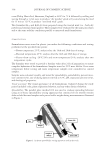
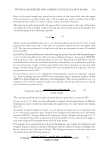
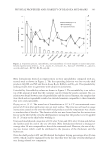
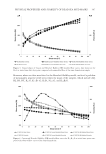
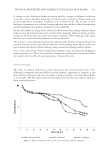
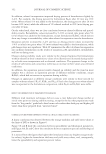
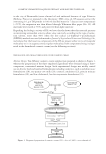
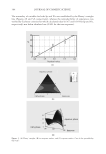
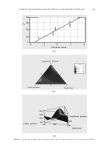
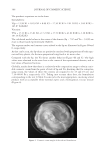
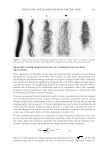
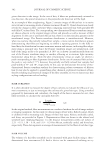
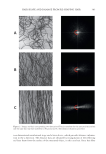
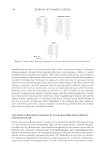
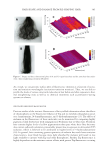
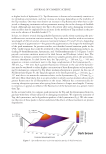
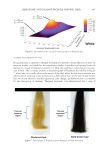
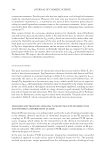
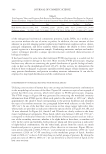
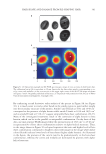
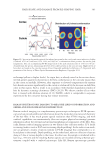
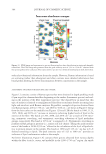
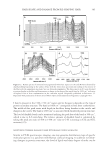
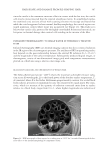
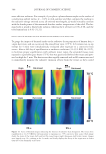
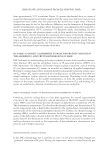
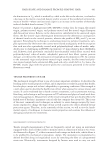
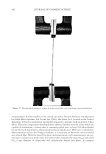
JOURNAL OF COSMETIC SCIENCE 366 The quadratic equations are in the form: Spreadability: YSp = 13.99 X1 + 18.59 X2 + 8.89 X3 − 17.36 X1X2 + 2.01 X1X3 + 3.06 X2X3 − 123.87 X1X2X3 Viscosity: YVis = 17.23 X1 + 33.81 X2 + 17.23 X3 + 37.53 X1X2 + 43.82 X1X3 + 3.28 X2X3 + 107.18 X1X2X3 The calculated model values in the center of the domain (Sp = 7.87 and Vis = 34.90) are close to those found experimentally (Table I). The response surface and contour curves related to the Sp are illustrated in Figure 2B and C, respectively. As that can be seen, the Sp values are positively correlated with proportions of both aque- ous and fatty phases, the beeswax proportion being fi xed at its mean value. Compared with the Sp, the Vis shows another behavior (Figure 3B and C). The high values were obtained in the area close to the center of the experimental domain, and at low values of beeswax fractions. Globally, results show that there is a relatively wide composition range to obtain a suit- able cosmetic cream from the point of view of Sp and Vis, knowing that for a moistur- izing cream, the values of these two criteria are required to be 15 and 19 cm2 and 7.16−88.00 Pa·s, respectively (33). Taking into account these data, the formulation corresponding to the test 2 (Table I) seems to be the most appropriate, involving a fi nal product with an acceptable white external aspect and a homogenous viscous texture (Figure 4). Figure 4. Cosmetic cream sample of the selected formulation.

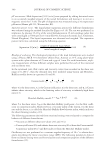
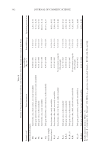
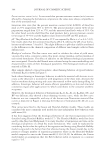
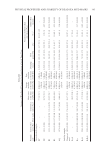
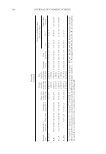
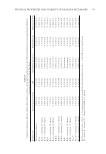
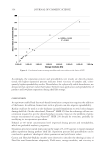
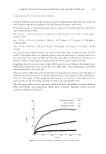
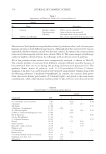
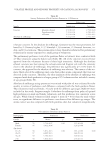
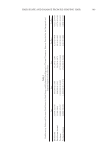
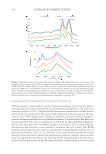
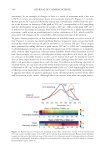
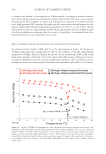
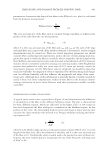
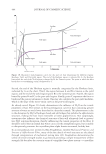
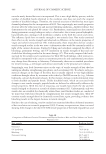
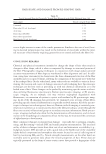
COSMETIC CREAM WITH AQUEOUS EXTRACT AND DATE FRUIT SEED OIL 367 CHARACTERIZATION OF THE SELECTED COSMETIC Stability. Table II represents the experience matrix, summarizing experimental conditions and obtained responses according to the full factorial design at two levels. From these results are then deduced the effects of the factors as represented by the follow- ing corresponding models: PI = 62.32 − 1.45 x1 + 1.93 x2 – 0.01 x3 + 1.102 x1x2 + 1.157 x1x3 − 0.425 x2x3 − 0.605 x1x2x3 Sp = 74.51 – 0.47 x1 + 0.20 x2 + 0.28 x3 − 0.533 x1x2 – 0.733 x1x3 + 0.358 x2x3 − 0.466 x1x2x3 Vis = 31.58 + 0.40 x1 – 2.66 x2 +0.18 x3 − 0.69 x1x2 – 0.74 x1x3 – 0.14 x2x3 – 10.66 x1x2x3 As it can be seen, different factors do not have the same effect on the responses. For Vis and PI, the highest effect (in absolute values) concerns the factor x2 (storage time). It is also clear that the content of DSO (x1) has the same effect on PI and Vis, tending to (i) protect cosmetic cream against oxidation and (ii) reduce the cosmetic viscosity. Regarding the interactions, some of their effects greatly exceed those of the main factors: DSO/time/temperature (case of the Vis) and DSO/time, time/temperature, and DSO/ time/temperature (case of the Sp). Rheological Profi le. Rheological measurements are important not only to assess the physical stability (36), but they are at the same time indicators of the quality of the analyzed sys- tem (37). The study of these properties has become a crucial tool in the analysis of cos- metic products, the aim being to produce stable structural profi les (38). The rheograms related to the enriched (added with DSO and DSAE), standard (without DSO and DSAE), and commercial (Mark Dove Unilever, Mumbai, India) cosmetic creams are displayed in Figure 5. Figure 5. Flow curves related to different cosmetic creams tested.
Purchased for the exclusive use of nofirst nolast (unknown)
From: SCC Media Library & Resource Center (library.scconline.org)