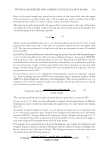
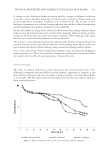
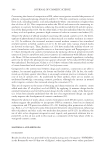
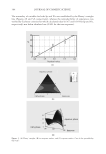
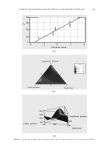
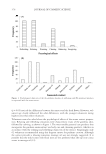
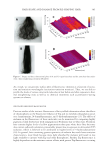
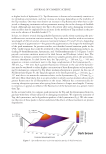
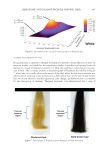
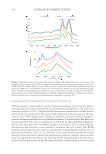
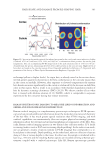
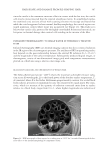
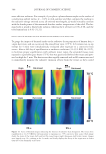
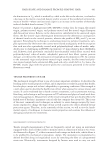
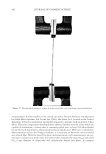
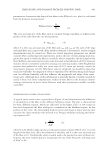
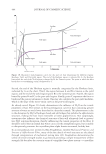
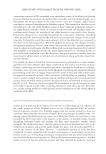
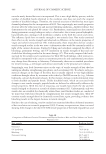
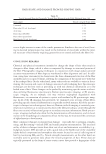
JOURNAL OF COSMETIC SCIENCE 396 monitored. As an example of changes in hair as a result of treatment with a hot iron (230°C, 12 min see explanation above for treatment protocol), Figure 13 contains Raman spectra for virgin and thermally treated hair. Immediately evident from the spec- tra is the decrease in intensity of the peak at 509 cm-1 corresponding to S–S stretching and the development (or an increase) of a peak at 487 cm-1. This second peak (487 cm-1) is believed to arise from an isomeric form of the S–S bond (30). It is likely that thermal treatment could result in transformation to other conformers of S–S, which could be associated with changes in the overall three-dimensional structure of the protein. To gain a better perspective on the distribution of disulfi de bonds in a cross section of hair, Figure 13 contains two depth profi ling Raman images for virgin versus thermally treated hair from the exterior (0 μm) of the fi ber to its interior (40 μm). These images were generated by taking the ratio of peak area at 509 cm-1 to 1004 cm-1 corresponding to phenylalanine present in the protein. On inspection of the images, it is immedi- ately evident that virgin hair contains more disulfi de bonds than thermally treated hair. Interestingly, we can see a distribution within virgin hair itself where the great- est amount of disulfi de bonds is in the cuticle region (0–5 μm). It should be noted that in these experiments we do not obtain accurate readings from the other side of the fi ber (40 μm) due to signal decay with the laser. In addition to following the level of disulfi de bonds, we can also look at the newly formed isomeric species by taking the ratio of the band at 487 cm-1 to the phenylalanine band (1004 cm-1). Not surprisingly, the level of this species in virgin hair is extremely low (see Figure 13). In thermally treated hair, it appears that there are greater quantities in the internal portion (cortex) of the fi ber and less present in the cuticle. Although this is in contrast with what one might expect, Figure 13. Raman spectra of virgin and thermally treated hair containing a normal S–S stretching band (509 cm-1) and a possible isomer of S–S (487 cm-1) resulting from thermal exposure. Raman depth profi ling images provide spatial distribution maps of the natural S–S conformation and its damage-induced conformer in healthy and thermally treated hair. Images were normalized by taking the ratio of these bands to a protein phenylalanine band at 1004 cm-1.

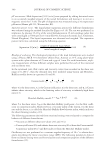
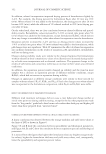
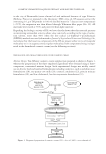
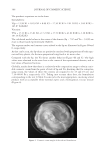
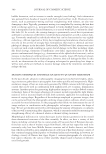
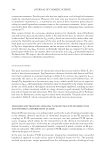
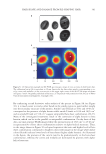
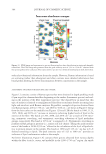
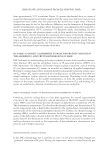
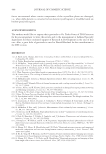
HAIR SHAPE AND DAMAGE FROM RE-SHAPING HAIR 397 since the cuticle is the outermost structure of hair in contact with the hot iron, the cuticle cells may be more protected than the internal amorphous matrix. In unpublished studies, we examined cross sections of hair with scanning electron microscopy and found that while the cuticles appeared to have normal, healthy morphology, the cortical region con- tained numerous cavities where tissue was incinerated (see Figure 14). This leads us to believe that cuticle cells, protected by the highly cross-linked A-layer and exocuticle, are less prone to thermal damage than cortical cells residing in the interior of the fi ber. INFRARED THERMOGRAPHY TO IMAGE WATER IN THERMALLY TREATED HAIR Infrared thermography (IRT) uses thermal imaging cameras that detect emitted radiation in the IR region of the electromagnetic spectrum. The usefulness of IRT in quantifying surface heat depends on the quasi-relationship between the emitted IR radiation (λ=3–15 cm-1) and the magnitude of the surface temperature. Subsequently produced digital images, or thermograms, consist of two-dimensional image grids with temperature measurements plotted on a third axis using a relative color image scale. BLACK BODY RADIATORS AND THE EMISSIVITY OF HUMAN HAIR The Stefan–Boltzmann law (Q = εσT4) relates the maximum achievable emissive radia- tion across all wavelengths, Q, to the fourth power of the absolute surface temperature, T, of a material, where σ is the Stefan–Boltzmann proportionality constant. For a solid black body radiator, Q reaches its maximum because the emissivity (ε) equals unity. The emis- sivity, which is a measure of the quantity of radiation a material emits from its surface relative to a black body, ranges from 0 to 1, where higher magnitudes are indicative of Figure 14. SEM micrograph of hair exposed to a curling iron at 230°C for 5 seconds illustrating the delete- rious effects to the internal morphological components of hair.
Purchased for the exclusive use of nofirst nolast (unknown)
From: SCC Media Library & Resource Center (library.scconline.org)