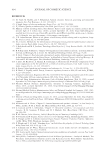
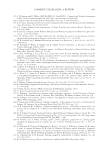
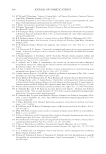
441 HISTORY OF COSMETIC (28) J. G. M. Francisco and B. D. Luis, The use of plants in skin-care products, cosmetics and fragrances: past and present, MDPI, 5(3) (2018). (29) A. Fathima, S. Varma, P. Jagannath, and M. Akash, General review on herbal cosmetics. Int J DRUG Formul Res., 2(5), 140–165 (2011). (30) R .B. Saudagar and M. H. Sisodiya, Review on herbal cosmetics, World J Pharm Res., 7(7), 573–591 (2018). (31) K. Sumit, S. Vivek, S. Sujata, and B. Ashish, Herbal cosmetics: used for skin and hair, Res Gate, 4, 1–7 (2012). (32) E. H. Schafer, The early history of lead pigments and cosmetics in China, T’oung Pao, 44:413–438 (1956). (33) K. Othmer, Kirk-Othmer Chemical Technology of Cosmetics, Wiley (2012). (34) F. Ling, Poria cocos extract, Accessed 20 Apr 2020. (35) M. T. Soo, Y. X. Sheng, H. W. Yan, and Y. Q. Xiao, Comprehension and experience of acne treated with traditional Chinese medicine facial mask of Bai Zhi(Radix angelicae formosanae) and Bai Fu Zi (Rhi- zoma typhonii gigantei) as the basis formula by external application, Chinese Medicine, 3, 87–93 (2012). (36) X. Jin, L. Y. Zhu, H. Shen, J. Xu, S. L. Li, X. B. Jia, C. Hao, C. Bao-Chang, and Y. Ru, Influence of sulphur-fumigation on the quality of white ginseng: a quantitative evaluation of major ginsenosides by high performance liquid chromatography, Food Chemistry, 135(3), 1141–1147 (2012). (37) D. Ally, TCM in cosmetics: back to the future, Happi, Accessed 12 May 2020, (2013). (38) T. Aburjai and F. M. Natsheh, Plants used in cosmetics, Phytother Res., 17, 987–1000 (2003). (39) K. H. Wang, R. D. Lin, F. L. Hsu, Y. H. Huang, H. C. Chang, and C. Y. Huang, Cosmetic applications of selected traditional Chinese herbal medicines, Journal of Ethnopharmacology, 106(3), 353–359 (2006). (40) K. K. H. Tan and J. Vanitha, Immunomodulatory and antimicrobial effects of some traditional chinese medicinal herbs: a review, Current Medicinal Chemistry, 11 (11), 1423–1430 (2004). (41) V. C. Efterpi and C. F. Panagiota, Aloe vera: a plant for many uses. Journal of Food, Agriculture & Environment, 8(2), 245–249 (2010). (42) L. Geggel, Ochre: the world’s first red paint, Live Science, Accessed 15 May 2020, (2018). (43) H. Eid, Cosmetics, Accessed 12 Apr 2020, (2016). (44) R. J. Forbes, Studies in Ancient Technology, Leiden, Vol. 3, (1965). (45) F. Blanco-Dávila, Beauty and the Body, the origins of Cosmetics in Plastic and Reconstructive Surgery, History of Cosmetics, 105(3), 1196–1204, (1998). (46) E. El-Kilany and E. Raoof, Facial cosmetics in ancient Egypt, Egypt J Tour Stud., 16, 19 (2017). (47) T. E. Oskouei and M. Najafi, Traditional and modern uses of natural honey in human diseases: a review, Iran J Basic Med Sci., 16(6), 731–742 (2013). (48) L. Sagrillo, Bees and Honey, in Oxford Encyclopaedia of Ancient Egypt, Edited by Donald Bruce Redford, Volume 1, 172–174 (2001). (49) Ancient Chinese make up, 2014. Accessed on 15 May 2020, (2014). (50) G. T. Renata, Incense as a trans disciplinary vehicle in ancient Egypt and Christianity. Similarities and Differences, p 170–176, (2007). (51) L. Ta-Chang, K. S. Guha, and C. S. David, Incense smoke: clinical, structural and molecular effects on airway disease, Clin. Mol. allergy, 6, 3 (2008). (52) K. Laden, Antiperspirants and deodorants, cosmetic science and technology series. New York, Marcel Dekker, (1999). (53) K. V. Giridhara and D. M. Basavaraja, Consumer behaviour towards ayurvedic cosmetics in Chikmagalur district with special reference to Himalaya ayurvedic concepts, Shodhganga, p 342, (2008). (54) F. Lippert, An introduction to toothpaste—its purpose, history and ingredients, Monogr Oral Sci., 23, 1–14 (2013). (55) R. Rupani and A. Chavez, Medicinal plants with traditional use: ethnobotany in the Indian subconti- nent, Clinics in Dermatology, 36(3), 306–309 (2018). (56) G. Gurudath, K. V. Vijayakumar, and R. Arun, Oral hygiene practices: ancient historical review, Journal of Orofacial Research, 2(4), 225–227 (2012). (57) R. Liu, X. Li, N. Huang, M. Fan, and R. Sun, Toxicity of traditional Chinese medicine herbal and min- eral products, Advances in Pharmacology, 87, 301–346 (2020). (58) K. Chan, Progress in traditional Chinese medicine, Trends in Pharmacological Sciences,16(6), 182–187 (1995).

442 Address all correspondence to Yoonjung Kim at yoonjungkim@amorepacific.com. J. Cosmet. Sci., 72, 442–498 (July/August 2021) Cosmetic Coloration: A Review YOONJUNG KIM and JUNGJA LEE AMOREPACIFIC Research and Development Center, 1920, Yonggu-daero, Giheung-gu, Yongin-si, Gyeonggi-do, Republic of Korea (Y.K., J.L.) Accepted for publication July 6, 2021. Synopsis Colorants for cosmetics appear to be more strictly regulated than any other cosmetic ingredients. Most countries have adopted a positive regulatory system for colorants used in cosmetics. Although there have been many reports on colorants that are used in food products from regulatory perspectives, reports on colorants used in cosmetic products have been limited. The objective of this report is to provide different countries’ regulatory requirements and to encourage the cosmetic industry to export products in compli- ance with global regulations through a comparative analysis of cosmetic colorant regulatory systems in major countries. We first provide an overview of cosmetic colorant regulatory frameworks of the European Union, the United States, China, and Korea. Then the cosmetic colorants were divided into three sectors: synthetic, inorganic, and natural. Each chapter describes the colorants’ general characteristics and explains the regulatory differences. Additionally, synthetic colorant labeling with a different nomenclature system is discussed. INTRODUCTION Colorants have been used since prehistoric times in cosmetics, foods, and fabrics (1). Colors influence people’s moods and feeling as well as the appearance of the products to others. It has been reported that when people have their first interaction with a person or a product, 62–90% of their assessments are based on colors alone (2). When consumers select cosmetic products, color is a decisive factor in their purchases (3). Recently, the cosmetic industry in Korea has developed at a very fast speed, and increased its global exports. Thanks to the growing popularity of K-beauty around the world, Korea has become the world’s fourth largest cosmetic exporter after France, the United States, and Germany (4). When exporting products to various countries, understanding the differences in cosmetic regulatory systems between countries is crucial. Specially, cosmetic colorants follow a positive system in most countries. Because all countries have different approaches to these regulations, they are perceived as the biggest barrier to exports to the international market. Therefore, we have compared Korea’s cosmetic regu- lations with those of other world leaders.
Purchased for the exclusive use of nofirst nolast (unknown)
From: SCC Media Library & Resource Center (library.scconline.org)