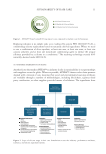
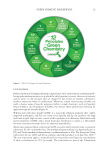
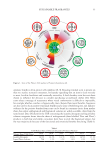
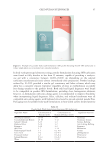
5 TheE 12 PrinciplesINCIPLES of GreenEEN ChemistryEMISTRY
CONCLUSION
The above represent the breadth of recent advances in sustainability in the cosmetic field in
the context of the 12 Principles. These examples are merely a fraction—there are many more.
Driven in part by consumer demand for clean and sustainable products, skin and hair care
markets are trending toward products that are bio-based and/or biodegradable. What the 12
Principles of Green Chemistry also draw attention to, which at times are aspects of sustainability
that are overlooked, are the processes involved in the manufacture and transport of not only the
finished goods, but also the ingredients from which they are made. Solvent use and byproduct
generation in the extraction and synthesis of ingredients demand greater attention. Energy usage
and CO
2 production in manufacturing processes must be evaluated more critically. Discoveries
in non-covalent derivatization for stabilizing actives merit further exploration beyond traditional
synthetic modifications. Considering these aspects, in addition to the more “popular” aspects of
sustainability, enables us to look at advancing sustainability in the cosmetics industry in a more
holistic manner. In this way, the 12 Principles provide a tool to help hold ourselves to a higher
standard by first focusing on principles of mechanistic chemistry, for clean and sustainable
personal care and cosmetic products, as well as the processes to make them.
REFERENCES
(1) Benvenuto MA. Green Chemistry: Research and Connections to Climate Change (M.A. Benvenuto &L.
A. Welch, Eds 1st Ed.). De Gruyter 2023. doi:10.1515/9783110745658
(2) da Costa JP, Santos PSM, Duarte AC, Rocha-Santos T. (Nano)plastics in the environment – Sources, fates
and effects. Sci Total Environ. 2016 566–567:15-26. doi:10.1016/j.scitotenv.2016.05.041
(3) Díaz S, Fargione J, Chapin FS, Tilman D. Biodiversity loss threatens human well-being. PLOS Biol.
2006 4(8):e277–e277. doi:10.1371/journal.pbio.0040277
(4) Navarrete-Meneses MDP, Salas-Labadía C, Gómez-Chávez F, Pérez-Vera P. Environmental pollution and
risk of childhood cancer: A scoping review of evidence from the last decade. Int J Mol Sci. 2024 25(6):3284-.
doi:10.3390/ijms25063284
(5) Claus Henn B, Werler MM. Environmental causes of birth defects: challenges and opportunities. Pediatr
Res. 2024 95(7):1675–1676. doi:10.1038/s41390-024-03051-4
(6) Wang J, Cortes-Ramirez J, Gan T, Davies JM, Hu W. Effects of climate and environmental factors on
childhood and adolescent asthma: A systematic review based on spatial and temporal analysis evidence.
Sci Total Environ. 2024 951:175863-. doi:10.1016/j.scitotenv.2024.175863
(7) Trasande L, Sargis RM. Endocrine-disrupting chemicals: mainstream recognition of health effects and
implications for the practicing internist. J Intern Med. 2024 295(2):259–274. doi:10.1111/joim.13748
(8) Dias LC, Caldeira C, Sala S. Multiple criteria decision analysis to support the design of safe and
sustainable chemicals and materials. Sci Total Environ. 2024 916:169599–169599. doi:10.1016/j.
scitotenv.2023.169599
(9) Ellen Macarthur Foundation. Available at: https://www.ellenmacarthurfoundation.org/. Accessed
September 15, 2024.
(10) Keijer T, Bakker V, Slootweg JC. Circular chemistry to enable a circular economy. Nat Chem.
2019 11(3):190–195. doi:10.1038/s41557-019-0226-9
(11) Richardson K, Steffen W, Lucht W, et al. Earth beyond six of nine planetary boundaries. Sci Adv.
2023 9(37):eadh2458–eadh2458. doi:10.1126/sciadv.adh2458
(12) McDonough W, Braungart M. Cradle to Cradle: Remaking the Way We Make Things. 1st ed. North
Point Press 2002.
(13) Simonen K. Life Cycle Assessment. 1st ed. Routledge 2014. doi:10.4324/9781315778730
CONCLUSION
The above represent the breadth of recent advances in sustainability in the cosmetic field in
the context of the 12 Principles. These examples are merely a fraction—there are many more.
Driven in part by consumer demand for clean and sustainable products, skin and hair care
markets are trending toward products that are bio-based and/or biodegradable. What the 12
Principles of Green Chemistry also draw attention to, which at times are aspects of sustainability
that are overlooked, are the processes involved in the manufacture and transport of not only the
finished goods, but also the ingredients from which they are made. Solvent use and byproduct
generation in the extraction and synthesis of ingredients demand greater attention. Energy usage
and CO
2 production in manufacturing processes must be evaluated more critically. Discoveries
in non-covalent derivatization for stabilizing actives merit further exploration beyond traditional
synthetic modifications. Considering these aspects, in addition to the more “popular” aspects of
sustainability, enables us to look at advancing sustainability in the cosmetics industry in a more
holistic manner. In this way, the 12 Principles provide a tool to help hold ourselves to a higher
standard by first focusing on principles of mechanistic chemistry, for clean and sustainable
personal care and cosmetic products, as well as the processes to make them.
REFERENCES
(1) Benvenuto MA. Green Chemistry: Research and Connections to Climate Change (M.A. Benvenuto &L.
A. Welch, Eds 1st Ed.). De Gruyter 2023. doi:10.1515/9783110745658
(2) da Costa JP, Santos PSM, Duarte AC, Rocha-Santos T. (Nano)plastics in the environment – Sources, fates
and effects. Sci Total Environ. 2016 566–567:15-26. doi:10.1016/j.scitotenv.2016.05.041
(3) Díaz S, Fargione J, Chapin FS, Tilman D. Biodiversity loss threatens human well-being. PLOS Biol.
2006 4(8):e277–e277. doi:10.1371/journal.pbio.0040277
(4) Navarrete-Meneses MDP, Salas-Labadía C, Gómez-Chávez F, Pérez-Vera P. Environmental pollution and
risk of childhood cancer: A scoping review of evidence from the last decade. Int J Mol Sci. 2024 25(6):3284-.
doi:10.3390/ijms25063284
(5) Claus Henn B, Werler MM. Environmental causes of birth defects: challenges and opportunities. Pediatr
Res. 2024 95(7):1675–1676. doi:10.1038/s41390-024-03051-4
(6) Wang J, Cortes-Ramirez J, Gan T, Davies JM, Hu W. Effects of climate and environmental factors on
childhood and adolescent asthma: A systematic review based on spatial and temporal analysis evidence.
Sci Total Environ. 2024 951:175863-. doi:10.1016/j.scitotenv.2024.175863
(7) Trasande L, Sargis RM. Endocrine-disrupting chemicals: mainstream recognition of health effects and
implications for the practicing internist. J Intern Med. 2024 295(2):259–274. doi:10.1111/joim.13748
(8) Dias LC, Caldeira C, Sala S. Multiple criteria decision analysis to support the design of safe and
sustainable chemicals and materials. Sci Total Environ. 2024 916:169599–169599. doi:10.1016/j.
scitotenv.2023.169599
(9) Ellen Macarthur Foundation. Available at: https://www.ellenmacarthurfoundation.org/. Accessed
September 15, 2024.
(10) Keijer T, Bakker V, Slootweg JC. Circular chemistry to enable a circular economy. Nat Chem.
2019 11(3):190–195. doi:10.1038/s41557-019-0226-9
(11) Richardson K, Steffen W, Lucht W, et al. Earth beyond six of nine planetary boundaries. Sci Adv.
2023 9(37):eadh2458–eadh2458. doi:10.1126/sciadv.adh2458
(12) McDonough W, Braungart M. Cradle to Cradle: Remaking the Way We Make Things. 1st ed. North
Point Press 2002.
(13) Simonen K. Life Cycle Assessment. 1st ed. Routledge 2014. doi:10.4324/9781315778730