1
J. Cosmet. Sci., 76.1, 1–8 (January/February 2025)
*Address all correspondence to Laura R. Muollo and John C. Warner, laura.r.muollo@gmail.com john@
johnwarner.org
The 12 Principles of Green Chemistry in Cosmetic Sciences
LAURA R. MUOLLO AND JOHN C. WARNER
VP Hairprint/True Colors (L.M.), CEO &CTO Technology Greenhouse (J.W.)
Accepted for publication January 28, 2025.
Synopsis
Consumers and regulatory agencies are applying more and more pressure on companies to create technologies
that address issues of health and environmental sustainability. There are many techniques and approaches to
describe, measure, and characterize the health and sustainability of a material or product. Green chemistry
is a mechanistic science that enables the design of products to avoid these issues. This manuscript describes
specific real-world examples utilizing the 12 Principles of Green Chemistry in cosmetic sciences.
INTRODUCTION
Well into the 21st century, consumer-facing companies have recognized the critical need
to address sustainability. The “WHY” is ever present in our culture. Evidence of the
changing climate is ever present.1 Images of plastics accumulating in the environment
are ever present.2 News of biodiversity loss and species extinction is ever present.3 News
of increasing incidents of cancer,4 birth defects,5 childhood asthma,6 and the impact of
endocrine disruptors7 on the human species is ever present. It is unlikely that anyone
today has not heard about and is likely convinced of the WHY we must be concerned
about sustainability. The “WHAT” of sustainability is equally clear. There are multiple
approaches (sadly, often in competition with each other) such as safe and sustainable by
design,8 circular economy9 and circular chemistry,10 planetary boundaries,11 and cradle to
cradle12 are all examples of various ways to characterize issues in sustainability through Life
Cycle Analyses.13 While each is subtly different, these approaches all illustrate various ways
to measure, characterize, and describe beneficial conditions, that we humans should strive
for to accomplish the goals of sustainability. While most efforts focus on the WHYs and
the WHATs of sustainability, stating the urgency of a crisis and providing mechanisms to
measure the crisis, while obviously important, do not offer any mechanism to SOLVE the
crisis. We also need the HOW to address sustainability challenges. This is the unique role
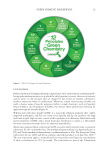
that Green Chemistry14 and its 12 Principles were designed to address. Green Chemistry is
defined as “the utilization of a set of principles that reduce or eliminate the use or generation
of hazardous substances in the design, manufacture, and application of chemical products.”
J. Cosmet. Sci., 76.1, 1–8 (January/February 2025)
*Address all correspondence to Laura R. Muollo and John C. Warner, laura.r.muollo@gmail.com john@
johnwarner.org
The 12 Principles of Green Chemistry in Cosmetic Sciences
LAURA R. MUOLLO AND JOHN C. WARNER
VP Hairprint/True Colors (L.M.), CEO &CTO Technology Greenhouse (J.W.)
Accepted for publication January 28, 2025.
Synopsis
Consumers and regulatory agencies are applying more and more pressure on companies to create technologies
that address issues of health and environmental sustainability. There are many techniques and approaches to
describe, measure, and characterize the health and sustainability of a material or product. Green chemistry
is a mechanistic science that enables the design of products to avoid these issues. This manuscript describes
specific real-world examples utilizing the 12 Principles of Green Chemistry in cosmetic sciences.
INTRODUCTION
Well into the 21st century, consumer-facing companies have recognized the critical need
to address sustainability. The “WHY” is ever present in our culture. Evidence of the
changing climate is ever present.1 Images of plastics accumulating in the environment
are ever present.2 News of biodiversity loss and species extinction is ever present.3 News
of increasing incidents of cancer,4 birth defects,5 childhood asthma,6 and the impact of
endocrine disruptors7 on the human species is ever present. It is unlikely that anyone
today has not heard about and is likely convinced of the WHY we must be concerned
about sustainability. The “WHAT” of sustainability is equally clear. There are multiple
approaches (sadly, often in competition with each other) such as safe and sustainable by
design,8 circular economy9 and circular chemistry,10 planetary boundaries,11 and cradle to
cradle12 are all examples of various ways to characterize issues in sustainability through Life
Cycle Analyses.13 While each is subtly different, these approaches all illustrate various ways
to measure, characterize, and describe beneficial conditions, that we humans should strive
for to accomplish the goals of sustainability. While most efforts focus on the WHYs and
the WHATs of sustainability, stating the urgency of a crisis and providing mechanisms to
measure the crisis, while obviously important, do not offer any mechanism to SOLVE the
crisis. We also need the HOW to address sustainability challenges. This is the unique role
that Green Chemistry14 and its 12 Principles were designed to address. Green Chemistry is
defined as “the utilization of a set of principles that reduce or eliminate the use or generation
of hazardous substances in the design, manufacture, and application of chemical products.”