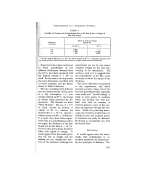
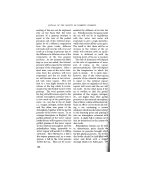
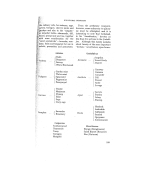
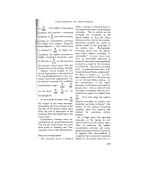
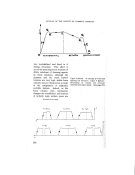
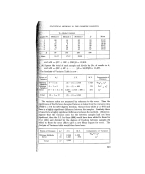
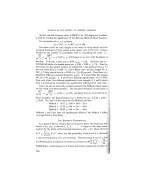
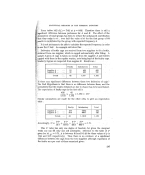
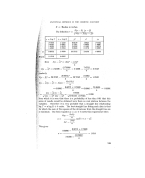
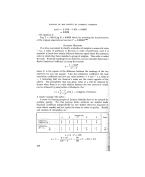
JOURNAL OF THE SOCIETY OF COSMETIC CHEMISTS (In this case the Variance ratio, 1,029/37.2 for 2/15 degrees of freedom, is used for testing the significance of the Between Methods Mean Squares.) - The calculation of (•fi, %L %2 gives ß aft • 33.1, (5 • = 48.7, cr,•' -- 166. The mean result for each sample is the mean'of three results and the standard deviation of those means is the square root of the error variance divided by the number of individuals used in calculating the mean, i.e., -- • •11.03 • • 3.32 based on an error with 10 de•ees of freedom. From the t table at p = 0.05, 1•0 aZ = 2-23. Therefore the p = 0.05 fiducial limits of a sample mean are & 2-23 x 3.32 = & 7-4. Thus the"' true mean for the alcohol content of Sample No. 1 lies between 31.0 • 7.4 per cent at the level 2 = 0-05•i.e., 24 to 38 per centsand for Sample No. 2, 14.0 • 7.4 per cent at level p = 0.05--i.e., 7 to 21 per cent. Thus there is a' significant difference between Samples 1 and 2. It is found that the samples fall into two groups' 1, 4 and 6 not differing significantly, at p = 0.05, from each other, but differing si•ificantly from Samples 2, 3 and 5 which•:•.: form a second group of samples not signiScantly differing from each There can also be found the variation between the Methods whose are the result of 6 determinations. The Standard deviation of each mean eft _ = •5.52 = • 2-35, calculated from an error with 10d.f.?• W6 •6 Thus, as before, the fiducial li•ts at p = 0.05 level, are • 2-23 x 2-35 • 5.24. The limits of the means for the Methods are then' .. Method 1 16-17 + 5-24 -- 10-9 -- 21.4 .• .•*• Method 2 17.70 + 5.24 ---- 12-5 -- 22-9. Method 3 39.33 •c 5.24 •- 34.1 -- 44-6 Methods 1 and 2 are thus nbt significantly different, but Method 3 very significantly from them. - THE BINOMIAL DISTRIBUTION In a game of dice in which n dice are tossed N times, the frequency which a six, say, is thrown 1, 2, 3 ....... n times in the same is given by the terms of the binomial expansion, N(p d- q)•, whose rth ,: ': •i•. • n ! p' q"", where p is the probability of the event (i.e., i is N • throw ng¾• a six) occurring and q of it not occurring. Thus throwing .5 dice at a t•me•:•c• 51 -- i.e. • for 36 times gives a frequency of 5 sixes at one throw of 36 5/ ' 65 0'004a times--and a frequency of 2 sixes and 3 other numbers at one throW' 244

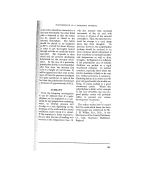
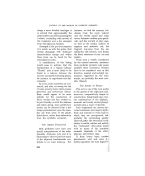
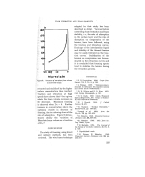
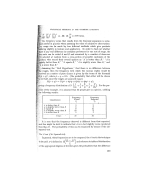
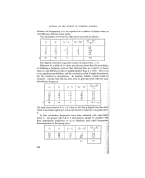
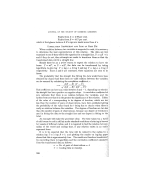
STATISTICAL METHODS IN THE COSMETIC INDUSTRY i.e., 36. 10. 6- • = 5.79 times. frequency series that results from the bim)mial expansion is some- useful in practice when assessing the value of subjective observations. rouge can be made by two different methods which give products slightly in texture and application. In order to find out whether is any real difference in consumer preference for one sort of rouge, the Sorts can be coded A and 23 and examined by a number of observers .'Selected at random from a cross-section of possible customers of the who record their overall opinion as "A is better than B," "A is ightly better than B," "A equals B," "A is slightly worse than B," and is worse than B." ?Assuming the "Null Hypothesis," that there is no difference between rouges, then the frequency with which the various replies would be ,,ived as a matter of pure chance is given by the terms of the binomial + q)', where p = q = 0.5. (The probability that either will be chosen since the rouges are assumed equal.) N(p q- q)* = N(p* q- 4p3q q- 6p•q • q- 4pq' q- (1 i a i ,) giving a frequency distribution of N •-• q- • q- • q- • q- • . For the pur- of the example, it is assumed that 32 people give an opinion, yielding following results: Classification A is better than B A is slightly better than A equals B A is slightly worse than A is worse than B Frequency Found fo Frequency Expected •e 3 6 8 10 5 2 8 12 8 2 Total: ' 32 32 It is seen that the frequency observed is different from that expected, •d•?:!i and this might be held to indicate that A is in fact slightly worse (preferred •/.•?':less) than B. The probability of this can be, examined by means of the chi- !•,ii!" squ area test. ?:,i'• In general, when frequencies are to be compared, the 7: test is the technique :./i•o be used. x•-is defined as • (fo -- f,)• andreferencetotablesofthisfunction ::: at the appropriate degrees of freedom gives the probability that the difference ß 245
Purchased for the exclusive use of nofirst nolast (unknown)
From: SCC Media Library & Resource Center (library.scconline.org)