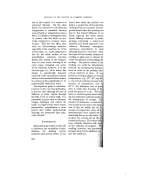
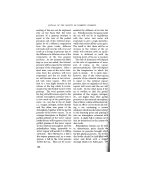
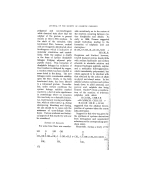
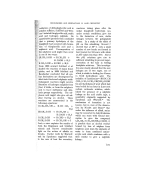
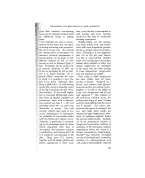
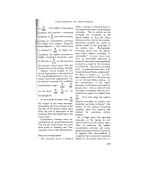
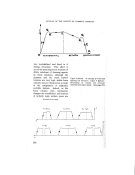
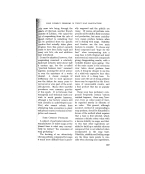
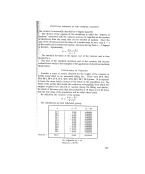
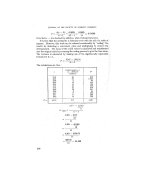
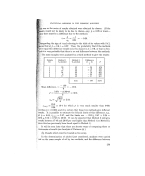
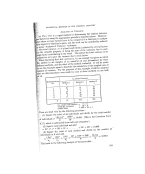
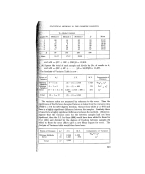
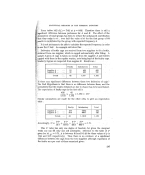
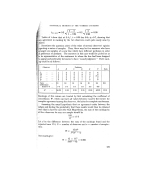
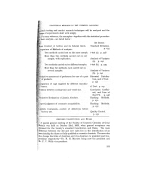
JOURNAL OF THE SOCIETY OF COSMETIC CHEMISTS and b -- 2.1518 -- 1.814 x 0-6925 = 0.8956 ß '. the equation is Log T = 1.814 Log R + 0.8956 which by reversing the transformation of the original observati0nS becomes T -- 0.8956R " RANKING METHODS It is often convenient to classify a selection of samples in numerical order --e.g., a series of perfumes or flayours in order of preference--and it is desirable to know how closely different observers agree about the numerical order in which they have classified a group of samples. This order is called the rank. From the marking by two observers, one can calculate Spearman's Rank Correlation Coefficient (0) using the formula where d ' is the square of the difference between the rankings of the tw ø:::' observers for any one sample. Like the correlation coefficient, the .rank:'. correlation coefficient can have any value between q- 1 and -- 1, a value of -- 1 indicating that'one observer's ranks are the exact opposite of the other's. The probability that any given value of p will be-obtained chance when there is no valid relation between the two observers' results'i.( can be obtained by .using tables of Student's t for t---- p 1 -- p' with_n 2 degrees of freedomß A simple example will suffice: A series of 5 buying samples of Jasmine Absolute have to be'assessed perfume quality. For this purpose dilute solutions are smelled standard conditions independently by two'skilled observers (andward' each other's results) and are ranked by them in order of' quality. and method of calculation are- '"' Sample No. -. _4 B c Observer L 2 - 1 3 4 5 ObserverM ...... 3 2 - . 5 1 4 Difference, ill ' 3/1' -- L, d .... 1 1 2 -- d •, ... 1 1 4 9 1 16 n=5, n *-- 125 6 x 16. 96 -- 1------ 1--0-8=0.2 125 - 5 12o 250

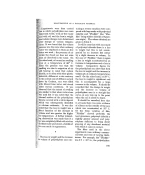
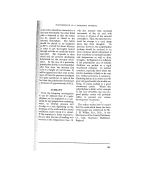
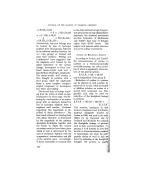
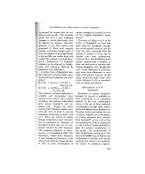
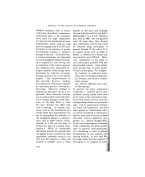
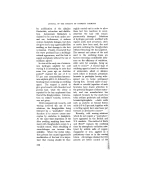
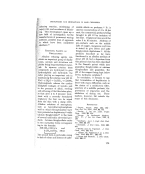
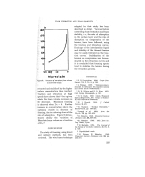
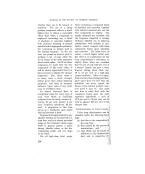
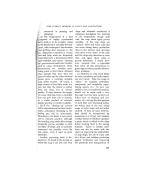
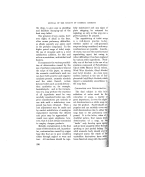
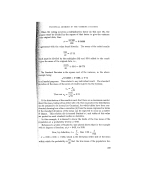
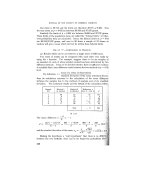
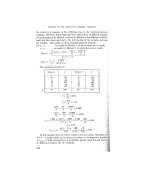
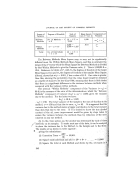
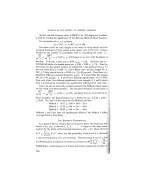
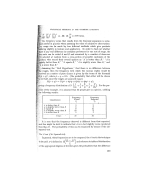
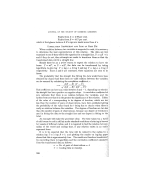
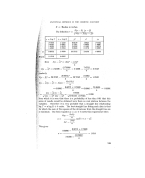
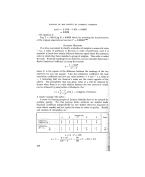
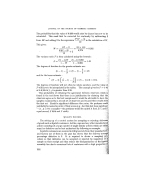
STATISTICAL METHODS IN THE COSMETIC INDUSTRY d 5--2 --0-2d 3 •0-35 t(5.,.,, ,,./.) -- 0-2 1 22 b704 0-96 Tables of t show that at 3 d.f., ! = 0-35 has 0.8100-7, showing that agreement in ranking by the two observers could quite easily arise by ce. Sometimes the question arises of the value of several observers' opinion a series of samples. Thus, there may be five assessors who have ed six samples of a new line which have different perfumes in order preference of perfume. The assessors in this case would be picked so as be representative of the customers to whom the line had been designed appeal and preferably be known to have "sound judgment.'" Their rank- lg could be as follows: :' !'i::' Observer Perfume ::i:: A B C D E F , Sum L ... 1 3 2 5 6 4 M ...... 1 2 3 4 5 6 •:N ...... 2 5 3 5 4 • 6 .P ...... 3 4 6 1 1 2 Q ...... 3 4 2 ! 5 6 Sum ... 10 18 16 16 21 24 I 105 ... Difference :i i:'- from 17.5 ... 7.5 0.5 1.5 1-5 3.5 6.5 -- d 2 ... •6.25 0.25 2.25 2-25 12-25 42-25 117-0 !•?Rankings of this nature are treated by first calculating the coefficient of iiiiiiconcordance, W, which can have all values between 1 and 0, the former for ?fComplete agreement among the observers, the latter for complete randomness. ??.:'i Assuming the.usual hypothesis that no agreement exists between the i?i!::jUdges and finding the probability that these resttits would then be obtained .):•-were that in fact the case (the Null Hypothesis), the sum of the rankings by ? all five observers for any one sample should be •,•:: 105 % -- 17.5 :!i:Let d be the difference between the sum of the rankings found and the :!:':: expected sum 17.5, N -- number of observers and n = number of samples ß i( then • 12.Z'd • , !¾2(•/, a -- }5)' The results give ß '•:: W-- 12 x 117 5'(6 • -- 6) -- 0.268. ' 251
Purchased for the exclusive use of nofirst nolast (unknown)
From: SCC Media Library & Resource Center (library.scconline.org)