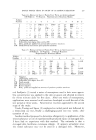
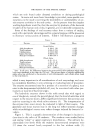
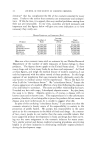
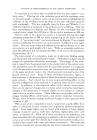
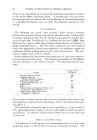
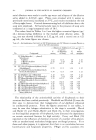
EFFECTS ON CHARACTERISTICS OF SUN SCREEN COMPOUNDS 289 TABLE 1--MODIFIED SUNSCREEN INDEXES, a USING ISOPKOPYL PALMITATE DATA qTl% qTl% Compound .... 0.1 min. ø"'1• C]•%T• b Giv Tan F 9.0 0. 090 2.2% Tinuvin P 5.5 0. 055 3.6% P.A.B.A. 5.2 0. 052 3.8% D.B.R. 4.2 0.042 5.8% Salol 2.5 0. 025 8.0% Benzocaine 2.3 0. 023 8.5% Escalol 106 2.0 0.020 10.0% • The optical density values at 308 m/• for a one per cent solution in isopropyl palmitate column 2 is for a 0.1 min. path length column 3 is for a 0.001 min. (1 micron) path length. b The concentration, pl%T •f '•lu , ,,, a sun screen deposited in a 0.01 mm. (10 micron) layer which is necessary to reduce the intensity of the transmitted light to one per cent of the intensity of the incident light (O.D. = 2.0). 100 - 1% Log % trans - S'I'I• X path length (L3t) X Concn. cl%T 2.0 10• = - 1% S.I.• X 10• and did not exceed 15 microns in the 60 measurements. An aerosol con- taining isopropyl myristate gave similar results. However, the use of a 10 per cent solution of isopropyl myristate in isopropyl alcohol resulted in a mean residual layer of 0.25 to 1.25 microns and the maximum did not exceed 1.25 microns. Table 1, column 3, includes a listing of the sun screen index on the basis of a 0.001 mm. (1.0 micron) path length. The residual film thickness must be determined for each preparation and, indeed, the actual concentra- tion of the sun screen would differ from the initial concentration in the product in relation to the amount of volatiles it contained. The data in column 3 can be used for further computations. Using government specifications allowing only one per cent transmission of the incident light, column 4 lists the residual concentration which must be retained in a deposited layer 10 microns thick in order to reduce the transmitted light to one per cent of the intensity of the incident light. The formula given in the footnote to Table 1 can be used to calculate the concentration required for any film thickness and residual concentration. The thickness of the residual film will be a relatively large variable among individual applications. The water content of the residual film and therefore the concentration of the active constituents may possibly vary with the amount of perspiration. It is important to recognize how much effect these variations may have on the per cent of transmitted light, independent of any change in absorption characteristics due to solvent effects. If the applied cost is only 5.0 microns instead of 10 microns, or if the drug concentration is only 50 per cent of the expected concentration, the amount of transmitted light will increase from 1 per cent to 10.25 per cent. On the other hand, if the vehicle is designed to allow 20 per cent

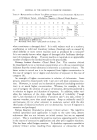
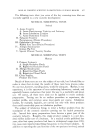
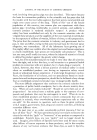
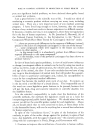
290 JOURNAL OF THE SOCIETY OF COSMETIC CHEMISTS transmitted light, i.e. (-20percent , x-,10/z , a path of $/• or a concentration error of 50 per cent will cause the amount of transmitted light to increase from 20 per cent to approximately 45 per cent. While the per cent change is bigger in the former case, the patient will suffer a great deal more from the effects of the latter. After the residual film has been formed, the active compounds will soon diffuse into the horny layer where it will come into the environment of the surface lipid film. This does not cancel the value of the above calculations, since the optical density in any spectrophotometric measurement is a product of the concentration times the path length. This product will re- main constant, if the solvent effect does not change the specific absorption powers of the sun screen. Therefore, the effectiveness will remain con- stant unless the compound is washed off, decomposed, or is absorbed into the circulating fluids of the body. In 1954, Stambovsky (18) wrote an extensive series of articles wherein he reviewed the factors which he considered important to the develop- ment of a suntan preparation. He criticized the use of a spectrophotometer for the evaluation of sun screen products on technical grounds which are completely wrong, and insisted that the skin erythema response tests are more accurate. However, the disparity of results which might exist be- tween the spectrophotometric data and the results of skin testing can easily be due to a neglect of the effect of the vehicle components on the absorbing properties of the active compound. Properly designed, spectrophotometric tests will always be a more sensitive, a more rapid, and probably a more accurate guide for product evaluation than human testing. The latter can then be reserved for an intensive study of the final formulation. SUMMARY 1. The sun screen effectiveness is profoundly influenced by the addition of different components of a vehicle. The effects of the different additives are unpredictable and must be evaluated by spectrophotometric methods. 2. Since the sun screen is designed to act on the skin as a residual film, the skin surface solvent environment is discussed in relation to the experi- mental data. Isopropyl pahnitate is suggested as a tentative solvent stand- ard upon which to base a modified sun screen index. REFERENCES (1) Petit, E., and Nicholson, S. B., Astrophys. •7., 75, 195 (1933). (2) Moon, P., y. Franklin Inst., 230, 583 (1941). (3) Hauser, K. W., and Vahle, W., Strahlentherapie, 13, 59 (1922). (4) Coblenz, W. W., and Stair, R., y. Res. Natl. Bur. Standards, 12, 14 (1934). (5) Crew, W. H., and Whittle, C. H., 7. Physiol., 93, 335 (1938). (6) Kumler, W. D., and Daniels, T. C., 7. Am. Pharrn..4ssoc., Sci. Ed., 37, 474 (1948). (7) Kumler, W. D., Ibid., 41,492 (1952). (8) Riegelman, S., Allawala, N. A., Hrenoff, M. K., and Strait, L. A., y. Colloid Sci., 13, 208 (1958).
Purchased for the exclusive use of nofirst nolast (unknown)
From: SCC Media Library & Resource Center (library.scconline.org)