PHOTOMICROGRAPHY AND THE PHOTOMICROGRAPHER 647 If the best is to be expected of him, he should be told why he is required to do a certain job. Surely the staff photographer has the right to know the goal of his investigation when studying a sample ? Code numbers or letters in place of a named product or specimen leave one cold I have experienced working with "unnamed material", trying to photograph what the scientists wanted, and with great difficulty battling to produce a record of what to me was the unknown. Any intelligent photographer cannot do his best under a cloud of secrecy, and he should be put in the picture. At one stage during the war I was photographer to a team investigating the cause of air accidents, and whenever I attended a crash and was asked to photograph a certain piece of the remains of an aircraft I was always told the reason for doing so, and this, I always felt, was a splendid incentive and called for my best. After a little experience the photomicrographer will be in a position to assist in the interpretation and application of his results. He should also be in a position to advise on the suitability of a subject and the method of illumination, etc. The highest possible magnification, which is so often requested, is not always the most revealing, and here the photomicrographer is able to advise. It is a help to the person who made the request if he is shown what his request produced. From time to time there is perhaps a tendency to regard the photo- micrographer merely as one who "looks at things", and so, by a few, his work is considered as inferior to quantitive analysis which produce impressive figures. Obviously the man behind the camera/microscope ought to have some knowledge of organic and inorganic materials, physical chemistry and biochemistry, as well as analytical chemistry. If he cannot speak the language of a chemist he must at once familiarize himself with the language in order to become more valuable to the organisation within which he has a part. A medical photographer must be able to talk the same language as the surgeon with whom he works, and if this were not so, confusion would most certainly follow. A certain amount of discreet "advertising" of photomicrography within the company is in order, and in fact desirable, not simply as an excuse for a display of expensive apparatus and impressive instruments, but to make known to all departments the usefulness of this department. Even in these days there are scientists who are not photographically minded, and it is such as these who need to be made aware of this useful tool. If the photomicro- grapher is ignored the final end product could very well suffer. ILLUMINATION When I first took up photomicrography I was told the following: "Be sure you always get the illumination right. Then everything else will fit into its right place and the right results will follow". It is absolutely necessary

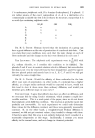
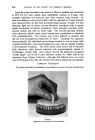
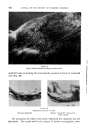
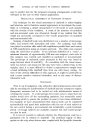
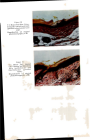
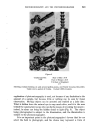
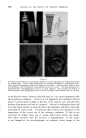
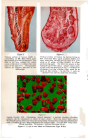
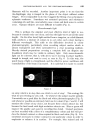
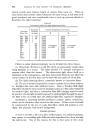
648 JOURNAL OF THE SOCIETY OF COSMETIC CHEMISTS Figure 5 Corrosion on the inside of a pressurized dispenser, lower left taken by method illustrated by dotted lines. Lower right illuminated by method indicated on continuous lines. Here grazed illumination reveals the depth of the effect. High incident light as seen here produces a lot of reflection, demonstrated to all, in colour. The incorporation of a behind-the-lens Iris-diaphragm used at a small aperture, will increase the depth of field necessary when taking shots such as the lower right. Ektachrome Type B cut film. to see that the source, whatever the bulb may be, is in correct alignment with the lamphouse condenser. If this is out of alignment the condenser will not project a pencil beam of light in the line of the optical axis, and therefore uniform illumination will not be obtained. Instead of uniformity there will be colour bands around, or along the side of the specimen, and this is especially noticeable in colour work. I would now like to draw your attention to the importance of the correct use of the substage condenser. If this is not corrected for height, blue, red or orange bands may border the image. This effect increases with the increase of magnification. If the source is not imaged at the iris-diaphragm, an enlarged colour image of the
Purchased for the exclusive use of nofirst nolast (unknown)
From: SCC Media Library & Resource Center (library.scconline.org)