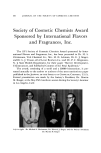
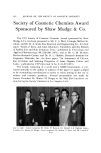
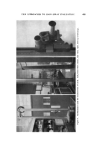
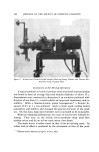
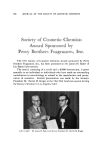
616 JOURNAL OF FHE SOCIETY ()F COSMETIC CHEMISTS Society of Cosmetic Chemists Award Sponsored by Shaw Mudge & Co. The 1971 Society of Cosmetic Chemists .\ward sponsored by Shaw Mudge g: Co. has been presented to Mr. C. S. Weil, Carnegie Mellon In- stitute, and Dr. R. A. Scala, Esso Research and Engineering Co., for their paper "Study of Intra- and Inter-laboratory Variability and the Results of Rabbit Eye and Skin Irritation Tests," published in Toxicology and Applied Pharmacology, 19, 276-360 (1971) and to Mr. C. M. Burnett, Revlon Research Center, and Dr. D. L. Opdyke, Research Institute for Fragrance Materials, Inc., for their paper "An Assessment of Chronic Eye Irritation and Staining Properties of Some Organic Colors and Lakes," published in CTFA Journal, 3, No. 2, 18-22 (1971). The award, consisting of a scroll and a $1000 honorarium, is pre- sented annually to the author or authors of the paper or papers judged to be outstanding contributions to safety or safety testing in the use of toiletry and cosmetic products. Forlnal presentation was made by Society President Dr. Martin M. Rieger at the May 25th lunche(m ses- sion during the Society's Seminar at I.os Angeles, Calif. • - : '3' . ." ? ::., , •, :. . • , .• •':', : ...•? :: • .." .. • . . Lelt to right: Award recipients Mr. Clyde M. Burnett, Dr. Donald L. J. Opdyke, Societ} President Dr. Martin M. Ricgcr, Award recipients Dr. Robert A. Scala, and Mr. Carroll S. Wcil

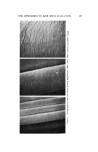
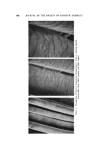
J. Soc. Cosmet. Chem., 23, 617-636 (September 14, 1972) Scanning Electron Microscopy and Other New Approaches to Hair Spray Evaluation RANDALL P. AYER, Ph.D., and JAMES A. THOMPSON, Ph.D. s Presented April 5, 1972, be[ore the New York Chapter Synopsis--The SCANNING ELECTRON MICRO•'COPE and its utility for studying HAIR SPRAY k-ILMS are described. The scanning electron microscope is an invaluable tool for studying the COATABILITY of hair spray films on individual or small groups of hair libors. Coatability can be improved by addition of certain SURFACTANTS to hair spray formulations and can be correlated qualitatively to hair spray properties such as luster, ap- I•earance, and flaking. Coatability does not correlate well with curl retention, another important property of hair sprays, which is much more dependent on the physical properties of the resin. Previ- ous methods for evaluating curl retention were inadequate therefore, a STATISTICAL APPROACH was developed. The method described is reliable, conclusions can be validated with a high degree of confidence and with these benefits, formulations can be optimized. INTRODUCTION Hair sprays have exhibited a remarkable growth over the 22 years they have been marketed. During 1971, the 500 million units sold represented about 20•o of the entire aerosol market. Part of the reason for the continued acceptance of hair sprays has been overall product improvement made possible through development of new resins. Another important factor has been selection of plasticizers and other additives to complement the resin's performance and appearance on women's, and more recently on men's, hair. "Freon" Products Laboratory, E. I. du Pont de Nemours 8c Co., '•Vilmington, Del. 19898. 617
Purchased for the exclusive use of nofirst nolast (unknown)
From: SCC Media Library & Resource Center (library.scconline.org)