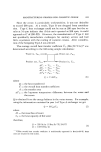
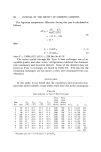
636 JOURNAL OF THE SOCIETY OF COSMETIC CHEMISTS tention measurements, Dr. Ronald D. Snee of the Engineering Depart- ment's Engineering Service Division for consultation on the statistical design of the curl retention experiments and the statistical analysis of the results, and Mr. Chester E. Shatrat of the Organic Chemicals De- partment's Jackson Laboratory for discussions concerning the operation of the scanning electron microscope. (Received April 10, 1972) REFERENCES (1) Root, M. J., Hair spray--future?, Amer. Per/urn. Cosmet., 86 (10), 39-41 (1971). (2) Shansky, A., Polymeric substances in hair spray film-forming compositions, Ibid., 83 (5), 31-5 (1968). (3) Eriemann, G. A., Objective and subjective methods for the evaluation of hairsprays, J. Soc. Cosmet. Chem., 22• 287-302 (1971). (4) Micchelli, A. L., and Koehler, F. T., Polymer properties influencing curl retention at high humidity, Ibid., 19, 863-80 (1968). (5) Root, M. J., and Bohac, S., Hygroscopicity and hardness of hair spray resins at varying humidities, Ibid., 17, 595-605 (1966). (6) Brookins, M. G., The action of hair sprays on hair, Ibid., 16• 309-15 (1965). (7) Reed, A. B., Jr., and Bronfein, I., Curl retention with hair sprays, Drug Cosmet. Ind., 94, 178 (1964). (8) Performance testing of aerosol hair sprays, Aerosol Age, 7, 26 (1962). (9) Grande, J., New Concepts in Hair Products and Evaluation Procedures (Humidity Stability and Hair Characteristics), General Anilene and Films Co. Brochure, New York, N.Y. (10) Princen, L. H., and Baker, F. L., New tool for coatings study, Paint Varn. Prod., 61, 21-9 (1971). (11) Black, J. T., SEM: scanning electron microscope, photographic applications in science, Technol. Med., 4 (16), 29 (1970). (12) Swift, J. A., New developments in electron microscopy, ]. Soc. Cosmet. Chem., 22, 477-86 (1971). (13) Johari, O., The scanning electron microscope--its operation and use, Metat Progr., 94, 147-50 (1968). (14) Takada, S., Possibilities of improving the quality of hair spray, Aerosol Rep., II, 12-25 (1972).

J. •5'oc. Cosmet. Chem., 23, 637-655 (September 14, 1972) The Design of a Continuous Manu- facturing Process for an Oil-in-Water Cosmetic Cream N. PHILIP REDMOND, B.S., and PAUL W. HALTENBERGER, B.S.* Presented December 13, 1971, New York City Synopsis--An important factor in the decision to consider the CONTINUOUS MANU- FACTURE of a COSMETIC CREAM is product volume or demand. The particular cos- roetic cream which is the subject of this discussion meets this requirement. In arriving at a final PROCESS DE•CIGN and selection of EQUIPMENT, emphasis is placed upon: (a) the determination of the basic chemistry responsible for the stability and characteristic con- sistency identified with the product under study, and (b) the determination of the relative importance of process and ingredient variations. Calorimetry and fractional factorial de- signed experiments conducted to study emulsification and crystallization behavior are de- scribed. Results lead to the conclusion that the fatty acid soap and fatty acid complexes present in the emulsion play an important role in determining product consistency and stability while moderate variations in other components have little or no effect. The types of equipment and process designs considered for the continuous process study are dis- cussed, including results of actual pilot-scale experiments. INTRODUCTION Cosmetic creams such as hand creams, facial creams, skin creams, and others have traditionally been manufactured by the "batch" pro- cess. The most popular creams produced by this metohd today are emul- sions of the oil-in-water type (O/W) and will generally be found to con- tain emulsifying agents either of the anionic or nonionic types, or pos- sibly both. This study was concerned with a cosmetic cream of the O/W type containing an anionic surface active agent (1), specifically, an ammonium soap of a straight chain fatty acid. Further, this soap is * Noxell Corp., 11050 York Road, Baltimore, Md. 21203. 637
Purchased for the exclusive use of nofirst nolast (unknown)
From: SCC Media Library & Resource Center (library.scconline.org)