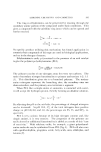
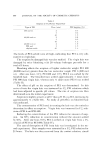
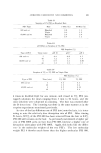
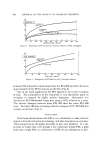
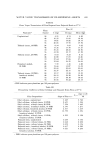
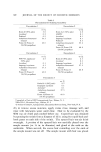
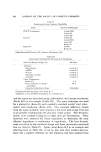
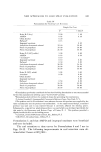
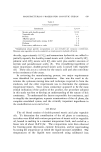
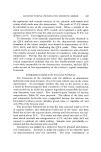
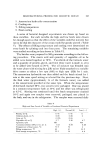
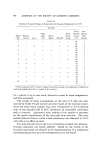
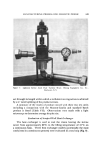
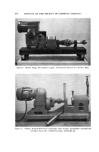
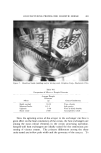
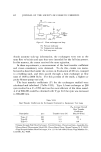
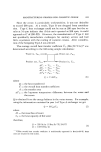
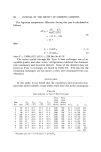
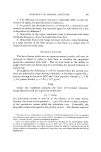
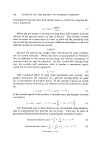
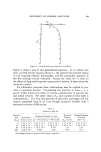
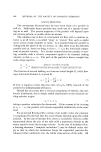
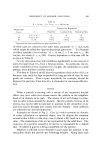
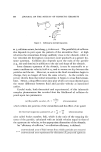
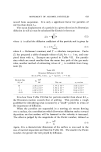
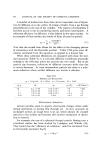
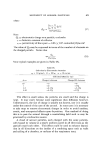
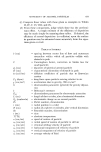
654 JOURNAL OF THE SOCIETY OF COSMETIC CHEMISTS The log-mean temperature difference during this pass is calculated as follows: ATa -- ATb A Tlm -- ln(/X Td/X Tb) = --21.3/--0.26 = 81.9 (4) then Q = UAAT•,,, (1, 5) U = Q/A/XT•m (6) thus U -- 13094/(0.7) (81.9) --- 228 Btu/hr-ft"øF. The cream cooled through the Type A heat exchanger was of ac- ceptable quality and after 4 days' refrigeration exhibited the character- istic consistency and structure desired. Some of the detailed data col- lected on Type A exchanger are found in Table IX. The data for the remaining exchangers are not shown as they were eliminated from con- sideration. CONCLUSION In this study, it was found that the consistency and structural char- acteristics of the cosmetic cream under study were due to the ammonium Table IX Data Collected on Type A a Heat Exchanger Flow Flow Rate Rate Pass Pvln T•,out Trout T•,in Prod. Water No. rpm (øC) (øC) (øC) (øC) (lb/hr) (lb/hr) 3T•,• q• Uw 1 88 65.3 25.7 63.3 11.9 2580 528 2 88 63.3 30.5 61.7 11.8 2580 528 3 88 61.7 24.3 60.5 11.8 2580 528 3' 200 61.7 25.4 54.4 11.8 2580 528 4 200 58.9 24.6 53.9 11.7 2580 528 5 200 56.7 24.0 53.3 12.0 2580 528 6 200 55 23.3 53.9 12.3 2580 525 7 200 51.7 22.1 47.8 12.2 2352 523 8 200 45.0 18.9 42.2 12.4 2352 528 9 200 41.7 14.4 39.4 12.3 2352 528 81 73 76 70 67 8 66 2 64 1 58 3 50.3 48.9 9 13,094 228 3 17,846 348 9 11,928 221 9 12,488 261 12,302 259 11,457 247 10,401 232 9,398 230 6,126 173 2,006 58.6 Ave 225 Transfer area (A) = 0.7 ft 2 and U = Q/AATg,•

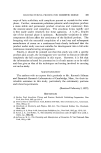
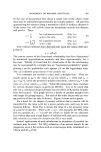
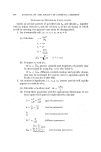
MANUFACTURING PROCESS FOR COSMETIC CREAM 655 soaps of fatty acids:fatty acid complexes present as crystals in the water phase. Further, ammonium palmitate:palmitic acid complexes produce a more stable and permanent product structure and consistency than the stearate:stearic acid complexes. The emulsion forms rapidly and is best made under relatively low shear agitation. A 5-10 t• droplet size of the internal phase is optimum. Reasonable variations in other components did not affect the consistency of the finished product. The foregoing with the successful completion of a test loop and subsequent manufacture of cream on a continuous basis clearly indicated that the product under study was most suitable for development into a full-scale continuous manufacturing arrangement. Finally, it should be pointed out that this study was with a specific product and, as such, the investigators were not free to discuss or identify completely the full composition in this report. However, it is felt that the information selected for presentation is of such nature as to be valid and does give an idea of the techniques and testing involved in carrying out such a study. ACKNOWLEDGMENT The authors wish to express their gratitude to Mr. Kenneth Sidman and Dynatech Research Laboratories of Cambridge, Mass., for their in- valuable assistance in this study, particularly the calorimetry portions and related experiments. (Received February 3, 1972) REFERENCES (1) Becher, Paul, Emulsions Theory and Practice, Reinhold Publishing Corporation, New York, New York, 1965, pp. 212-4. (2) Emersol Stearic and Palraitic Acids, Bulletin EM-õ52C, Emery Industries, Inc., Cincinnati, Ohio, 1967, p. 17. (3) Handboob of Chemistry and Physics, 49th Ed., The Chemical Rubber Co., Cleveland, Ohio, 1968. (4) MarkIcy, K. S., Fatty Acids, Interscience Publishers, Inc., New York, 1947, pp. 117-9, 124. (5) Kench, J. E., and Malkin, T., The instability of ammonium salts of higher fatty acids, J. Che•n. Soc., 1959, 230. (6) deNavarre, M. G., The Chemistry and Manufacture of Cosmetics, D. Van Nostrand, New York, 1941, p. 246.
Purchased for the exclusive use of nofirst nolast (unknown)
From: SCC Media Library & Resource Center (library.scconline.org)