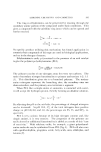
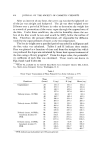
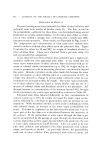
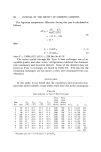
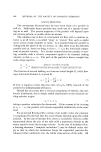
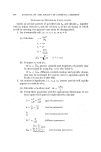
664 JOURNAL OF THE SOCIETY OF COSMETIC CHEMISTS Gravity Deposition The movements discussed thus far have been those of a particle in still air. Sufficiently heavy particles may settle out of a stream of mov- ing air as well. The precise trajectory of the particle will depend upon the velocity pattern, or profile, of the air stream. The simplest case is that of a horizontal air flow with a uniform ve- locity v0 at all levels, a so-called "plug" or "piston" flow such as might occur across a large chamber or room. It is assumed that the particle is riding with the speed of the air stream, i.e., that there is no slip between particle and air, hence no drag, so that ux --- v0 is the horizontal compo- nent of particle velocity. It is further assumed that the particle is mov- ing vertically with a velocity component equal to its terminal settling velocity, so that uv = u•. The path of the particle is then a straight line with a slope equal to: u v u8 distance traveled vertically ux v0 distance traveled horizontally, in same period of time The fraction of aerosol settling out from an ini,tial height R, while flow- ing a horizontal distance L, is given by u8 L grL V - voR - voR - G (7) If R/L is equal to or less than the ratio of u•/vo, 100% removal of the particles by sedimentation will occur. Should the air stream have a vertical component of velocity, also uni- formly distributed, this is simply added algebraically to the terminal set- tling velocity, to give u•=us+v• (8) taking a positive velocity to be downward. If the current of air is rising at v v = --u•, the particle will remain suspended indefinitely at the same level. For an aerosol flowing with a stream of air inside a tube, the situation is complicated by the fact that the axial velocity depends upon the radial position. In the case of laminar flow, there is a parabolic velocity profile symmetrical about the axis of the tube with a maximum velocity-at the center equal to twice the average velocity. In the case of turbulent flow, a limiting situation ("complete turbulence") may be defined rather sim- ply as that in which the turbulence keeps the suspended particles dis- tributed rather uniformly over the whole cross section of the tube. All

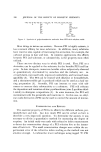
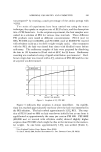
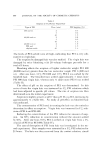
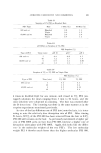
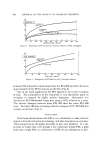
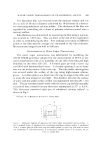
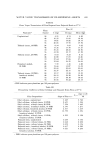
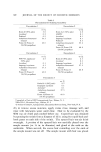
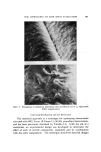
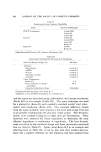
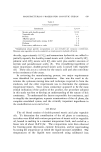
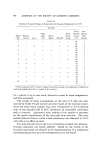
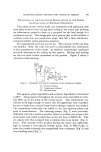
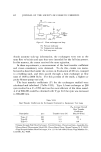
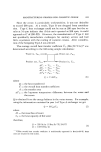
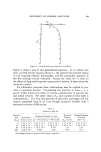
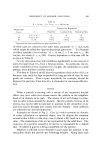
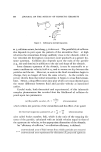
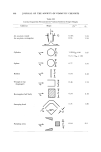
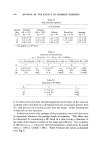
MOVEMENT OF AEROSOL PAR•IICLES Table II R = 1• cm L = 5 cm v0 = 100 cm/sec 665 Particle Size Removal by Deposition s (dr, t•) G Plug Flow Laminar Flow Turbulent Flow 1 3.47 X 10 10 3.02 X 10 -2 •3% •-•1% •-•2% 50 0.755 •-•75 % •-•41% ,--•38% • Equations for these calculations are given by Fuchs (4). of these cases are related to the same basic parameter G --- (u•L/voR) which might be called the "gravity deposition parameter." To illustrate its effect, consider a set of values: R • « cm, L -- 5 cm, and v0 = 100 cm/sec, for which G = u•/100. Gravity deposition in this case will be as given in Table II. Gravity deposition thus will contribute significantly to the removal of particles larger than 10 g from a flowing stream. In particular, the ex- ample conditions chosen represent very roughly the conditions in a nasal passage, when the flow would be laminar. The data in Tables I and II show that particles of the order of 10 g in diameter may easily be kept suspended for long periods of time by very gentle air currents. Thus a space insecticide, for example, should be dispersed in particles of less than 50 g in diameter for maximum effective- ness. Inertia When a particle is moving with a stream of air, important inertial effects may arise when that stream carries the particle in the neighbor- hood of an obstacle in its path. The stream of air will change its direc- tion in order to flow around the obstacle. But the particle, because of its inertia, may not be able to maintain its position in the streamline of air and thus may be brought into contact with the obstacle. Such collisions are referred to as "inertial impaction." Examples are shown in Fig. 2. Case (a) would represent an obstacle ot• either cylindrical or spherical shape case (b) depicts the situation around either a disk or a flat strip case (c) shows a 90 ø bend in a pipe or tube. The streamlines of the air are represented by the solid lines. The trajectory of a particle, caused by its inertia, is represented by a dashed line. N o effect of gravity is being considered, for the present. Whether a collision occurs depends in part upon the position of the streamline which the particle was following initially. Along lines such
Purchased for the exclusive use of nofirst nolast (unknown)
From: SCC Media Library & Resource Center (library.scconline.org)