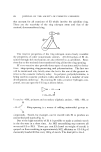
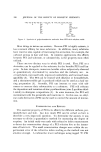
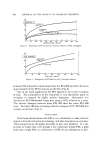
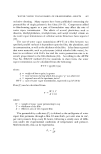
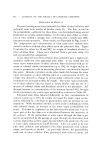
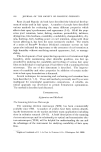
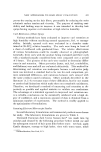
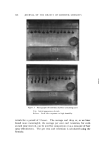
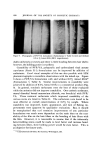
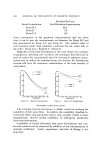
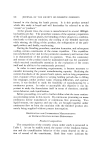
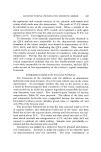
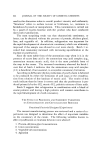
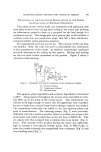
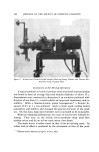
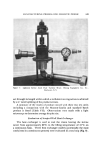
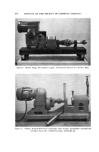
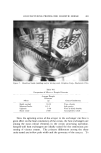
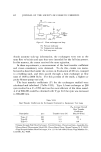
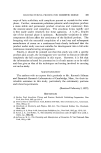
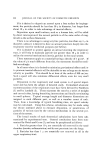
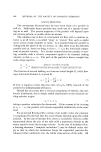
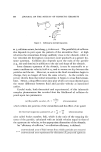
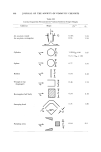
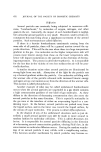
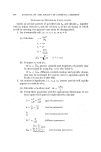
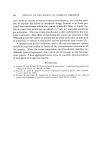
666 JOURNAL OF THE SOCIETY OF COSMETIC CHEMISTS Vo •.ff (b} (o } Figure 2. Collision by inertial impaction as & collision occurs, but along •2 it does not. The possibility of collision also depends in part upon the pattern of the streamline flow: at high velocities the'streamlines diverge suddenly close to the obstacle, while at low velocities the divergence commences more gradually at a greater dis- tance upstream. Collision also depends upon the mass of the particle (e.g., size and density) in addition to the size and shape of the obstacle. Some distance upstream of the obstacle, it may be reasonable to as- sume a uniform air velocity field at v0, and to assume no slip between the particles and the air. However, as soon as the fluid streamlines begin to diverge, they no longer all have the same velocity. As the particle tra- jectory diverts from the initial streamline, it begins to cross fluid stream- lines. Hence, a drag effect comes into play which now must depend upon the vector difference between fluid and particle velocity as mentioned earlier. Careful study, both theoretical and experimental, of this inherently complex phenomenon has revealed that the likelihood of collision de- pends upon two parameters: voDps (a) Reynold's number, Re - (dimensionless) which reflects the patterns of the streamlines and the effect of air speed X s II oT (b) Inertial impaction parameter, • - D - D (dimensionless) (also called Stokes number, Stk), which is the ratio of the stopping dis- tance of the particle, calculated with an initial velocity equal to that of the upstream air velocity, to the appropriate dimension of the obstacle. An "efficiency of collision," or collection efficiency, is defined: cross-sectional area of fluid stream from which particles are removed cross-sectional area represented by dimension D, projected upstream

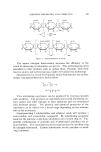
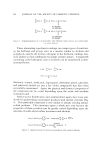
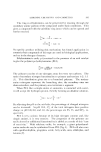
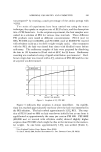
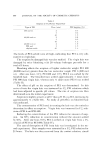
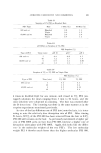
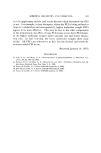
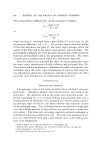
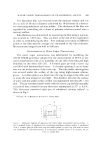
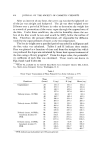
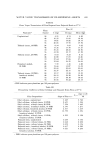
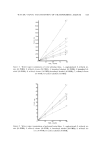
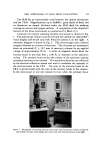
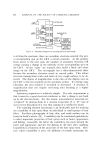
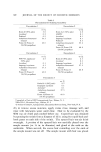
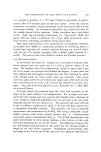
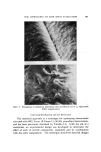
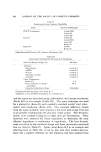
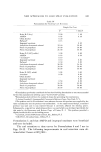
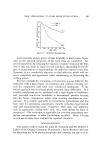
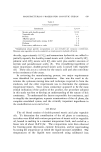
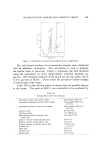
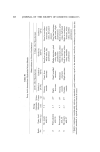
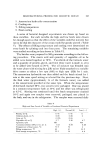
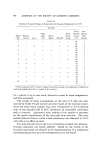
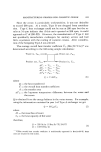
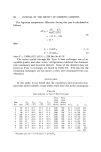
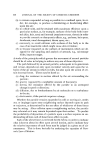
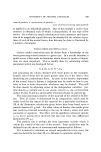
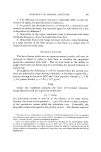
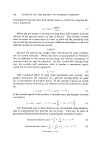
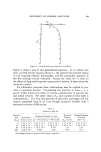
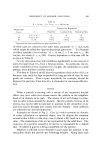
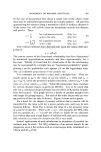
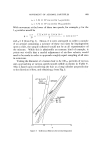
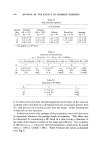
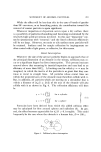
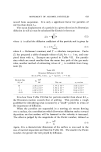
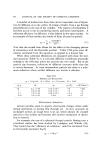
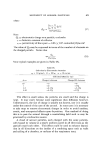
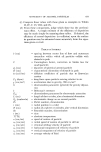
MOVEMENT OF AEROSOL PARTICLES 667 In the case of symmetrical flow about a center line ot5 the object, these areas may be represented geometrically in a simple manner. All particles approaching the obstacle along a streamline which is within a distance b of the center line will collide those on streamlines outside this distance will pass by. Thus: b for a cylindrical obstacle, (Fig. 2,a) v - D or for a flat strip (Fig. 2,b) (9) (•)2 for a spherical obstacle, (Fig. 2,a) • = or for a disk (Fig. 2,b) (10) The evidence indicates that ,• depends only upon the values of _Re and ½, that is: • = •q(Re,•) The precise nature of this functional relationship has been determined by numerical approximation methods, and also experimentally, for a few cases. Whitby (5) found that for a fixed value of _Re, the relationship may be represented by a straight line on "log-normal probability" graph, __ plotting ,• on the probability scale against X/q• on the logarithmic scale. _ The X/½ is directly proportional to the particle size. Two constants are needed to place such a straight line. They are -- usually given as •ul/2, the value of X/q• for which ,• -- 0.50, and • -- (•841/2/•ul/•), called the geometric standard deviation, wherein •841/• is the value ol• X/• for which 't -- 0.84. Table III summarizes these numbers for various obstacle shapes, as given by Whitby. It is to be noted that only for a cylindrical shaped obstacle has the effect of Reynolds number been determined: The graph will be a family of parallel straight lines with larger Re giving larger ,•. For each of the other shapes only an aver- age position of the line may be drawn. Figure $ shows such a graph. For a fixed Re, the degree of particle collision due to inertia will be controlled by the ratio void for a given particle size, and may be esti- mated as follows. From Fig. $, obtain the value of ½ for whatever value of • may be of interest. Then vo/D -- q,/r. For example, for 99% colli- sion by particles of p _-• 1 g/cm a the values in Table IV are obtained. It is evident that such a high degree of collision will only occur at reason- able velocities (v0) when the obstacle size (D) is very small. Several applications of such calculations to situations of practical im- portance may be cited. For 99% collection of an aerosol sample by im- pingement ur)on a flat surface such as a microscope slide, considered as a ribbon with D __-- 2 cm:
Purchased for the exclusive use of nofirst nolast (unknown)
From: SCC Media Library & Resource Center (library.scconline.org)