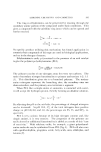
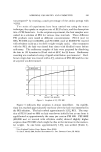
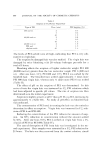
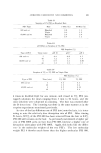
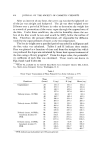
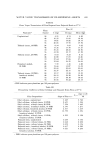
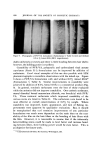
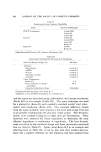
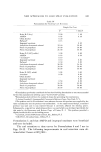
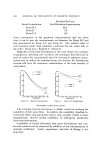
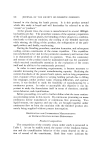
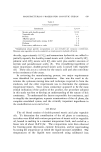
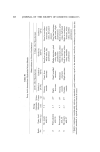
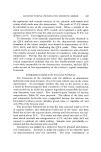
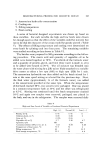
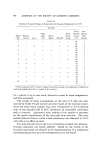
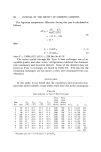
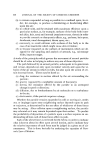
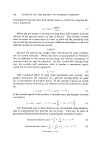
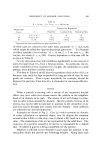
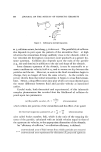
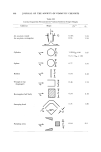
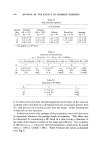
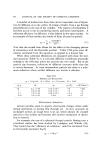
67O JOURNAL OF THE SOCIETY OF COSMETIC CHEMISTS Table IV 99% Inertial Impaction voiD, Seconds Particle Cylinder Cylinder Size (Re = 0.2) (Re = 100) ø Ribbon Round Jet Impinger (d•,, ix) •b99 = 16 •bg• = 9 •b• = 22 •b•9 = 0.36 •p• = 9 1 4.52 X 10⁶ 2.54 X 10⁶ 6.21 X 10⁶ 1.02 X 10⁵ 1.13 X 10 10 5.19 X 10⁴ 2.92 X 10⁴ 7.14 X 10⁴ 1.17 X 10 s 1.30 X 10 50 2.08 X 10 a 1.17 X 10 a 2.86 X 10 a 46.7 5.19 X 10 Also applies to a 90 ø bend. Table V Impaction on Human Hair p• = 1.0g/cma D = 100n Re = 0.0662v0 v0 = 10 cm/sec Re = 0.66 v0 = 100 cm/secRe = 6.62 v0 = 1000 cm/sec Re = 66.2 1 l0 5O 3.54 X 10 -a ,'-•0 3.54 X 10 -• ,-¾0 3.54 X 3.08 X 10-' 5% 3.08 •-•80% 30.8 •-•100% 7.70 90% 77.0 •-dO0 % 770 •-d O0 % Table VI Impaction in 90ø-Bend 1 1.77 X 10 -a 10 1.54 X 10 -• -•18% 50 3.85 •96% It is evident from this how inertial impaction on the hairs in the nose, for example, will contribute to a substantial removal of particles greater than 10 t, and prevent their being carried into the lungs. Other mechanisms of removal are also operative. Further removal in the passages of the respiratory tract will also occur by impaction whenever the passage bends or branches. This effect may be illustrated by considering a 90ø-bend in a tube having a diameter of the order of the smaller bronchi of the lungs (say 0.20 cm). For a velocity of 100 cm/sec, pp -- 1.0 g/cm a, inertial impactions would occur in accord with q• z (100 X •-/0.20) • 500 •-. Table VI shows the values as obtained from Fig. 3.

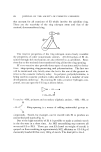
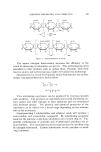
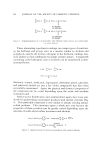
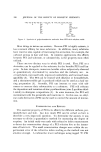
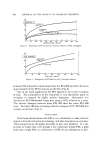
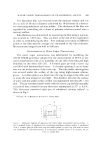
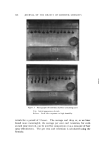
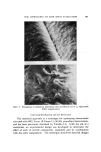
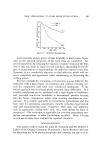
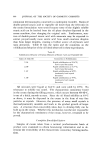
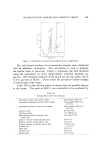
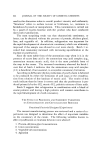
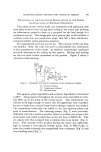
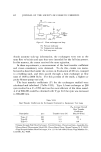
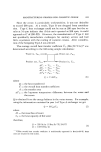
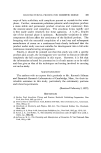
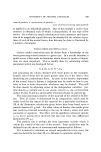
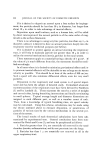
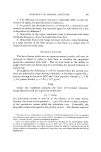
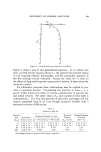
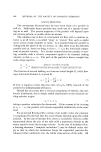
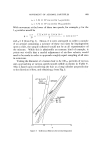
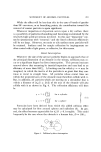
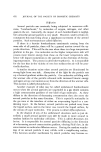
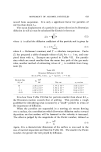
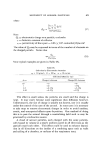
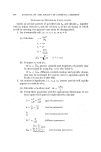
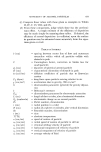
MOVEMENT OF AEROSOL PARTICLES 671 While the effect will be less than this in the case of bends of gentler than 90ø-curvature, or at branching points, the contribution toward the removal of coarser particles is again significant. Whenever impaction or deposition occurs upon a dry surface, there is a possibility of particles rebounding and becoming re-entrained by the relatively high speed air streams involved. In this case "impaction" can- not be synonymous with "removal," and the listed collection efficiencies will be too large. However, on moist or oily surfaces most particles will be retained. Surfaces used for sample collection by impingement are often coated with a light grease, or adhesive, for this reason. Direct In tercep tion Whenever the size of the aerosol particles begins to approach that of the principal dimension of an obstacle in the stream, collisions may oc- cur to a significant degree by direct interception. This process increases removal above that occurring by inertial impaction and may lead to an efficiency of more than 100%. A limiting case for which f -- oo may be imagined, in which the inertia of the particles is so great that they con- tinue to travel in straight lines. All particles whose center lines are within the projected area of the obstacle must therefore collide with it. But, in addition, all particles which are moving on a streamline that is within a distance of (dp/2 -+- D/2) of the axis of the obstacle will also collide with it as shown in Fig. 4. The collection efficiency will then be r/ = 1 d- (•) for a cylinder r/ = 1 d- for a sphere (1t) Formulas have been derived from which this added collision effect may be calculated for flow around spheres and cylinders (6). In gen- eral, the effect becomes appreciable for dp/D 0.1 roughly. This could frequently be the case where the obstacle is a human hair, D • 100 •. Figure 4. Collision by direct interception
Purchased for the exclusive use of nofirst nolast (unknown)
From: SCC Media Library & Resource Center (library.scconline.org)