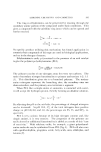
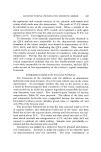
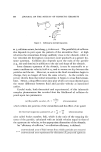
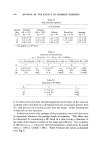
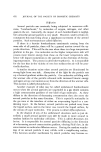
672 JOURNAL OF THE SOCIETY OF COSMETIC CHEMISTS Diffusion Aerosol particles are constantly being subjected to numerous colli- sions, "bombardment," by molecules of oxygen, nitrogen, and other gases in the air. Generally, the impact of such bombardment is negligi- ble unless the aerosol particle is very small. However, under certain cir- cumstances this may bring about a significant movement of the aerosol particles. Such movements are called diffusion. If there is a heavier bombardment consisten.tly coming from the same side of all particles, there will be a general motion toward the op- posite direction. This will be the case when there is a large temperature gradient in the gas. Gas molecules on the higher temperature side will possess more kinetic energy than those on the lower temperature side, hence will impart momentum to the particle in the direction of decreas- ing temperature. The process is called thermophoresis. It is responsible for the fact that in the vicinity of very hot surfaces the air will be prac- tically dust-free. A similar situation exists when aerosol particles are illuminated by strong light from one side. Absorption of the light by the particle sets up a thermal gradient within the particle. Gas molecules colliding with the warmer side of the particle rebound with increased kinetic energy and again set up a net motion away from the direction of the warmer side. This motion is called photophoresis. Another example of what may be called unbalanced bombardment occurs when the aerosol particles are suspended in a gas which contains a high concentration gradient of one kind of gas molecules. As these diffuse in the direction of decreasing concentration they also move the aerosol particles in the same direction. This is especially noticeable in the gas zone at the interface of either an evaporating liquid or a con- densing vapor. In the former, aerosol particles are pushed away from the liquid surface, and in the latter case toward the liquid surface, by the stream of vapor molecules. The process is called dil•usiophoresis. In the absence of any of the unbalanced situations such as just de- scribed, a small aerosol particle may still be made to move around in random fashion by molecular collisions. This is called Brownian di[- [usion. It is responsible for aerosol particles diffusing in the direction of a decreasing aerosol concentration gradient, obeying Fick's law, in the same manner as molecular diffusion occurs. During the random wander- ings of an aerosol particle it may collide with a neighboring surface. This becomes another mechanism by which particles may become re-

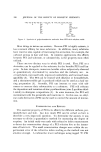
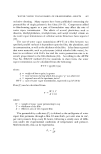
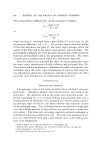
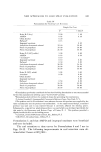
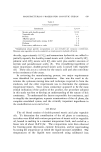
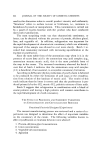
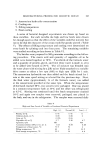
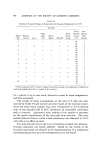
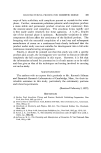
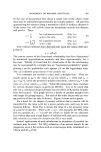
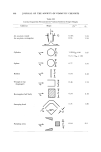
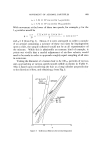
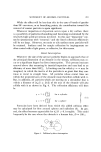
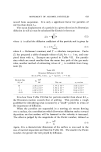
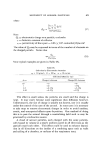
MOVEMENT OF AEROSOL PARTICLES 673 tnoved from suspension. It is only a significant factor for particles of size less than about 1 v. : The mean displacement of a particle in a given direction by Brownfan diffusion in still air may be calculated by Einstein's theory as AxB = i•:Dt (12) where f) is called the diffusion coefficient of the particle and is given by C = (13) where k: Boltzman's constant, and T = absolute temperature. Fuchs (7_) has prepared a table of sample values of •xx, for t = 1 sec, and com- phred them with us. Excerpts are quoted in Table VII. For particle sizes which are much smaller than the mean free path of the gas mole- cules, another method of estimating values of .• is available from Lang- muir (8). Table VII Brownfan Diffusion in Still Air Air at23øC, 1 atm p• = 1 g/cma t = 1 sec Particle Size •D, cm• __ (d v, la) sec AxB, sec u,, cm/sec 10 2.38 X 10 -8 1.74 X 10 -4 3.02 X 10 -2 1 2.74 X 10 -7 5.90 X 10 -4 3.47 X 10 -a 0.1 6.82 X 10 -6 2.95 X 10 -a 8.64 X 10-a 0.01 5.24 X 10 -4 2.58 X 10 -• 6.63 X 10 -6 It is clear from Table VII that for particles smaller than about 0.5 p, the Brownfan motion exceeds that of settling. This provides a rough guideline for identifying what is meant by a "small" particle in terms of the importance of diffusion. When the particles are suspended in a moving air stream flowing over a surface, the contribution which Brownfan diffusion makes toward deposition on that surface will be lessened as the velocity is increased. The effect is judged by the magnitude of the Peclet number, defined as voD (14) Again, D is a characteristic dimension of the surface as was used in the case of inertial impaction and listed in Table III. The smaller the Peclet number, the greater the role played by diffusion.
Purchased for the exclusive use of nofirst nolast (unknown)
From: SCC Media Library & Resource Center (library.scconline.org)