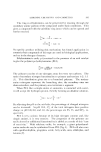
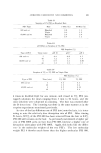
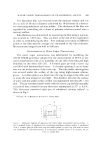
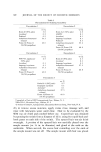
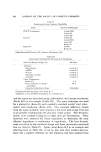
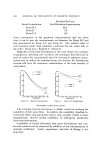
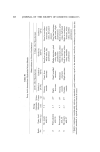
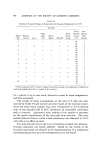
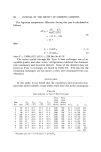
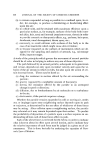
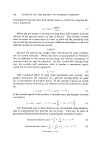
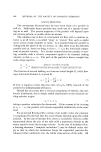
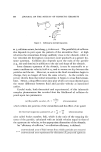
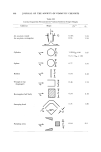
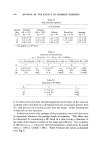
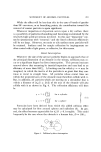
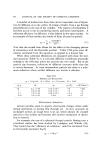
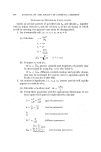
674 JOURNAL OF THE SOCIETY OF COSMETIC CHEMISTS A number of studies have been done on the important case of deposi- tion by diffusion on to the surface of a large cylinder, from a gas flowing perpendicular to the axis of the cylinder. The pattern of streamlines is involved just as it was in considering inertia and direct interception. A collection efficiency, by diffusion, is also defined in the same manner. As an example of these studies, the results of Ranz (9) may be quoted: 1 0.55•rRe 1/6 Note that the second term allows for the effect of the changing pattern of streamlines with the Reynolds number. Table VIII gives some effi- ciencies calculated •rom this equation, as applied to a human hair. When these collection efficiencies are compared with those for iner- tial impaction (Table V), it is seen that diffusion contributes practically nothing to the collection unless the particles are very small. But as the particle size decreases, collection by diffusion increases while that due to inertia decreases. At some intermediate particle size there is a mini- mum collection where neither diffusion nor inertia is effective. Table VIII Diffusion onto Human Hair Pv -- 1.0g/cm3 D = 100/z v0 = 10cm/sec Re = 0.662 d v, tz Pe •D •z• (%) • (% Table V) 10 4.2 X 10⁶ 0.63 X 10 -4 --•0 ,'-•5% 1 3.65 X 10⁵ 0.32 X 10 -3 •0 -,•0 0.1 1.47 X 10⁴ 0.28 X 10 -2 •0.3 ,--•0 0.01 1.85 X 10² 0.065 •6.5 ,'--'0 Electrostatic Attraction Aerosol particles seem to acquire electrostatic charges rather easily during generation or during flow through air. As they approach an uncharged surface, an image force is set up, which attracts the charged particles to the surface and becomes still another mechanism of deposi- tion or removal. For example, the case of a spherical charged particle flowing near a cylindrical surface has been studied by Lundgren and Whitby (10). They found that the "efficiency of collection" could be calculated from an electrostatic parameter K• by •/• = 1.5K•1/• (16)

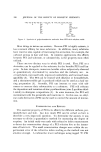
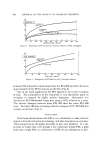
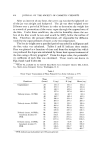
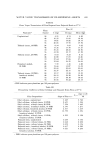
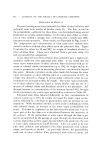
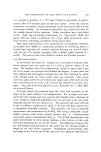
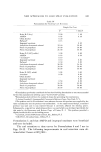
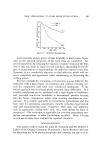
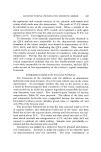
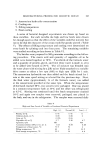
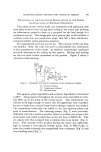
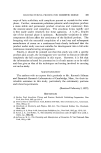
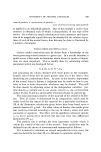
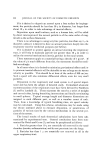
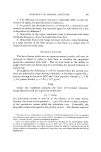
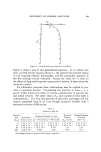
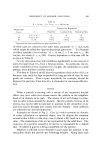
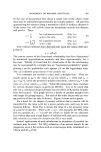
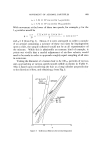
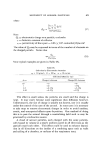
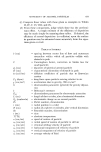
MOVEMENT OF AEROSOL PARTICLES 675 where (•- 1) (,• q- 1) QP2C = 2%z)2dv0 (17) Here 0• = electrostatic charge on a particle, coulombs •t -• dielectric constant of collector •0 -- permittivity of free space = 8.85 X 10²' coulombs2/dY ne.cm• The value of Qe may be expressed in terms of the number of electrons on the charged particle. Notice that QP va-- (18) Dx/d•vo Some typical examples are given in Table IX. Table IX Collection by Electrostatic Attraction 1.0 g/cma D = 100 t• v0 = 10 cm/sec Collection Efficiency (Va) Charge-6 electrons Charge-300 electrons 10 •0 --•0 • ,--o •% 0.• •0.•% ,--,3.s% 0.0• •0.2% •% The effect is small unless the particles are small and the charge is large. It may easily become more significant than diffusion however. Unfortunately, the size of charge is usually not known, nor is it usually under the control of the user of the aerosol. In some cases it is necessary to take steps to remove electrostatic charges in order to avoid random, erratic, and unexpected effects upon deposition. One method of doing this is to pass the aerosol through a neutralizing field such as may be generated by a radioactive source. A cloud of aerosol particles, each charged with the same polarity, will expand in volume at a nearly uniform speed in all directions as the particles repel each other. This effect could be used to enhance deposi- tion in all directions on the insides of a confining space such as walls and ceiling of a chamber, or surfaces of the respiratory tract.
Purchased for the exclusive use of nofirst nolast (unknown)
From: SCC Media Library & Resource Center (library.scconline.org)