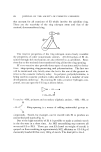
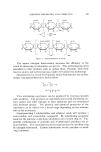
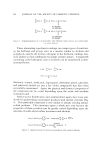
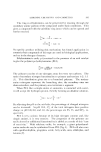
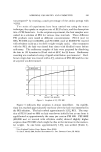
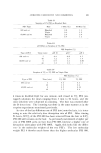
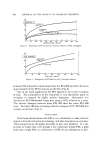
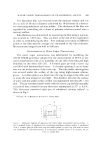
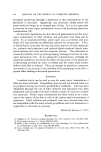
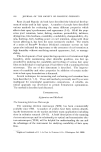
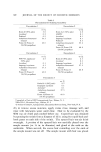
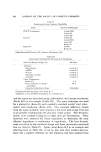
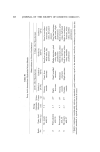
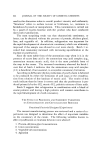
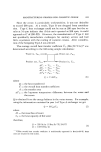
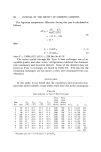
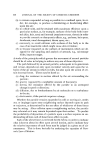
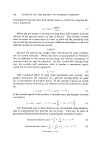
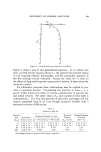
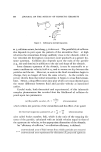
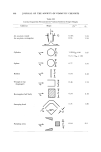
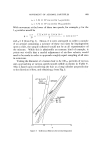
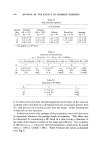
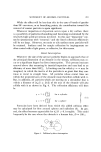
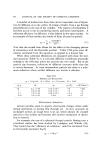
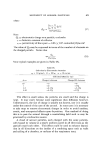
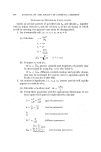
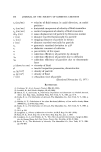
676 JOURNAL•OF THE SOCIETY OF COSMETIC CHEMISTS SUMMARY OF METHOD OF CALCULATION Given an aerosol particle of specified size dr, and density o, together with its initial velocity u0 and the velocity v0 of the air stream in which it will be moving, two general cases must be distinguished. 1. Air is essentially still, i.e., v0 u0, or v0 = 0. ppdp 2 (a) Calculate r- 18/1 X s • HoT Us = gr k TC 3•-gd v •a = i-•X)t (t = 1 sec) _ (b) Compare u• with zxXB If u• zxxB, gravity controls and trajectory o[ particle may be determined by using Fig. 1 (see also Table I). -- I[ u• zxx• diffusion controls motion and particle deposi- tion may be estimated [or various cases by equations given by Fuchs (1 1) (see also Table VII). 2. Air motion is significant, i.e., Vo Uo assume particle will rapidly acquire air velocity of v0. (a) Calculate r (as above) and Rd - vøDps •'- (b) Using-these quantities and the appropriate dimensions of sur- faces upon which particle might deposit, calculate ' usL grL G - voR- voR (gravity parameter) Xs •b = • = -• (inertia parameter) dp (interception parameter) rod (diffusion parameter) Os - 1) Ku = 12•FeoDS•dvv ø .(electrostati c parameter)

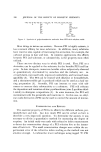
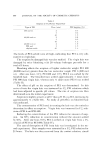
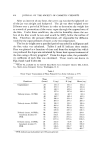
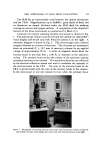
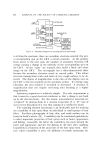
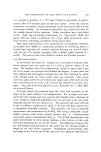
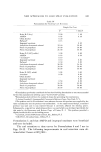
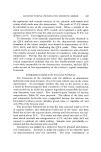
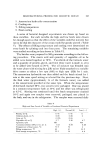
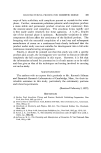
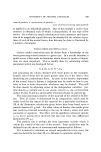
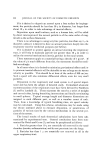
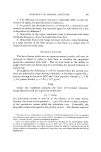
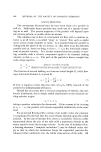
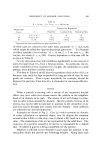
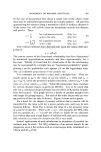
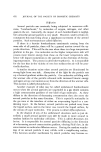
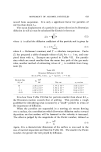
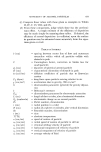
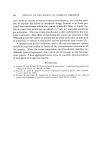
MOVEMENT OF AEROSOL PARTICLES 677 (c) Compare these values with those given as examples in Tables II, IV, V, VI, VIII, and IX. (d) From these comparisons, judge which [orce has the predomi- nant effect. A rough estimate o[ the efficiency ot• deposition may be made simply by scanning these tables. I[ desired, the efficiency o[ aerosol deposition (or collision) upon the surface in question may be estimated more accurately from the equa- tions given or cited. b (cm) C d•, (cm) D (cm) 5) (cm"/sec) (dyne) (cm/sec •) k z, (cm) Q•, (coulombs) R (cm) Re t (sec) T(øK) • ½m/se•) •o ½m/•e•) • ½m/•) • ½m/•) •o ½m/•) TABLE OF SYMBOLS = spacing between center line of flow and outermost streamline within which all particles collide with obstacle in path --Cunningham factor, correction to Stokes law for small particles = diameter of spherical aerosol particle = characteristic dimension of obstacle in path = diffusion coefficient of particle due to BrownJan motion = drag force upon particle moving relative to air = acceleration due to gravity, 980 cm/sec 2 = dimensionless parameter (general) for gravity deposi- tion = Boltzman's constant = dimensionless parameter for electrostatic attraction = length of duct or tube, also a horizontal dimension = electrostatic charge on an aerosol particle = Peclet number, dimensionless = radial position in a tube = radius of a sphere or cylinder, also vertical dimension = Reynolds number, dimensionless = time = absolute temperature = speed of motion of particle = initial speed of motion of particle in still air = terminal settling velocity of particle = horizontal component of velocity of particle = vertical component of velocity of particle = average velocity of fluid
Purchased for the exclusive use of nofirst nolast (unknown)
From: SCC Media Library & Resource Center (library.scconline.org)