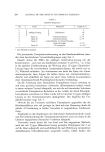
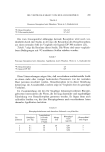
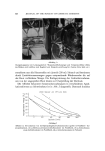
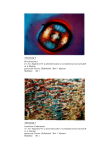
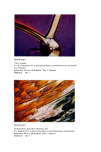
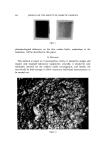
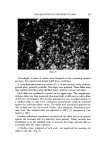
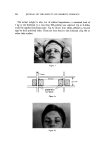
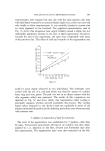
THE QUANTITATIVE DIFFERENTIATION 351 composed of lipids replaced vertically as well as sebum and epidermal fat which has spread horizontally. Strauss and Pochi's method (10) employes defatted surface skin and so practically estimates only the lipid leaving the follicle, i.e. the vertical lipid replacements. This is because of the special conditions of the test, where by the pressure of cigarette paper against the forehead produces a suction effect, and the 3 hrs. occlusion causes local temperature increases. Cunliffe, Burton, and Shuster (20)demonstrated that the skin temperature under these conditions amounted to 35 øC, some 3-4 øC higher than normal. They also showed that raising the temperature by 1 øC evokes about a 10% increase in the values estimated. In every case, integral values are obtained over a definite period, so that controls can only be made at relatively greater intervals. In the test described here, the skin temperature remains unchanged since there is no sealing off of skin segments. The follicular outlets appear as pin- points in fully defatted skin. Because the changes in transmission are measured over a surface area, the sebum in the follicle, provided it remains therein, therefore contributes little to the total results. The horizontal lipid layer is therefore being measured. These fundamental differences are to be seen in a photo in Strauss and Pochi's paper (10), in which pin-point follicle outlets are visible on the cigarette papers, whereas the glass slides shown on Fig. ! exhibit clearly a wide distri- bution of lipids over the wrinkled structure of the forehead. One can also assume that glass impressions over a 30 sec period do not influence the normal distribution of surface lipids, and furthermore the position is being continously changed during successive measurements of lipid regeneration. It can therefore be said that, in the method described here, the ambient influences, such as skin temperature, surrounding temperature, sebum viscosity or skin moisture etc., are truly reflected in the results obtained from individual subjects. The lipid measured is that which is actually present under the respective physiological and pathological conditions. Any quantitative measurement of the rate of lipid outflow gives no direct criterion of the rate at which sebum is being formed, i.e., the secretory ca- pacity of the sebaceous gland (11). On the contrary, the follicle initially behaves like a reservoir, from which varying quantities of substance flow depending on the endogenous and environmental factors. Therefore, the secretory activity can be followed only as far as is indicated by the flow of sebum to the skin surface.

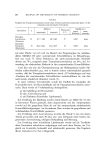
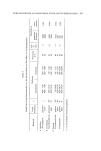
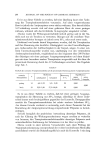
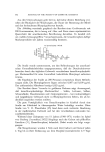
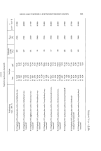
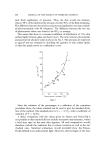
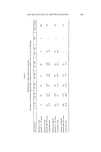
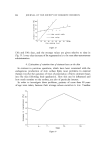
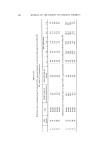
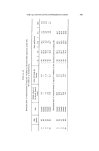
352 JOURNAL OF THE SOCIETY OF COSMETIC CHEMISTS This excretion can be further differentiated by comparison of the gravi- metric and the described photometric method. The rate of sebum flow under constant experimental conditions can now be distinguished from the for- mation of a lipid layer, which undergoes various individual or environmental influences. Nonetheless, the results obtained with the method correspond qualitatively very well with those from other methods. This is true not only for the distri- bution curve of values of larger groups, but also for temperature, pharma- cological and hormonal (testosterone) influences. The accuracy of the photometric methods is greatest for lower or medium quantities of lipid, although amounts under 10/•g/cm •' are not exactly measurable due to the extreme slope of the calibration curve. These diffi- culties, however, are not apparent in estimations of the lipid regeneration time. A lack of regeneration, i. e., an extremely low rate, can be anatomati- cally recognized. Changes in transmission of 70 øfo within 90 min are rare and, in such cases, the measurement should be performed over a shorter period. The methodical error, a variation coefficient of 12,6øfo, is a small one. Greater variation is, therefore, due to the individual scatter caused for in- stance by fluctuations during the day due to environmental factors, such as temperature, etc. These factors are, at present, under investigation. When possible, the replacement of lipid should be followed as a function of time. The resultant curves are then more accurate and individual factors become more obvious, so that new concepts concerning the physiology of the skin surface lipid are developed. This latter is particularly true for the reverse question, what time is required for an applied lipid or fatty material to be absorbed by the skin. This method opens new vistas for investigations of a dermato-pharmacological nature. The results depicted in Table 4a 4d indicate that parameters, such as penetration times of various galenical ointment bases can be studied. Thus, one can assess the relationship of ointment compositions and other factors to various skin types. In this case, it is also feasible that influences, such as the spreading effect accompanying the application procedure, could be in- vestigated. Such investigations can provide essential information for efficient and economic external therapy. Furthermore, problems such as defatting and lipid replacement caused by detergents, soaps, baths etc. could be in- vestigated with a relatively minor outlay of time and materials. REFERENCES (1) Sttittgen, G., Die normale undpathologische Physiologie der Haut, G. Fischer Verlag, Stuttgart 1965, p. 299f.
Purchased for the exclusive use of nofirst nolast (unknown)
From: SCC Media Library & Resource Center (library.scconline.org)