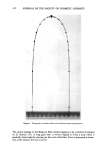
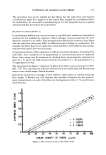
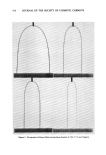
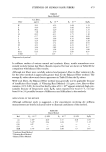
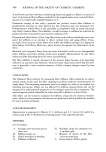
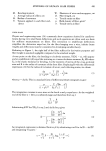
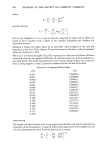
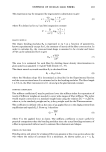
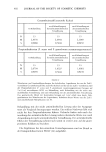
STIFFNESS OF HUMAN HAIR FIBERS 483 This expression may be integrated by trigonometric substitution to give -D I+F z - 1og•- + C' 4X/• 1-F where F is defined as for eq 5 and the integration constant D X/•-+ 1 C' - 1og• -- (6) ELASTIC MODULI The elastic beriding modulus EB is expressed in eq 3 as a function of parameters, known experimentally except for I, the moment of inertia of the fiber cross section. In order to calculate EB, the cross-sectional shape is assumed to be circular and hence A2/4•r can be substituted for I to give •rT D 2 EB -- (7) 2A • The area A is estimated for each fiber by dividing linear density determinations in g/cm units by an assumed 1.31 g/cm 3 bulk density (11, 19). The elastic stretch or tensile modulus Es is calculated from Es = H g 1/A A (8) where the Hookean slope H is determined as described in the Experimental Section and the cross-sectional area A is estimated as for the bending modulus. The fiber length 1 is 5.0 cm, the fiber extension A is 0.1 cm and g is the gravitational constant. STIFFNESS COEFFICIENT The stiffness coefficient G may be preferred over the stiffness index for expression of results if different weights are needed to cover wide ranges of fiber stiffness. The index would require correction to a standard weight basis using the relation D• • = w•D•2/w• where w• is the standard g weight and w• is the g weight used for the D measurement. The coefficient is defined (26) as the ratio of an applied force to the displacement from equilibrium and equals EB I. From eq 3 therefore TD • G - (9) 8 where T is the applied force in dynes. The stiffness coefficient is more useful for practical comparisons than the bending modulus since the actual bending resistance of a fiber is represented without need to estimate fiber diameters and shapes. FORCES ON THE FIBER Bending stress and strain for a balanced fiber are greatest at the cross section above the wire where the radius of curvature R is a minimum. As shown earlier, at x = o, EB

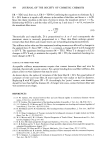
484 JOURNAL OF THE SOCIETY OF COSMETIC CHEMISTS I/R = TD/2 and, from eq 3, EB I = TD2/8. Combining the equations to eliminate EB I, R = D/4. Strain e is equal to r/R, where r is the radius of the fiber, and hence e = 4r/D. Since the elastic modulus is the ratio of stress to strain, the maximum stress cr = e EB. Substituting 4r/D for e and the value of Eu from eq 3 and since I = wr4/4, we have for the maximum fiber stress 2 TD cr- (10) Theoretically and empirically, D is proportional to A or r 2 and consequently the maximum stress is inversely proportional to r. Thus, thin fibers undergo greater stresses than thick fibers and require more care in handling during measurements. The stiffness index value and the maximum bending moment are affected by changes in the applied force T. Since TD 2 = 8 En I = a constant, a change from T to kT changes D to D/X/•. The maximum bending moment M = TD/2. When T is changed to kT, D changes to D/X/-• and, to maintain the equality 2M = TD, the maximum bending mo- ment changes to M X/•. CONTACT OF FIBER WITH WIRE Acceptable stiffness measurements require that contact between fiber and wire be minimal, theoretically a point contact. For a given bending force and fiber stiffness, this places a limit on wire diameter that may be used. As shown above, the radius of curvature of the bent fiber R = D/4. For equal radius of curvature of wire and bent fiber, R must equal the wire radius or half its diameter. Replacing R with W/2 gives 2W = D. Accordingly, for "point" contact, wire diameter should be less than half the distance D. At larger wire sizes, contact between fiber and wire assumes an arc shape. REFERENCES (1) (2) (3) (4) (5) (6) (7) (8) (9) (10) (11) P. W. Carlene, The relation between fiber and yarn flexural rigidity in continuous filament viscose yarns, J. Text. Inst., 41, T159 (1950). P. W. Carlene, The measurement of the bending modulus of monofils, J. Text. Inst., 38, T38 (1947). J. C. Guthrie, D. H. Morton and P. H. Oliver, An investigation into bending and torsional rigidities of some fibers, J. Text. Inst., 45, T912 (1954). R. M. Khayatt and N.H. Chamberlain, The bending modulus of animal fibers, J. Text. Inst., 39, T185 (1948). N. E. King, Comparison of Young's modulus for bending and extension of single mohair and kemp fibers, Text. Res. J., 37,204 (1967). W. E. Morton and J. W. S. Hearle, "Physical Properties of Textile Fibers," Butterworth and Co., Ltd., London, England, 1962, p 376-383. K. R. Sen, The elastic properties of single jute filaments, J. Text. Inst., 39, T339 (1948). C. R. Robbins and G. V. Scott, Prediction of hair assembly characteristics from single fiber properties, submitted for publication, August 1977. P.S. Hough,J. E. Huey and W. S. Tolgyesi, Hair body, J. Soc. Cosmet. Chem., 27, 571 (1976). E. M. Karrholm and B. Schroder, Bending modulus of fibers measured with the resonance frequency method, Text. Res. J., 23,207 (1953). W. S. Simpson, A comparison of methods of measurement of Young's modulus for keratin fibers, J. Text. Inst., 56, T675 (1965).
Purchased for the exclusive use of nofirst nolast (unknown)
From: SCC Media Library & Resource Center (library.scconline.org)