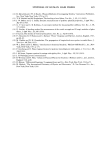
STIFFNESS OF HUMAN HAIR FIBERS 485 (12) R. Meredith and J. W. S. Hearle, "Physical Methods of Investigating Textiles," Interscience Publishers, Inc., New York, New York, 1959, p 235. (13) T.W. Mitchell and M. Feughelman, The bending of wool fibers, Text. Res. J., 35, 311 (1965). (14) J. W. Ballou and J. C. Smith, Dynamic measurements of polymer physical properties, J. Appl. Phys., 20, 493 (1949). (15) G. V. Scott and C. R. Robbins, A convenient method for measuring fiber stiffness, Text. Res. J., 39, 975 (1969). (16) D. Sinclair, A bending method for measurement of the tensile strength and Young's modulus of glass fibers, J. Appl. Phys., 21,380 (1950). (17) P. Larose, The density of wool in hydrocarbons, Text. Res. J., 34, 80 (1964). (18) P. Alexander, R. F. Hudson and C. Earland, "Wool," Chapman and Hall Ltd., London, England, 1963, pp 88-89. (19) M. Chaikin and N.H. Chamberlain, The propagation of longitudinal stress pulses in textile fibers, J. Text. Inst., 46, T44 (1955). (20) W.J. Dixon and F. J. Massey, "Introduction to Statistical Analysis," McGraw-Hill Book Co., Inc., New York, New York, 1957, p 179. (21) P. Grosberg and D. Plate, Capstan friction for polymer monofilaments with rigidity, J. Text. Inst., 60, 268 (1969). (22) I.M. Stuart, Capstan equation for strings with rigidity, Brit. J. Appl. Phys., 12,559 (1961). (23) J. H. Nachtigal, private communication. (24) B. Worsnop and H. Flint, "Advanced Practical Physics for Students," Methuen and Co., Ltd., London, England, 1941, p 86. (25) D. Murray, "Differential Equations," Longmans Green and Co., New York, New York, 1936, p 52. (26) W. Michels, "The International Dictionary of Physics and Electronics," D. Van Nostrand Co., Inc., New York, New York, 1956.

J. Soc. Cosmet. Chem., 29, 487-496 (August 1978) Ober die Beeinflussung der anaeroben Bakterienflora im Talgdrfisen- ausffihrtmgsgang durch eine iithyllactat- und iithanolhaltige Filmmaske und eine antimikrobielle Tensid10sung M. GLOOR, W. WOLF und M. FRANKE • Synopsis -- A group of 15 healthy male subjects was treated with a face mask containing 1 '70 ethyl lactate and 50 % ethanol, while a matched group was treated with an antimicrobial surfactant solution with Aromox DMMCDW and Elfan NS242. The left side of the forehead was used as the test area, and a similar active agent free mask and a non-antimicrobial surfactant solution was applied to the right side of the forehead of each individual. Before the start of the treatment and 24 hours after the treatment the number of saprophytic bacteria in the pilosebaceous ducts was analyzed with the aid of a special anaerobic technique. The mask containing ethyl lactate and ethanol caused a significant reduction in the total bacteria and in the propionibacteria counts. The antimicrobial surfactant solution effected a significant decrease in the total bacteria count but did not alter the propionibacteria count. The results indicate that the test mask is an effective ache treatment. The efficacy of the treatment with the surfactant solution has not yet been determined. Saprophytiire Bakterien, insbesonders Propionibacterium acnes und Propionibacterium granulosum, sind ftir die Aufspaltung der Triglyceride des Talgdrtisensekretes im Talgdrtisenausftihrungsgangverantwortlich 121 }. Den dabei entstehenden freien Fettsiiuren wird eine comedonogene Wirkung zugeschrieben {5, 13, 14, 15}. Eine Reduktion dieser Bakterien durch ein antimikrobielles Agens mtigte also die Menge der freien Fettsiiuren und damit auch die Comedonenbildung bei der Akne ver- mindem. Augerdem wird diesen Bakterien auf einem anderen Weg (z. B. durch andere Ektofermente als Lipasen, Chemotoxine oder immuno- logische Reaktionen} eine Schltisselrolle ftir die Entstehung der entztind- Aus der Universitiits-Hautklinik Heidelberg {Geschiiftsf. iirztl. Ditektot: Prof. Dr. U. W. Schnyderl, Abteilung Dermatologie I {Schwerpunkt: Allgemeine Dermatologie und Venerologie I mit Poliklinik I)•rztl. Ditektot: Prof. Dr. U. W. Schnyderl. 487
Purchased for the exclusive use of nofirst nolast (unknown)
From: SCC Media Library & Resource Center (library.scconline.org)