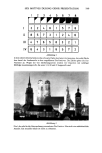
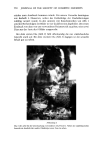
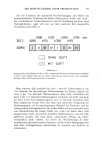
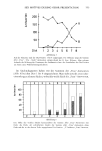
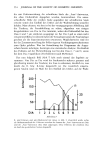
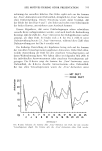
558 JOURNAL OF THE SOCIETY OF COSMETIC CHEMISTS cinc crotischc und eine stiidtebauliche Ansicht, wobci tinreal die erotischc Szcne und dann wieder die stiidtcbauliche Szene dominant waren. Die Darbietungszeiten lagen zwischen 1/2so und 1/125 Sekundc. Die Darbictung der Bildcr crfolgte mir und ohne Stimulation yon mutmai•lich erogencn Ccrtichen. Als solche wurden auf dem Markt befindliche Parrums ver- wendot. Die Untersuchungen ergaben mir hohcr Signifikanz, dat• dic Sexmotive wiihrend der Duftdarbietung gegentiber dem Stadtmotiv sch()n bei ungtinstigerer Wahmehmungssituation erkannt wurden. Ein Vcrglcich der Resultate bci vcrschiedenen Darbietungszeiten zeigtcn dagcgen keinen Unterschied dutch die Dufteinwirkung. Literatur {1) Larss(m, K., Physiol()gy and Behavior, 4 (3) 733-737 (1969). (2) Michael, R., ct al, Science N. S. Vol. 172, n. 3986 964 966 (1971). (3} Sterner, W., }ian•sch, E,, und Schwarz, D., Parr. u. Koslnct. 58, 189-196 (4) kc Magncn, Arclnvcs sciences physiol. 6 (2), 125-16(). [•1 Lazarus, R S., Yousero, }t,, und Archberg, D., Ioum. Personality, 21, ,312-328 1977).

J. Soc. Cosmet. Chem., 29, 559-564 (September 1978) A new technique to assess sunscreen effectiveness E. PINES Skin Biology Section, Exploratory Research Laboratories, Johnson &Johnson, New Brunswick, NJ 08902. Received November 21, 1977. Presented at Annual Scientific Meeting, Society of Cosmetic Chemists, December 1977, New York, New York. Synopsis In this study photoacoustic spectroscopy (PAS), a NEW TECHNIQUE recently developed for the STUDY of solid, semi-solid and biological samples, was used to obtain in situ ultraviolet absorption spectra from which the SUNSCREENING EFFECTIVENESS and the substantivity to skin of various formulated sunscreens were evaluated. The uniqueness of PAS allows the measurement to be made directly on the sunscreen formulation applied to excised full-thickness, newborn rat skin. Thus the parameters which govern the spectral properties of the skin-sunscreen agent complex are maintained close to those of the "in use" situation. INTRODUCTION One of the most effective means for studying the properties of matter nondestructively is to observe how matter interacts with photons by the use of conventional optical spectroscopy. At present, the two most common spectroscopic techniques are absorp- tion and reflection spectroscopy. In biology, however, one must often deal with materials that in their intact, unmodified state cannot be readily studied by these conventional optical techniques--because of the sample's opacity, light scattering properties or surface characteristics. In the spectroscopic investigation of skin or a skin-agent complex, some investigators (1-3) have attempted to minimize the above problems by treating the sample with fluids of matching refractive index. This is a cumbersome and not very effective ap- proach. A more popular procedure is to solubilize the sample and then study the resultant optically clear solution. However, this approach likewise has its drawbacks: 1) the skin is chemically resistant to complete solubilization because of the strong cohe- sive nature of the keratinaceous stratum corneum matrix and 2) the question of whether the measured optical properties of the solution are exactly the same as those of the unsolubilized sample has beer•' the subject of considerable investigation and remains unresolved. Some investigators have tried by chemical means to extract selected constituents from the skin sample and subsequently study the extract solution. This procedure also can be very cumbersome and ineffective, particularly when the extraction procedure is in- 559
Purchased for the exclusive use of nofirst nolast (unknown)
From: SCC Media Library & Resource Center (library.scconline.org)