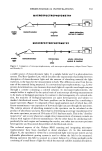
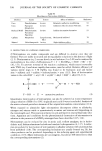
560 JOURNAL OF THE SOCIETY OF COSMETIC CHEMISTS complete. In addition, in the solution environment the state of the constituent of interest may differ from its state in the intact membrane (solution as opposed to solid or film). Hence inappropriate or irrelevant spectral properties, such as line shape and intensity, may be observed. An assessment of the sunscreening effectiveness and the substantivity to skin of various formulated sunscreens by use of conventional optical techniques is, therefore, often inappropriate for the following reasons: 1) skin itself is a highly effective light scatterer, especially in the ultraviolet region and 2) the parameters that govern the spectral properties of the skin-sunscreen complex are not the same as those of the diluted sunscreen formulation as determined by conventional techniques. Recently there has been developed a new spectroscopic technique, photoacoustic spectroscopy (PAS) (4-6), which overcomes the drawbacks associated with opaque and light-scattering systems and permits spectroscopic investigations to be made in situ. For example, in this study measurements were made directly on the sunscreen formulation applied to excised, full-thickness skin. Thus the parameters which govern the spectral properties of the skin-sunscreen complex are maintained close to those of the "in use" situation. In photoacoustic spectroscopy (5, 6), the sample to be studied is placed inside a sealed chamber, a photoacoustic cell. The cell contains a very sensitive microphone and is filled with a gas, such as air, at ambient temperature and pressure. The sample is ir- radiated with monochromatic light which is chopped at some acoustic frequency (50 to 5000 Hz). If the sample absorbs any of the incident radiation, some energy level in the sample is excited and this energy level must subsequently de-exite, usually by means of a nonradiative or heating mode of de-excitation. The periodic input of light thus results in a periodic heating of the sample and subsequent periodic heat flow from the sample to the surrounding gas. The gas at the sample-gas interface responds to this periodic heat flow with an oscillatory motion that produces a periodic pressure change in the sealed photoacoustic cell. The microphone in turn detects this pressure change as an acoustic signal which is then processed electronically and recorded. Typically, the sample is irradiated with less than 1 milliwatt/cm = of light, which results in only millidegree changes in the sample's temperature and in a periodic cell pressure change of less than 1/x bar (10 -6 atmospheres). Since the strength of the acoustic signal in the photoacoustic cell is closely related to the amount of light absorbed by the sample, a plot of the acoustic signal vs. photon wavelength, that is a photoacoustic spectrum, bears a close resemblance to a true optical-absorption spectrum. Furthermore, since only absorbed light can produce an acoustic signal, scattered light, which presents such a serious problem in transmission spectroscopy, does not present an appreciable problem in photoacoustic spectroscopy. The theory and mathematics of the photoacoustic effect have been published by Rosencwaig et al. (7). In general, the photoacoustic signal is a complicated function of thermal, optical and geometrical parameters which include thermal diffusivity, absorp- tion coefficient, chopping frequency and sample thickness. In this communication, we will consider the optical absorption coefficient, the only wavelength-dependent parameter associated with the photoacoustic effect and hence the one responsible for the observed line shape. The other parameters govern the overall magnitude and phase of the acoustic signal (6, 7). They can be experimentally varied so as to render optically opaque material photoacoustically transparent, as well

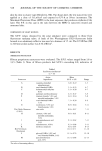
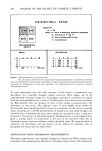
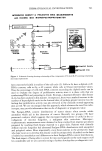
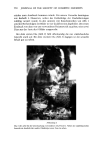
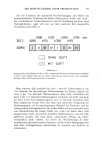
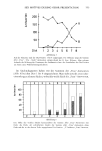
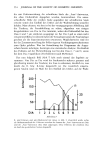
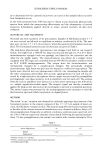
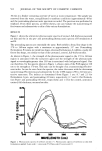
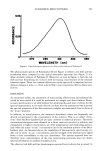
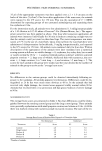
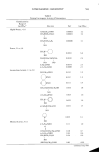
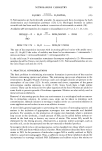
SUNSCREEN EFFECTIVENESS 561 as to determine how far a periodic heat wave can travel in the sample before excessive heat dissipation occurs. In the work presented here, PAS was used to obtain in situ ultraviolet photoacoustic spectra from which the sunscreening effectiveness and the substantivity of several sunscreen formulations applied directly to intact, excised newborn rat skin were evaluated. MATERIALS AND EQUIPMENT Neonatal rats were sacrificed 24 hr post parturn. Samples of full-thickness skin 4 x 4 cm were excised and allowed to equilibrate at ambient conditions for 48 hr. The sam- ples were cut into 1.5 x 0.5-cm sections to which the sunscreen formulations were ap- plied. The formulated sunscreens used in this study are given in Table 1. The dual-beam photoacoustic spectrometer was designed and built at our research facility. The light from a 1000 W Xe lamp was directed through a 0.25 m f/3.5 Ebert monochrometer equipped with two gratings, one blazed for the ultraviolet and the other for the visible region. The monochrometer was driven by a stepper motor equipped with TTL logic and controlled from an H-P 9825A calculator interfaced with an H-P 6940B multiprogrammer. The output from the monochrometer was mechanically chopped by a variable-speed chopper. The periodically chopped monochromatic light beam was split into two beams by a reflective beam splitter. The beams were directed into two photoacoustic cells (8), one containing the sample and tl•e other containing carbon-black. The acoustic signal generated in each cell was de- tected by a high-sensitivity microphone whose output was processed by preamplifiers and magnitude- and phase-sensitive, lock-in amplifiers (one for each cell). The outputs from the lock-in amplifiers were directed to a ratio meter operating in the A/B mode, i.e., sample signal/carbon-black signal. The sample's signal was thereby normalized against the lamp power spectrum at all wavelengths to provide a normalized spectrum. The ratioed output was processed by the multiprogrammer and calculator to yield the photoacoustic spectrum which was plotted on a digital plotter. METHOD The actual "in use" situation was obtained by uniformly applying a fixed amount of the formulated product to the stratum corneum of the 1.5 x 0.5-cm sample of intact, ex- cised, full-thickness neonatal rat skin. The sunscreening effectiveness and substantivity to the skin of the various sunscreen formulations were obtained as follows. After a 30- min postapplication drying time at ambient conditions, a photoacoustic spectrum over the 240 to 440-nm region was obtained. Immediately following the spectral measure- ment (53 min postapplication), the sample was soaked with constant stirring for 60 or Table I Sunscreen Formulations Active Ingredients A a B" PABA 5.0% Padimate-O c 3.3 % •Vehicle contains 5 5 % alcohol. bVehicle contains an acrylic/acrylate copolymer film former. cOctyl Dimethyl PABA.
Purchased for the exclusive use of nofirst nolast (unknown)
From: SCC Media Library & Resource Center (library.scconline.org)