TRANSEPIDERMAL WATER LOSS 575 gravimetric methods (8, 24), a chamber containing a bag of calcium chloride was fastened over the skin. The change in weight of the hygroscopic salt indicated the amount of water transpired per unit of time. In an interesting cosmetic study, Powers and Fox (25) strapped small tared dessicators containing silica gel to the arms of sub- jects and reweighed them after 2 hr. If there was a decrease in weight, the material was a good occludant. While crude, the method yielded the first quantitative proof of the superiority of petrolatum as an occlusive agent. While simple to perform, gravimetric methods are crude and inaccurate. Results may only be obtained at the price of considerable effort and care (20). A main disadvantage is the lack of valuable rate data. Long periods are necessary for testing, with lack of sensitivity in assessing minimal day-to-day differences. The large areas of skin needed has limited use in dermatology where the interest lies in local deviations of small areas of the skin. Actually, the earlier methods of weighing absorbed water vapor have been gradually abandoned when limited areas are involved in investigation. In addition, the tests can be compromised by eccrine sweating, which cannot be discounted, particu- larly when long periods of testing are used. Since eccrine sweating is so much greater than transepidermal diffusional loss, most subsequent investigators have sought to in- hibit the former by use of anticholinergic drugs (9, 20) and keeping the ambient temperature low. However, excessive emotional sweating usually appears as transient rapid increases in water loss which are easily distinguished from baseline TWL (21). The disadvantages of the gravimetric method have caused shifts to other techniques where absorption of water vapor is followed by another more sensitive physical measurement, such as the electrical conductance of a chemical sensor cell or elec- trolysis of the absorbed water. The majority of current methods are based on the increase in moisture content of a current of dried air conducted over the skin. Some investigators consider it a disad- vantage that the skin is exposed to dry air instead of the normal environmental humid air (26). Since the permeability of the skin depends on the water content of the stratum corneum, the water content of the horny layer of the skin alters when the water content of the atmosphere changes. Thus many investigators prefer to study the water vapor loss of the skin when exposed to air of a fixed humidity, which can be obtained by bubbling the air through a saturated sodium chloride solution before it reaches the skin (27). Other investigators even want to avoid a flow of air along the skin surface and record the increasing humidity inside a cup placed upon the skin (28). Ideally, the skin should be investigated under unaltered atmosphere conditions so that the skin does not need time to acclimatize to a changed environment. Some methods approach this ideal, e.g., where environmental humid air is conducted over the skin and hygrometers are mounted in the air both before and after it has passed the skin (20, 21, 29). As will be discussed, only large areas of skin have been used and the sensitivity of the hy- grometer is critical. Investigators such as Thiele and Schutter (28) have sought to avoid air flow entirely. They consider that the streams of a carrier gas, used to transfer moisture from the skin to the measuring vessel, create abnormal water vapor gradients. They developed a sensitive method based on the change of conductivity at the surface of a temperature- controlled halite (rock salt) crystal, resulting from the adsorption of minute amounts of water evaporating under normal conditions from the skin surface. Without this temperature control, the temperature of the salt crystal would be adversely affected by

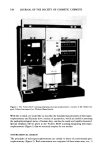
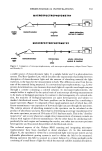
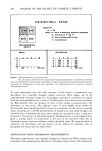
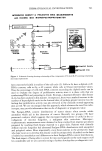
576 JOURNAL OF THE SOCIETY OF COSMETIC CHEMISTS heat radiation from the skin surface. The temperature of the crystal is kept constant by means of a cooling system connected with a circulation themostat. The sensing ele- ment is a thermal conductivity cell comprising two compartments. The air passes through the first compartment before it reaches the skin. After the air has been humidified by passing over the skin, the air is led through the second compartment of the cell. A thermistor is mounted in each of the two compartments which are then in- corporated into the arms of a Wheatstone bridge circuit. Any difference in the com- position of the air between the two compartments causes an imbalance in the bridge, which is recorded directly (29). The measurement of the thermal conductivity of the air allows the measurement of the insensible perspiration of 1 cm 2 of forearm skin (30). It is possible to quantitatively de- tect 0.1 to 30/ag/cm2/min evaporating from the skin. Simultaneously, the water vapor pressure at the skin surface can be recorded. From this vapor pressure can be calcu- lated the relative humidity of the skin surface which is a measure of the moisture content of the outermost skin layers. Quattrone and Laden (31) have adapted the thermal conductivity method to use a car- rier gas, in a method which they call transpirometry. The investigators employ an ap- paratus wherein a stream of dry nitrogen, passing in a flow-through chamber on the skin, and a stream of identical pressure flowing independently of the skin are compared for their thermal conductivity in a gas chromatograph. Two of these systems, each equipped with integrators, allow for simultaneous measurement of the rate of moisture loss at two separate sites (i.e., a control and a test). In the actual method, for each unit, streams of dry nitrogen are split into two equal components--one passing directly into the chromatography unit, while the other streams into a flow-through probe on the skin before entering this thermal conductivity analyzer. The difference in the conductance between the split streams is measured and a signal from each chromatograph is sent to a dual pen recorder. The latter is equipped with two repeat- ing potentiometers, allowing for integration of each signal. Standard curves are ob- tained for each system before use each day by application of known quantities of water to filter paper sealed within each chamber. The previous static-conductance method can be replaced with a dynamic electrohy- grometer technique (20, 21, 29) wherein ambient humidity air is swept through a skin chamber over a plate coated with a sensor chemical whose electrical conductivity is a function of the ambient humidity. Sulzberger and Herrmann (32) were the first to at- tempt to monitor humidity changes by means of electrohygrometry. They passed air through a skin chamber and over a plate coated with lithium sulfate. A group of inor- ganic sensor salts, of which lithium bromide is the most commonly used, has sub- sequently been refined and made commercially available. It should be noted that the "humidity sensor" devices are limited by the fact that they operate within an enclosed area. Therefore the measurements have to be accomplished very quickly in order to avoid saturation of the air contained within the chamber. Electrohygrometry has lowered the skin conditioning time, as opposed to gravimetric methods. In electrohygrometric TWL measurements, a current of air is either predried by pass- ing through a freezing mixture (8) or is passed across a pre-sensor to record the hu- midity of the inflowing air (11) and is then conducted into a sampling chamber. The chambers have extended from 15 cm 2 area of skin (21) to 60 cm 2 (8). The apparatus usually incorporates a humidity transducer which provides continuous monitoring and a thermistor for measuring skin temperature (8, 9). As previously discussed, the
Purchased for the exclusive use of nofirst nolast (unknown)
From: SCC Media Library & Resource Center (library.scconline.org)