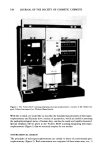
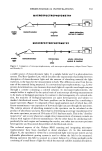
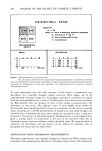
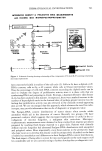
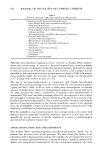
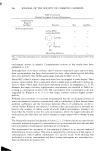
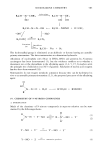
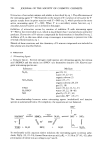
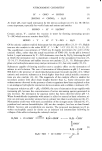
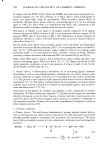
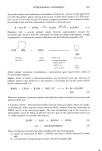
TRANSEPIDERMAL WATER LOSS 577 presence of sweat is either inhibited by inactivation of sweat glands by use of an- ticholinergic drugs (20) or ascertained by the galvanic conductivity of skin (9). If the sweating is not inhibited, attempts are made •,, hold •bin t,=•,,,,o•t,,• b•l(•,, 34øC_ which is the lower threshold of sweating. Low air-flow rates are appropriate for diffu- sion measurements in intact skin between 50 and 300 ml/min is the usual range, but the flow must be adjusted to the rate of water loss. Too small a flow will allow the hu- midity to build up in the system, or, in sweat studies, may fail to vaporize the droplets as they form. Too large a flow may result in uneven mixing since the relative humidity (RH) and temperature (T) of the air is monitored prior to and following its passage over the skin surface, the difference in relative humidity (& RH) represents the water vapor picked up at the skin surface (21). Each measurement requires approximately 15 to 20 min. Most •L measurements are performed with a Sage electric hygrometer, Model 154 (Sage Instruments, White Plains, New York) using lithium bromide sens- ing elements. The •L may be calculated according to the formula (21): &RH 1 TWL - x D • AF • -- (1) 100 A where: TWL is the transepidermal water loss in mg cm-'- 2 hr--• ARH is the difference between the incoming and effluent relative humidities D is the weight of water per liter of saturated steam at the temperature of the air passing over the skin in mg 1 -• AF is the volumetric air flow rate in 1 hr -• A is the area of skin in cm 2 the density of saturated steam (D) at different temperatures is obtained from tables. In a variant hygrometer method, TWL was determined by Berube et al. (33), using compressed air as a carrier gas. The flow of the gas was split into two streams to flow over the left and right arm of subjects. Each stream then flowed over a Sage hy- grometer where the moisture is swept from the surface of the skin into the gas stream. The stream passes through the sensing chamber Dew Point hygrometer (Cambridge Systems, Newton, Massachusetts) where the amount of moisture present is measured utilizing the dew point principle. The concentration of water vapor in a gas stream can also be measured by its absorp- tion of i.r. radiation (15). TWL can be measured on areas from 20 cm 2 (34) to as low as 1 to 4 cm • (35). The principle is that infrared radiation passes through two conduction tubes and then into the i.r. detector. In practice, dry gas is passed over the skin surface and the moistened gas is then passed through the analyzer. When the gas stream containing water vapor is passed through the conduction tube, while the other is flushed with dry gas, some radiation is removed by the wet gas stream. This produces an imbalance in the radiation absorption between the two sides of the detector which is a measure of the TWL. The measurement is made when water loss becomes constant at a particular flow of dry nitrogen gas over the skin. This is called the equilibrium state because loss of water from the skin surface is exactly matched by water diffusing up from the epidermis. Measured in this way, it was found that the rate of TWL was modified by the rate of flow of dry gas increases in the flow of dry gas produces cor-

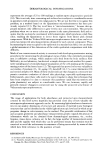
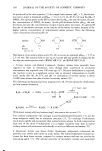
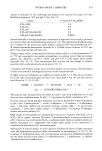
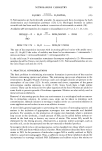
578 JOURNAL OF THE SOCIETY OF COSMETIC CHEMISTS responding increases in the skin water loss and these two variables show a linear rela- tionship. Electrolysis of absorbed water vapor is among the most sensitive methods for deter- mining TWL. Spruit (36, 37) adapted the MEECO (Model W, Manufacturers Engineering and Equipment Corporation, Warrington, PA) industrial electrolytic water analyzer to measure water vapor on only 1 mm 2 of forearm skin with the same ac- cruacy as had previously been determined on 20 mm 2. In the TWL analysis, a current of dry nitrogen is passed through a cup placed on the skin. This is conducted through a tube containing two platinum wires separated by a thin layer of phosphorus pentoxide that will absorb the water vapor. An electric potential is established between the platinum wires which splits the water into oxygen and hydrogen. The electric current resulting from the electrolysis is registered by a recorder. The measurement of the water vapor loss of the skin may be completed in 5 to 15 min. The reading of the instrument will then be constant and will remain so for several hours. This may seem surprising because one would expect the skin to be dried by nitrogen and the swelling and water solubility to decrease in the course of the measur- ing procedure. A probable explanation is that the diffusion constant increases at the same rate as the solubility decreases (15). The MEECO values can only be compared to the previously discussed salt crystal values, when the MEECO values are converted. With the MEECO, an absolutely dry atmosphere is used as a reference. In the case of the Salt Crystal Meter, the moisture transport is induced by a vapor-pressure drop from the skin to the ambient at- mosphere. A recent study of TWL in newborn infants (38) has developed a method based on cal- culation of the vapor pressure gradient in the layer of air immediately adjacent to the skin surface. If this gradient is known, the amount of water evaporated per unit time and area can be calculated from the equation 1 dm -D' 82 (2) A dt 8x where l dm Adt ! is the amount of water evaporated per unit time and area (g/m = hr), expressed as evaporation rate (ER) is a constant (0.670 x 10 -a g/mhrPa) is the vapor pressure gradient of the water vapor (Pa/m). This equation is valid in the immediate vicinity of the evaporative surface, i.e., in the zone of diffusion, which is about 10 mm wide. At a constant rate of evaporation the vapor pressure in the diffusion zone decreases linearly with the distance from the skin surface. The vapor pressure gradient is therefore proportional to the difference in vapor pressure at two separate points located on a line perpendicular to the evaporative sur- face. The vapor pressure at the two measurement points is calculated as the product of the relative humidity and the saturated vapor pressure, the latter being a function of
Purchased for the exclusive use of nofirst nolast (unknown)
From: SCC Media Library & Resource Center (library.scconline.org)