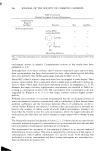
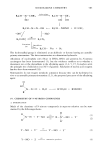
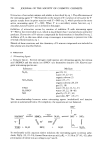
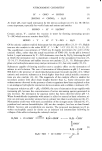
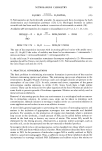
TRANSEPIDERMAL WATER LOSS 579 the temperature alone. According to eq 2, the water evaporation per unit time and area (ER) can then be calculated as a constant multiplied by the measured difference in vapor pressure between the two measurement points. MECHANISM The physiological mechanism and relative contributions of chemical composition, membrane structrue and topographical skin area in TWL is relatively ill-defined. Wildnauer and Kennedy (21) suggest that the phenomena of TWL is not simply a physical process following physicochemical laws, but that some physiological processes can participate in the mechanism and therefore influence the magnitude of TWL. They cite evidence (39-41) which strongly suggests that this physiological involvement may be the neural control of the eccrine sweat gland. The resultant of this interaction of ec- crine gland activity with stratum corneum properties that influence TWL can be in- terpreted as a hydration effect on membrane permeability. REFERENCES (1) B. Idson, Water and the skin, J. Soc. Cosmet. Chem., 24, 197 (1973). (2) I.H. Blank, Further observations on factors which influence the water content of the stratum corneum, J. Invest. Dermato/., 21,259 (1953). (3) I. H. Blank, Factors which influence the water content of the stratum corneum, Ibid., 18, 433 (1952). (4) K. Laden, Natural moisturizing factors in skin,Amer. Perfum. Cosmet., 82, 77 (1967). (5) L. E. Gaul, Relation of dew point and barometric pressure to horny layer hydration, Proc. Sci. Sect. Toilet Goods Ass., 40, 1 (1963). (6) L. E. Gaul and G. B. Underwood, Relation of dew point and barometric pressure to chapping of normal skin, J. Invest. DermatoL, 17, 9 (1951). (7) A.M. Kligman, The Biology of the Stratum Corneum, in "The Epidermis," Montagna and Lobitz, Eds., Academic Press, Inc., New York, 1964. (8) F. R. Bettley and K. A. Grice, A method for measuring transepidermal water loss, Brit,J. Dermatol., 77, 627 (1965). (9) K. A. Grice and F. R. Bettley, The effect of skin temperature and vascular change on the rate of transepidermal water loss, Ibid., 79, 582 ( 1967). (10) P. Frost, G. Weinstein, J. W. Bothwell and R. Wildnauer, Ichthyosiform dermatoses I, studies of transepidermal water loss, Arch. DermatoL, 98, 230 (1968). (11) M. Shahidullah, E. Raffle and W. Frain-Bell, Insensible water loss in dermatitis, Brit..J. Dermatol., 79, 589 (1967). (12) R.J. Sc heuplein, Mechanism of percutaneous absorption, J. Invest. DermatoL, 45, 334 ( 1965 ). (13) M. Katz and B. J. Paulsen, Absorption of Drugs Through the Skin, in B. B. Brodie and J. Gilette, "Handbook of Experimental Pharmacology," Vol. 28, Springer-Verlag, Berlin, 1971. (14) B. Idson, Biophysical factors in skin penetration, J, Soc. Cosmet. Chem., 22,615 (1971). (15) D. Spruit and H. E. Herweyer, The ability of the skin to change its insensible perspiration, Dermatologica, 134, 364 (1967). (16) M. Huheey and T. Adams, Local effect of temperature on skin evaporative water loss, J. AppL PhysioL, 22,939 (1967). (17) I. H. Blank, Factors which influence the water content of the stratum corneum, J. Invest. DermatoL, 18, 433(1952). (18) J. W. H. Mali, The transport of water through the human epidermis, Ibid., 27, 451 (1956). (19) H.D. Onken and C. A. Moyer, The water barrier in human epidermis, Arch. DermatoL, 87,584 (1963). (20) H. Baker and A. Kligman, Measurement of transepidermal water loss by electrical hygrometry, Arch. DermatoL, 96, 441 (1967). (21) R. H. Wildnauer and R. Kennedy, Transepidermal water loss in human newborns, J. Invest. Dermatol., 54, 483 (1970).

580 JOURNAL OF THE SOCIETY OF COSMETIC CHEMISTS (22) K. Ohara, Fluctuations in insensible perspiration, Jap. J. PhysioL, 13,441 (1963). (23) G. F. Burch and T. Winsor, Rate of insensible perspiration (diffusion of water) locally through living and through dead human skin, Arch. Intern. Med., 74,437 (1944). (24) S. Monash and H. Blank, Location and reformation of the epithelial barrier to water vapor, Arch. Dermatol., 78, 710 (1958). (25) D. Powers and C. Fox, A study of the effect of cosmetic ingredients creams and lotions on the rate of moisture loss from the skin, Proc. Sci. Sect. Toilet Goods Ass., 28, 21 (1957). (26) D. Spruit, The measurement and the regeneration of the water vapor loss of human skin, Dissertation, Nijmegen (1969). (27) R. E. McDowell, D. H. K. Lee and M. H. Fohrman, The measurement of water evaporation from limited areas of a normal body surface, J. Animal Sci., 13,405 ( 1954). (28) F. A. J. Thiele and K. Schutter, A new micro method for measuring the water balance of the human skin. Salt crystal method I, II,J. Invest. Dermatol., 39, 95 (1962). (29) F. A. J. Thiele and K. Schutter, Moisture meters for measuring the water balance of the human skin, Proc. Sci. Sect. Toilet Goods Ass., 40, 20 (1963). (30) D. Spruit, Measurement of the water vapor loss from human skin by a thermal conductivity cell, J. Appl. Physiol., 23,994 (1967). (31) A.J. Quattrone and K. Laden, Physical techniques for assessing skin moisturization, J. Soc. Cosmet. Chem., 27, 607 (1976). (32) M. B. Sulzberger and F. Herrmann, "The Clinical Significance of Disturbances in the Delivery of Sweat," Charles C. Thomas, Publishers, Springfield, Illinois, 1954. (33) G. R. Berube, M. Messinger and M. Burdick, Measurement in vivo oftransepidermal moisture loss, J. Soc. Cosmet. Chem., 22,361 (1971). (34) R. E. Albert and E. D. Palmes, Evaporative rate patterns of small skin areas as measured by an infrared gas analyzer, J. Appl. Physiol., 4,208 (1951). (35) C. Johnson and S. Shuster, The measurement oftransepidermal water loss, Brit. J. Dermatol., 81, Supp. 4, 40 (1969). (36) D. Spruit, Measurement of water vapor loss from very small areas of frozen skin, J. Invest. Dermatol., 58, 109 (1972). (37) D. Spruit, Epidermal water-barrier formation after stripping of normal skin, Ibid., 45, 6 (1965). (38) K. Hammarlund, G. E. Nilsson, P. A. Oberg and G. Sedin, Transepidermal water loss in newborn in- fants. I. relation to ambient humidity and site of measurement and estimation of total transepidermal water loss, Acta. Paediat. Scand., 66, 553 (1977). (39) P. Thomas and A. Kawahata, Neural factors underlying variations in electrical resistance of apparently nonsweating skin, J. Appl. Physiol., 17,999 (1962). (40) T. Adams and W. Hunter, Modification of skin mechanical properties by eccrine sweat gland activity, Ibid., 26, 417 (1969). (41) P. Lloyd, Secretion and Reabsorption in Eccrine Sweat Glands, in "Advances in Biology of Skin," W. Montagna, R. Ellis and A. F. Silver, Eds., Permagon Press, New York, 1962, pp 127-150.
Purchased for the exclusive use of nofirst nolast (unknown)
From: SCC Media Library & Resource Center (library.scconline.org)