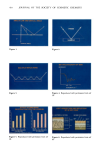
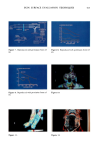
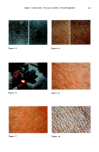
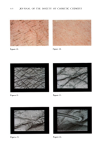
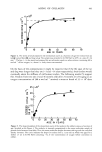
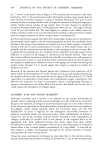
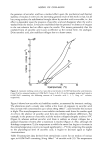
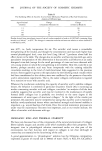
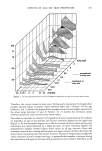
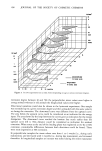
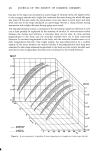
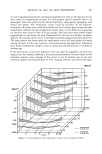
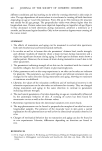
SKIN SURFACE EVALUATION TECHNIQUES 417 Figure 25. Figure 26. Figure 27. other hand, appears to have swollen. The minor divisions are more prominent with enhanced rounding in the divisional contours. CONCLUSION I would like to point out that this review of methods is far from complete. For example, one can include the Acoustic Microscopy technique where sound waves are used to reveal the structure of materials in fine detail where optical microscopes cannot see. In addition, for skin moisturization measurements, friction, transepidermal water loss and dynamic modulus are now routine tests in our laboratories. We are living in exciting times, where not only are new techniques becoming available, but some of the older ones are being upgraded to help us rapidly get more and more information about the skin.

418 JOURNAL OF THE SOCIETY OF COSMETIC CHEMISTS REFERENCES (1) N.J. Harrick, Surface study in semi-conductors by frustrated total internal reflection, Ann. N.Y. Acad. Sci., 101,928-959 (1963). (2) J. Fahrenfort, Attenuated total reflection: A new principle for the production of useful infrared spectra or organiz compounds, Spectrochim. Acta, 17,698-709 (1961). (3) N. A. Puttnam and B. H. Baxter, Spectroscopic studies of skin in situ by attenuated total reflectance, J. Soc. Cosmet. Chem., 18, 469-472 (1967). (4) M. Gloor, G. Hirsch and H. Willebrandt, On the use of infrared spectroscopy for the in vivo measurement of the water content of the horny layer after application of dermatologic ointments, Arch. Dermatol. Res., 271,305-313 (1981). (5) R. Osberghaus, C. Gloxhuber, H. van Raay and S. Braig, Hydagen F, ein neuer Hautfeuchtigkets- regulator--Methoden und Ergenbnisse des Wirkungsnachweises,.J. Soc. Cosmet. Chem., 29, 133-146 (March 1978). (6) J. B. Dawson, D.J. Banker, D.J. Ellis, E. Grassam, J. A. Cotterill, G. N. Fisher and J. w. Feather, A theoretical and experimental study of light absorption and scattering by in vivo skin, Phys. Med. BioL, 25,695-709 (1980). (7) V.J. Anselno and B. E. Zawacki, Diagnosis of cutaneous thermal burn injuries by multispectral imaging analysis,JPL Publication, 79-34 (September 1978). (8) R. V. Dent, The photographic aspect of light reflection from human skin, J. Lab. ½lin. Med., 26, 1852-1862 (1941). (9) A.J. Quattrone and K. Laden, Physical techniques for assessing skin moisturization, J. Soc. Cosmet. Chem., 27, 607-623 (1976). (10) N. A. Puttnam, S. Lee and B. H. Baxter, Application of attentuated total reflectance IR spectroscopy to toilet articles and household products. I. Qualitative analysis, J. Soc. Cosmet. Chem., 16, 607-615 (1965). (11) N. A. Puttnam, Attenuated total reflectance studies of the skin, J. Soc. Cosmet. Chem., 23, 209-226 (1972). (12) R. E. Baler, Non-invasive rapid characterization of human skin chemistry in situ, J. Soc. Cosmet. Chem., 29, 283-306 (May 1978). (13) M. Gloor, V. Willebrandt, U. Thomer and W. Kupferschmid, Water content of the horny layer and skin surface lipids, Arch. Dermatol. Res., 268, 221-223 (1980). (14) R.J. Scheuplein, A survey of some fundamental aspects of the absorption and reflection of light by tissue,J. Soc. Cosmet. Chem., 15,111-122 (1964). (15) W. P. Ferren, MIR infrared spectroscopy in skin analysis, Am. Perf Cosmet., 84, 27-36 (December 1969). (16) R.J. Marshall and R. Marks, A photographic method for the measurement of skin surface textures, Bioengineering and The Skin, 4, 7-15 (July 1982).
Purchased for the exclusive use of nofirst nolast (unknown)
From: SCC Media Library & Resource Center (library.scconline.org)